Portrait de Yoshua Bengio

Yoshua Bengio

Membre académique principal
Chaire en IA Canada-CIFAR
Professeur titulaire, Université de Montréal, Département d'informatique et de recherche opérationnelle
Fondateur et Conseiller scientifique, Équipe de direction
Sujets de recherche
Apprentissage automatique médical
Apprentissage de représentations
Apprentissage par renforcement
Apprentissage profond
Causalité
Modèles génératifs
Modèles probabilistes
Modélisation moléculaire
Neurosciences computationnelles
Raisonnement
Réseaux de neurones en graphes
Réseaux de neurones récurrents
Théorie de l'apprentissage automatique
Traitement du langage naturel

Biographie

*Pour toute demande média, veuillez écrire à medias@mila.quebec.

Pour plus d’information, contactez Cassidy MacNeil, adjointe principale et responsable des opérations cassidy.macneil@mila.quebec.

Reconnu comme une sommité mondiale en intelligence artificielle, Yoshua Bengio s’est surtout distingué par son rôle de pionnier en apprentissage profond, ce qui lui a valu le prix A. M. Turing 2018, le « prix Nobel de l’informatique », avec Geoffrey Hinton et Yann LeCun. Il est professeur titulaire à l’Université de Montréal, fondateur et conseiller scientifique de Mila – Institut québécois d’intelligence artificielle, et codirige en tant que senior fellow le programme Apprentissage automatique, apprentissage biologique de l'Institut canadien de recherches avancées (CIFAR). Il occupe également la fonction de conseiller spécial et directeur scientifique fondateur d’IVADO.

En 2018, il a été l’informaticien qui a recueilli le plus grand nombre de nouvelles citations au monde. En 2019, il s’est vu décerner le prestigieux prix Killam. Depuis 2022, il détient le plus grand facteur d’impact (h-index) en informatique à l’échelle mondiale. Il est fellow de la Royal Society de Londres et de la Société royale du Canada, et officier de l’Ordre du Canada.

Soucieux des répercussions sociales de l’IA et de l’objectif que l’IA bénéficie à tous, il a contribué activement à la Déclaration de Montréal pour un développement responsable de l’intelligence artificielle.

Étudiants actuels

Collaborateur·rice alumni - McGill
Collaborateur·rice de recherche - Cambridge University
Superviseur⋅e principal⋅e :
Doctorat - UdeM
Visiteur de recherche indépendant
Co-superviseur⋅e :
Collaborateur·rice de recherche - N/A
Superviseur⋅e principal⋅e :
Doctorat - UdeM
Collaborateur·rice de recherche - KAIST
Collaborateur·rice alumni - UdeM
Co-superviseur⋅e :
Visiteur de recherche indépendant
Superviseur⋅e principal⋅e :
Doctorat - UdeM
Co-superviseur⋅e :
Doctorat - UdeM
Doctorat - UdeM
Superviseur⋅e principal⋅e :
Collaborateur·rice alumni - UdeM
Postdoctorat - UdeM
Superviseur⋅e principal⋅e :
Postdoctorat - UdeM
Superviseur⋅e principal⋅e :
Collaborateur·rice alumni
Collaborateur·rice alumni - UdeM
Doctorat - UdeM
Co-superviseur⋅e :
Doctorat - UdeM
Superviseur⋅e principal⋅e :
Visiteur de recherche indépendant - UdeM
Doctorat - UdeM
Superviseur⋅e principal⋅e :
Collaborateur·rice de recherche - Ying Wu Coll of Computing
Collaborateur·rice de recherche - University of Waterloo
Superviseur⋅e principal⋅e :
Collaborateur·rice alumni - Max-Planck-Institute for Intelligent Systems
Collaborateur·rice de recherche - UdeM
Co-superviseur⋅e :
Doctorat - UdeM
Postdoctorat - UdeM
Postdoctorat - UdeM
Doctorat - UdeM
Superviseur⋅e principal⋅e :
Collaborateur·rice alumni - UdeM
Postdoctorat
Co-superviseur⋅e :
Collaborateur·rice alumni - Polytechnique
Co-superviseur⋅e :
Doctorat - UdeM
Co-superviseur⋅e :
Collaborateur·rice de recherche
Superviseur⋅e principal⋅e :
Collaborateur·rice alumni - UdeM
Co-superviseur⋅e :
Doctorat - UdeM
Superviseur⋅e principal⋅e :
Collaborateur·rice de recherche
Collaborateur·rice de recherche - UdeM
Doctorat - McGill
Superviseur⋅e principal⋅e :
Doctorat - UdeM
Superviseur⋅e principal⋅e :
Collaborateur·rice alumni - McGill
Superviseur⋅e principal⋅e :

Publications

MixupE: Understanding and improving Mixup from directional derivative perspective
Yingtian Zou
Wai Hoh Tang
Hieu Pham
Juho Kannala
Arno Solin
NEURAL NETWORK-BASED SOLVERS FOR PDES
M. Cameron
Ian G Goodfellow
(1) N (x; θ) = Ll+1 ○ σl ○Ll ○ σl−1 ○ . . . ○ σ1 ○L1. The symbol Lk denotes the k’s affine operator of the form Lk(x) = … (voir plus)Akx + bk, while σk denotes a nonlinear function called an activation function. The activation functions are chosen by the user. The matrices Ak and shift vectors (or bias vectors) bk are encoded into the argument θ: θ = {Ak, bk} l+1 k=1. The term training neural network means finding {Ak, bk} l+1 k=1 such that N (x; θ) satisfies certain conditions. These conditions are described by the loss function chosen by the user. For example, one might want the neural network to assume certain values fj at certain points xj , j = 1, . . . ,N . These points x are called the training data. In this case, a common choice of the loss function is the least squares error:
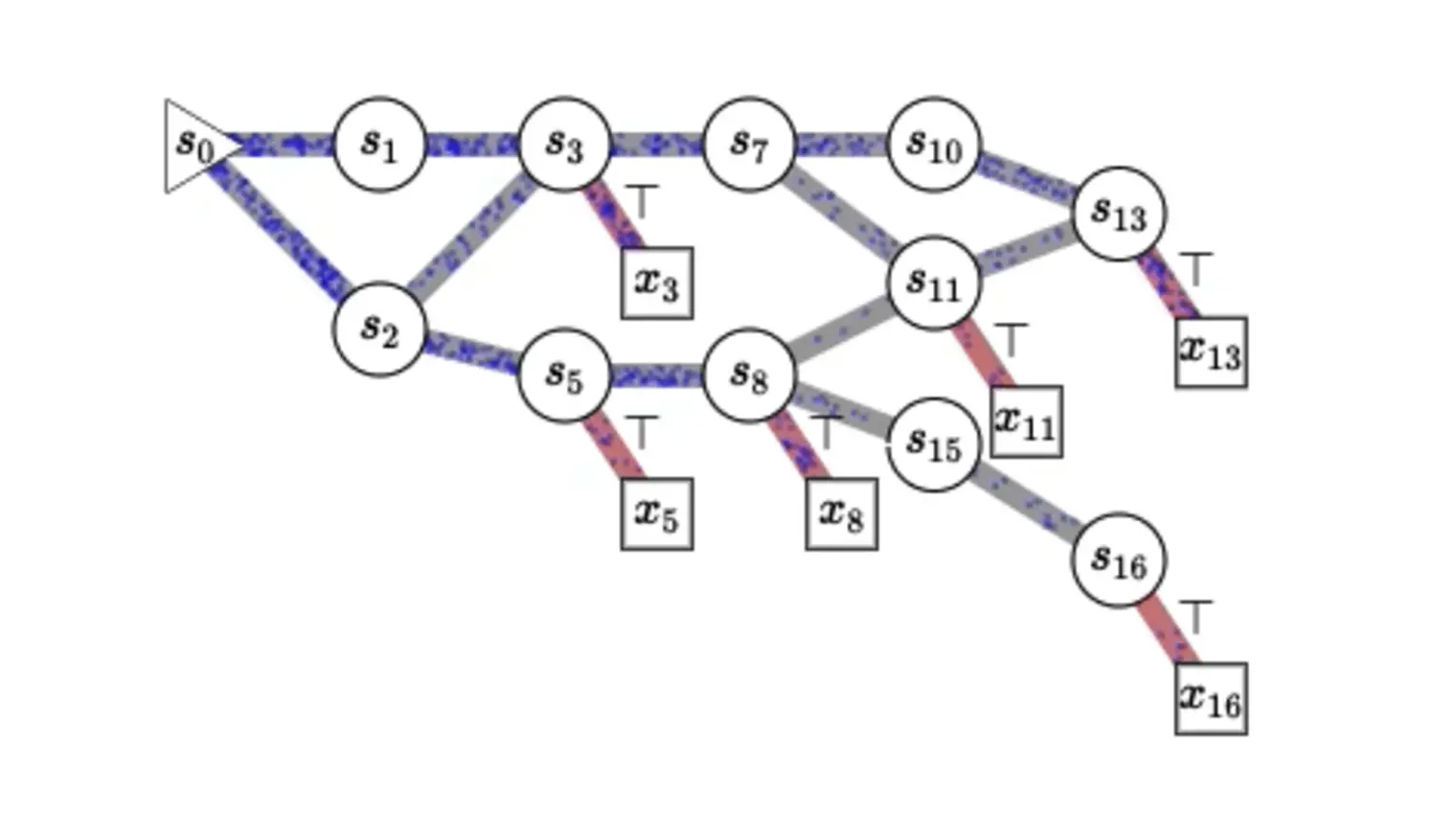
Stochastic Generative Flow Networks
Moksh J. Jain
Longbo Huang
Supplementary Material for MixupE
Yingtian Zou
Wai Hoh Tang
Hieu Pham
Juho Kannala
Arno Solin
We denote by z = (x,y) the input and output pair where x ∈ X ⊆ R and y ∈ Y ⊆ R . Let fθ(x) ∈ R be the output of the logits (i.e.,… (voir plus) the last layer before the softmax or sigmoid) of the model parameterized by θ. We use l(θ, z) = h(fθ(x)) − yfθ(x) to denote the loss function. Let g(·) be the activation function. We use x(i) to index i-th element of the vector x and xj to represent j-th variable in a set. The notation list is:
Synergies between Disentanglement and Sparsity: Generalization and Identifiability in Multi-Task Learning
Although disentangled representations are often said to be beneficial for downstream tasks, current empirical and theoretical understanding … (voir plus)is limited. In this work, we provide evidence that disentangled representations coupled with sparse base-predictors improve generalization. In the context of multi-task learning, we prove a new identifiability result that provides conditions under which maximally sparse base-predictors yield disentangled representations. Motivated by this theoretical result, we propose a practical approach to learn disentangled representations based on a sparsity-promoting bi-level optimization problem. Finally, we explore a meta-learning version of this algorithm based on group Lasso multiclass SVM base-predictors, for which we derive a tractable dual formulation. It obtains competitive results on standard few-shot classification benchmarks, while each task is using only a fraction of the learned representations.
A Theory of Continuous Generative Flow Networks
Generative flow networks (GFlowNets) are amortized variational inference algorithms that are trained to sample from unnormalized target dist… (voir plus)ributions over compositional objects. A key limitation of GFlowNets until this time has been that they are restricted to discrete spaces. We present a theory for generalized GFlowNets, which encompasses both existing discrete GFlowNets and ones with continuous or hybrid state spaces, and perform experiments with two goals in mind. First, we illustrate critical points of the theory and the importance of various assumptions. Second, we empirically demonstrate how observations about discrete GFlowNets transfer to the continuous case and show strong results compared to non-GFlowNet baselines on several previously studied tasks. This work greatly widens the perspectives for the application of GFlowNets in probabilistic inference and various modeling settings.
Tree Cross Attention
Frederick Tung
Hossein Hajimirsadeghi
Mohamed Osama Ahmed
Cross Attention is a popular method for retrieving information from a set of context tokens for making predictions. At inference time, for e… (voir plus)ach prediction, Cross Attention scans the full set of
Rethinking Learning Dynamics in RL using Adversarial Networks
Recent years have seen tremendous progress in methods of reinforcement learning. However, most of these approaches have been trained in a st… (voir plus)raightforward fashion and are generally not robust to adversity, especially in the meta-RL setting. To the best of our knowledge, our work is the first to propose an adversarial training regime for Multi-Task Reinforcement Learning, which requires no manual intervention or domain knowledge of the environments. Our experiments on multiple environments in the Multi-Task Reinforcement learning domain demonstrate that the adversarial process leads to a better exploration of numerous solutions and a deeper understanding of the environment. We also adapt existing measures of causal attribution to draw insights from the skills learned, facilitating easier re-purposing of skills for adaptation to unseen environments and tasks.
Bayesian Dynamic Causal Discovery
Learning the causal structure of observable variables is a central focus for scientific discovery. Bayesian causal discovery methods tackle … (voir plus)this problem by learning a posterior over the set of admissible graphs that are equally likely given our priors and observations. Existing methods primarily consider observations from static systems and assume the underlying causal structure takes the form of a directed acyclic graph (DAG). In settings with dynamic feedback mechanisms that regulate the trajectories of individual variables, this acyclicity assumption fails unless we account for time. We treat causal discovery in the unrolled causal graph as a problem of sparse identification of a dynamical system. This imposes a natural temporal causal order between variables and captures cyclic feedback loops through time. Under this lens, we propose a new framework for Bayesian causal discovery for dynamical systems and present a novel generative flow network architecture (Dyn-GFN) tailored for this task. Dyn-GFN imposes an edge-wise sparse prior to sequentially build a k -sparse causal graph. Through evaluation on temporal data, our results show that the posterior learned with Dyn-GFN yields improved Bayes coverage of admissible causal structures relative to state of the art Bayesian causal discovery methods.
Object-centric causal representation learning
Posterior samples of source galaxies in strong gravitational lenses with score-based priors
Inferring accurate posteriors for high-dimensional representations of the brightness of gravitationally-lensed sources is a major challenge,… (voir plus) in part due to the difficulties of accurately quantifying the priors. Here, we report the use of a score-based model to encode the prior for the inference of undistorted images of background galaxies. This model is trained on a set of high-resolution images of undistorted galaxies. By adding the likelihood score to the prior score and using a reverse-time stochastic differential equation solver, we obtain samples from the posterior. Our method produces independent posterior samples and models the data almost down to the noise level. We show how the balance between the likelihood and the prior meet our expectations in an experiment with out-of-distribution data.
Bayesian learning of Causal Structure and Mechanisms with GFlowNets and Variational Bayes
Bayesian causal structure learning aims to learn a posterior distribution over directed acyclic graphs (DAGs), and the mechanisms that defin… (voir plus)e the relationship between parent and child variables. By taking a Bayesian approach, it is possible to reason about the uncertainty of the causal model. The notion of modelling the uncertainty over models is particularly crucial for causal structure learning since the model could be unidentifiable when given only a finite amount of observational data. In this paper, we introduce a novel method to jointly learn the structure and mechanisms of the causal model using Variational Bayes, which we call Variational Bayes-DAG-GFlowNet (VBG). We extend the method of Bayesian causal structure learning using GFlowNets to learn not only the posterior distribution over the structure, but also the parameters of a linear-Gaussian model. Our results on simulated data suggest that VBG is competitive against several baselines in modelling the posterior over DAGs and mechanisms, while offering several advantages over existing methods, including the guarantee to sample acyclic graphs, and the flexibility to generalize to non-linear causal mechanisms.