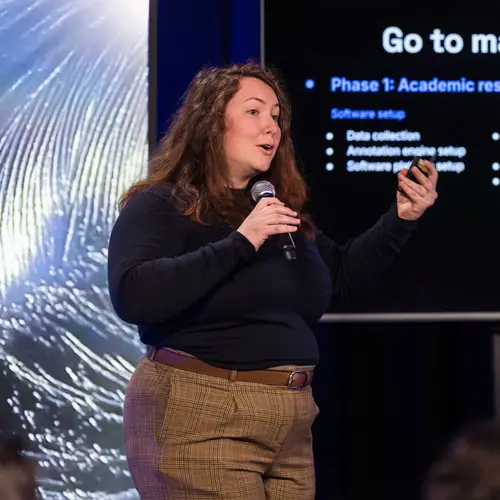
La prochaine rencontre, qui aura lieu le 10 novembre à Mila, permettra d'explorer comment pouvons-nous collectivement développer, encadrer et déployer des systèmes agentiques performants, fiables et sécuritaires en connectant chercheur·euse·s académiques, expert·e·s industriel·le·s et praticien·ne·s.
Ce programme à temps partiel offre aux scientifiques l'opportunité de tester leur intérêt pour l'entrepreneuriat. Vous avez jusqu'au 5 octobre pour postuler.
Avantage IA : productivité dans la fonction publique
Apprenez à tirer parti de l’IA générative pour soutenir et améliorer votre productivité au travail. La prochaine cohorte se déroulera en ligne les 6 et 8 octobre 2026, en anglais.
Nous utilisons des témoins pour analyser le trafic et l’utilisation de notre site web, afin de personnaliser votre expérience. Vous pouvez désactiver ces technologies à tout moment, mais cela peut restreindre certaines fonctionnalités du site. Consultez notre Politique de protection de la vie privée pour en savoir plus.
Paramètre des cookies
Vous pouvez activer et désactiver les types de cookies que vous souhaitez accepter. Cependant certains choix que vous ferez pourraient affecter les services proposés sur nos sites (ex : suggestions, annonces personnalisées, etc.).
Cookies essentiels
Ces cookies sont nécessaires au fonctionnement du site et ne peuvent être désactivés. (Toujours actif)
Cookies analyse
Acceptez-vous l'utilisation de cookies pour mesurer l'audience de nos sites ?
Lecteur Multimédia
Acceptez-vous l'utilisation de cookies pour afficher et vous permettre de regarder les contenus vidéo hébergés par nos partenaires (YouTube, etc.) ?
Due to fundamental exploration challenges without informed priors or specialized algorithms, agents may be unable to consistently receive in… (voir plus)formative rewards, leading to inefficient or intractable learning. To address these challenges, we introduce CURATE, an automatic curriculum learning algorithm for reinforcement learning agents in structured task spaces of monotonic difficulty. Through "exploration by exploitation," CURATE dynamically scales the task difficulty to match the agent's current competence. By exploiting its current capabilities that were learned in easier tasks, the agent improves its exploration in more difficult tasks. Our key insight is that the learning improvement in tasks that are close to those used for training is inversely proportional to their difficulty, and an agent that chooses a nearby distribution of the easiest unsolved tasks at any given time can automatically induce an easiest-to-hardest curriculum in these task spaces. To achieve this, CURATE conducts policy search in the task space to learn the best task distribution for training. As the agent's mastery grows, the learned curriculum adapts in an approximately easiest-to-hardest and task-directed fashion, efficiently culminating in a performant agent. Our experiments across three diverse domains (MiniGrid, Procgen, BipedalWalker) demonstrate that CURATE learns effective curricula for sample efficiency and proficiency with the potential for yielding broadly capable agents, matching or exceeding prior curriculum methods that do not require informed initialization or predefined schedules.
2026-08-30
Transactions on Machine Learning Research (accepté)
With the rapid advancement and deployment of Agentic AI, our scientific understanding of capabilities and limitations has not kept pace, lea… (voir plus)ding to cases where AI agents cause harm. We argue that many of these safety limitations are not novel problems. Instead, the safety challenges currently facing AI agents can be seen as instances of problems the reinforcement learning (RL) community has studied rigorously for decades. The core of this argument concerns the problem formulation of AI agents. AI agents are designed to solve sequential decision-making problems: problems with long-term objectives in which actions have delayed consequences. To model these types of problem, the problem is set up the problem such that the agent receives observations, feedback on its progress, and then takes actions. This is precisely the formulation of the RL problem. In this paper, we formalize the problem equivalence, which we then leverage to argue that \textbf{AI Agent safety is a reinforcement learning problem: the failure modes currently observed in deployed AI agents are structural instances of problems RL has formalized for decades, and the RL safety literature provides principled tools to diagnose and address them.}. We conclude with a call for deliberate collaboration between the RL and AI agent research communities: AI agent researchers gain access to principled frameworks, while RL researchers gain a class of real-world problems that could expose fundamental gaps in current RL benchmarks and theory.
2026-05-22
AIWILD @ International Conference on Machine Learning (publié)