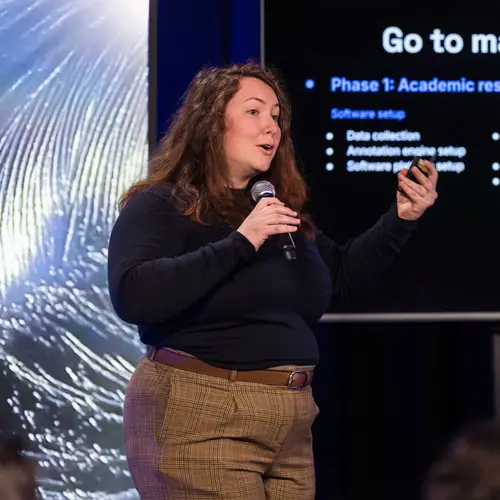
La prochaine rencontre, qui aura lieu le 10 novembre à Mila, permettra d'explorer comment pouvons-nous collectivement développer, encadrer et déployer des systèmes agentiques performants, fiables et sécuritaires en connectant chercheur·euse·s académiques, expert·e·s industriel·le·s et praticien·ne·s.
Ce programme à temps partiel offre aux scientifiques l'opportunité de tester leur intérêt pour l'entrepreneuriat. Vous avez jusqu'au 5 octobre pour postuler.
Avantage IA : productivité dans la fonction publique
Apprenez à tirer parti de l’IA générative pour soutenir et améliorer votre productivité au travail. La prochaine cohorte se déroulera en ligne les 6 et 8 octobre 2026, en anglais.

Nous utilisons des témoins pour analyser le trafic et l’utilisation de notre site web, afin de personnaliser votre expérience. Vous pouvez désactiver ces technologies à tout moment, mais cela peut restreindre certaines fonctionnalités du site. Consultez notre Politique de protection de la vie privée pour en savoir plus.
Paramètre des cookies
Vous pouvez activer et désactiver les types de cookies que vous souhaitez accepter. Cependant certains choix que vous ferez pourraient affecter les services proposés sur nos sites (ex : suggestions, annonces personnalisées, etc.).
Cookies essentiels
Ces cookies sont nécessaires au fonctionnement du site et ne peuvent être désactivés. (Toujours actif)
Cookies analyse
Acceptez-vous l'utilisation de cookies pour mesurer l'audience de nos sites ?
Lecteur Multimédia
Acceptez-vous l'utilisation de cookies pour afficher et vous permettre de regarder les contenus vidéo hébergés par nos partenaires (YouTube, etc.) ?
The superficial alignment hypothesis (SAH) posits that large language models learn most of their knowledge during pre-training, and that pos… (voir plus)t-training merely surfaces this knowledge. The SAH, however, lacks a precise definition, which has led to (i) different and seemingly orthogonal arguments supporting it, and (ii) important critiques to it. We propose a new metric called task complexity: the length of the shortest program that achieves a target performance on a task. In this framework, the SAH simply claims that pre-trained models drastically reduce the complexity of achieving high performance on many tasks. Our definition unifies prior arguments supporting the SAH, interpreting them as different strategies to find such short programs. Experimentally, we estimate the task complexity of mathematical reasoning, machine translation, and instruction following; we then show that these complexities can be remarkably low when conditioned on a pre-trained model. Further, we find that pre-training enables access to strong performances on our tasks, but it can require programs of gigabytes of length to access them. Post-training, on the other hand, collapses the complexity of reaching this same performance by several orders of magnitude. Overall, our results highlight that task adaptation often requires surprisingly little information -- often just a few kilobytes.
2026-04-29
International Conference on Machine Learning (accepté)
The superficial alignment hypothesis (SAH) posits that large language models learn most of their knowledge during pre-training, and that pos… (voir plus)t-training merely surfaces this knowledge. The SAH, however, lacks a precise definition, which has led to (i) different and seemingly orthogonal arguments supporting it, and (ii) important critiques to it. We propose a new metric called **Task Complexity**: the length of the shortest program that achieves a target performance on a task. In this framework, the SAH claims that pre-trained models drastically reduce the task complexity of achieving high performance on many tasks. Our definition unifies prior arguments supporting the SAH, interpreting them as different strategies to find such short programs. Experimentally, we estimate task complexities of mathematical reasoning, machine translation, and instruction following tasks and show that their respective task complexities can be remarkably low when conditioned on a pre-trained model. Further, we find that pre-training enables access to strong performances on our tasks, but it can require programs of gigabytes of length to access them. Post-training, on the other hand, collapses the complexity of reaching this same performance by several orders of magnitude. Overall, our results highlight that task adaptation can require remarkably little information—often just a few kilobytes.
2025-12-31
International Conference on Machine Learning (Accept (regular))