


Portrait de Yoshua Bengio

Yoshua Bengio

Membre académique principal
Chaire en IA Canada-CIFAR
Professeur titulaire, Université de Montréal, Département d'informatique et de recherche opérationnelle
Fondateur et Conseiller scientifique, Équipe de direction
Sujets de recherche
Apprentissage automatique médical
Apprentissage de représentations
Apprentissage par renforcement
Apprentissage profond
Causalité
Modèles génératifs
Modèles probabilistes
Modélisation moléculaire
Neurosciences computationnelles
Raisonnement
Réseaux de neurones en graphes
Réseaux de neurones récurrents
Théorie de l'apprentissage automatique
Traitement du langage naturel

Biographie

*Pour toute demande média, veuillez écrire à medias@mila.quebec.

Pour plus d’information, contactez Cassidy MacNeil, adjointe principale et responsable des opérations cassidy.macneil@mila.quebec.

Reconnu comme une sommité mondiale en intelligence artificielle, Yoshua Bengio s’est surtout distingué par son rôle de pionnier en apprentissage profond, ce qui lui a valu le prix A. M. Turing 2018, le « prix Nobel de l’informatique », avec Geoffrey Hinton et Yann LeCun. Il est professeur titulaire à l’Université de Montréal, fondateur et conseiller scientifique de Mila – Institut québécois d’intelligence artificielle, et codirige en tant que senior fellow le programme Apprentissage automatique, apprentissage biologique de l'Institut canadien de recherches avancées (CIFAR). Il occupe également la fonction de conseiller spécial et directeur scientifique fondateur d’IVADO.

En 2018, il a été l’informaticien qui a recueilli le plus grand nombre de nouvelles citations au monde. En 2019, il s’est vu décerner le prestigieux prix Killam. Depuis 2022, il détient le plus grand facteur d’impact (h-index) en informatique à l’échelle mondiale. Il est fellow de la Royal Society de Londres et de la Société royale du Canada, et officier de l’Ordre du Canada.

Soucieux des répercussions sociales de l’IA et de l’objectif que l’IA bénéficie à tous, il a contribué activement à la Déclaration de Montréal pour un développement responsable de l’intelligence artificielle.

Étudiants actuels

Collaborateur·rice alumni - McGill
Collaborateur·rice de recherche - Cambridge University
Superviseur⋅e principal⋅e :
Doctorat - UdeM
Visiteur de recherche indépendant
Co-superviseur⋅e :
Collaborateur·rice de recherche - N/A
Superviseur⋅e principal⋅e :
Doctorat - UdeM
Collaborateur·rice de recherche - KAIST
Collaborateur·rice alumni - UdeM
Co-superviseur⋅e :
Visiteur de recherche indépendant
Superviseur⋅e principal⋅e :
Doctorat - UdeM
Co-superviseur⋅e :
Doctorat - UdeM
Doctorat - UdeM
Superviseur⋅e principal⋅e :
Collaborateur·rice alumni - UdeM
Postdoctorat - UdeM
Superviseur⋅e principal⋅e :
Postdoctorat - UdeM
Superviseur⋅e principal⋅e :
Collaborateur·rice alumni
Collaborateur·rice alumni - UdeM
Doctorat - UdeM
Co-superviseur⋅e :
Doctorat - UdeM
Superviseur⋅e principal⋅e :
Visiteur de recherche indépendant - UdeM
Doctorat - UdeM
Superviseur⋅e principal⋅e :
Collaborateur·rice de recherche - Ying Wu Coll of Computing
Collaborateur·rice de recherche - University of Waterloo
Superviseur⋅e principal⋅e :
Collaborateur·rice alumni - Max-Planck-Institute for Intelligent Systems
Collaborateur·rice de recherche - UdeM
Co-superviseur⋅e :
Doctorat - UdeM
Postdoctorat - UdeM
Postdoctorat - UdeM
Doctorat - UdeM
Superviseur⋅e principal⋅e :
Collaborateur·rice alumni - UdeM
Postdoctorat
Co-superviseur⋅e :
Collaborateur·rice alumni - Polytechnique
Co-superviseur⋅e :
Doctorat - UdeM
Co-superviseur⋅e :
Collaborateur·rice de recherche
Superviseur⋅e principal⋅e :
Collaborateur·rice alumni - UdeM
Co-superviseur⋅e :
Doctorat - UdeM
Superviseur⋅e principal⋅e :
Collaborateur·rice de recherche
Collaborateur·rice de recherche - UdeM
Doctorat - McGill
Superviseur⋅e principal⋅e :
Doctorat - UdeM
Superviseur⋅e principal⋅e :
Collaborateur·rice alumni - McGill
Superviseur⋅e principal⋅e :

Publications

Discrete, compositional, and symbolic representations through attractor dynamics
Compositionality is an important feature of discrete symbolic systems, such as language and programs, as it enables them to have infinite ca… (voir plus)pacity despite a finite symbol set. It serves as a useful abstraction for reasoning in both cognitive science and in AI, yet the interface between continuous and symbolic processing is often imposed by fiat at the algorithmic level, such as by means of quantization or a softmax sampling step. In this work, we explore how discretization could be implemented in a more neurally plausible manner through the modeling of attractor dynamics that partition the continuous representation space into basins that correspond to sequences of symbols. Building on established work in attractor networks and introducing novel training methods, we show that imposing structure in the symbolic space can produce compositionality in the attractor-supported representation space of rich sensory inputs. Lastly, we argue that our model exhibits the process of an information bottleneck that is thought to play a role in conscious experience, decomposing the rich information of a sensory input into stable components encoding symbolic information.
On the importance of catalyst-adsorbate 3D interactions for relaxed energy predictions
The use of machine learning for material property prediction and discovery has traditionally centered on graph neural networks that incorpor… (voir plus)ate the geometric configuration of all atoms. However, in practice not all this information may be readily available, e.g.~when evaluating the potentially unknown binding of adsorbates to catalyst. In this paper, we investigate whether it is possible to predict a system's relaxed energy in the OC20 dataset while ignoring the relative position of the adsorbate with respect to the electro-catalyst. We consider SchNet, DimeNet++ and FAENet as base architectures and measure the impact of four modifications on model performance: removing edges in the input graph, pooling independent representations, not sharing the backbone weights and using an attention mechanism to propagate non-geometric relative information. We find that while removing binding site information impairs accuracy as expected, modified models are able to predict relaxed energies with remarkably decent MAE. Our work suggests future research directions in accelerated materials discovery where information on reactant configurations can be reduced or altogether omitted.
Towards equilibrium molecular conformation generation with GFlowNets
Cheng-Hao Liu
Santiago Miret
Luca Thiede
Alán Aspuru-Guzik
Sampling diverse, thermodynamically feasible molecular conformations plays a crucial role in predicting properties of a molecule. In this pa… (voir plus)per we propose to use GFlowNet for sampling conformations of small molecules from the Boltzmann distribution, as determined by the molecule's energy. The proposed approach can be used in combination with energy estimation methods of different fidelity and discovers a diverse set of low-energy conformations for highly flexible drug-like molecules. We demonstrate that GFlowNet can reproduce molecular potential energy surfaces by sampling proportionally to the Boltzmann distribution.
Managing extreme AI risks amid rapid progress
Geoffrey Hinton
Andrew Yao
Dawn Song
Pieter Abbeel
Yuval Noah Harari
Trevor Darrell
Ya-Qin Zhang
Lan Xue
Shai Shalev-Shwartz
Gillian Hadfield
Jeff Clune
Frank Hutter
Atilim Güneş Baydin
Sheila McIlraith
Qiqi Gao
Ashwin Acharya
David Krueger
Anca Dragan … (voir 5 de plus)
Philip Torr
Stuart Russell
Daniel Kahneman
Jan Brauner
Artificial Intelligence (AI) is progressing rapidly, and companies are shifting their focus to developing generalist AI systems that can aut… (voir plus)onomously act and pursue goals. Increases in capabilities and autonomy may soon massively amplify AI's impact, with risks that include large-scale social harms, malicious uses, and an irreversible loss of human control over autonomous AI systems. Although researchers have warned of extreme risks from AI, there is a lack of consensus about how exactly such risks arise, and how to manage them. Society's response, despite promising first steps, is incommensurate with the possibility of rapid, transformative progress that is expected by many experts. AI safety research is lagging. Present governance initiatives lack the mechanisms and institutions to prevent misuse and recklessness, and barely address autonomous systems. In this short consensus paper, we describe extreme risks from upcoming, advanced AI systems. Drawing on lessons learned from other safety-critical technologies, we then outline a comprehensive plan combining technical research and development with proactive, adaptive governance mechanisms for a more commensurate preparation.
Causal machine learning for single-cell genomics
Alejandro Tejada-Lapuerta
Hananeh Aliee
Fabian J. Theis
A cry for help: Early detection of brain injury in newborns
Samantha Latremouille
Arsenii Gorin
Junhao Wang
Uchenna Ekwochi
P. Ubuane
O. Kehinde
Muhammad A. Salisu
Datonye Briggs
Crystal-GFN: sampling crystals with desirable properties and constraints
Accelerating material discovery holds the potential to greatly help mitigate the climate crisis. Discovering new solid-state materials such … (voir plus)as electrocatalysts, super-ionic conductors or photovoltaic materials can have a crucial impact, for instance, in improving the efficiency of renewable energy production and storage. In this paper, we introduce Crystal-GFN, a generative model of crystal structures that sequentially samples structural properties of crystalline materials, namely the space group, composition and lattice parameters. This domain-inspired approach enables the flexible incorporation of physical and structural hard constraints, as well as the use of any available predictive model of a desired physicochemical property as an objective function. To design stable materials, one must target the candidates with the lowest formation energy. Here, we use as objective the formation energy per atom of a crystal structure predicted by a new proxy machine learning model trained on MatBench. The results demonstrate that Crystal-GFN is able to sample highly diverse crystals with low (median -3.1 eV/atom) predicted formation energy.
Causal Inference in Gene Regulatory Networks with GFlowNet: Towards Scalability in Large Systems
Trang Nguyen
Dianbo Liu
Understanding causal relationships within Gene Regulatory Networks (GRNs) is essential for unraveling the gene interactions in cellular proc… (voir plus)esses. However, causal discovery in GRNs is a challenging problem for multiple reasons including the existence of cyclic feedback loops and uncertainty that yields diverse possible causal structures. Previous works in this area either ignore cyclic dynamics (assume acyclic structure) or struggle with scalability. We introduce Swift-DynGFN as a novel framework that enhances causal structure learning in GRNs while addressing scalability concerns. Specifically, Swift-DynGFN exploits gene-wise independence to boost parallelization and to lower computational cost. Experiments on real single-cell RNA velocity and synthetic GRN datasets showcase the advancement in learning causal structure in GRNs and scalability in larger systems.
Leveraging Diffusion Disentangled Representations to Mitigate Shortcuts in Underspecified Visual Tasks
Alexander Rubinstein
Armand Mihai Nicolicioiu
Damien Teney
Spurious correlations in the data, where multiple cues are predictive of the target labels, often lead to shortcut learning phenomena, where… (voir plus) a model may rely on erroneous, easy-to-learn, cues while ignoring reliable ones. In this work, we propose an ensemble diversification framework exploiting the generation of synthetic counterfactuals using Diffusion Probabilistic Models (DPMs). We discover that DPMs have the inherent capability to represent multiple visual cues independently, even when they are largely correlated in the training data. We leverage this characteristic to encourage model diversity and empirically show the efficacy of the approach with respect to several diversification objectives. We show that diffusion-guided diversification can lead models to avert attention from shortcut cues, achieving ensemble diversity performance comparable to previous methods requiring additional data collection.
AI and Catastrophic Risk
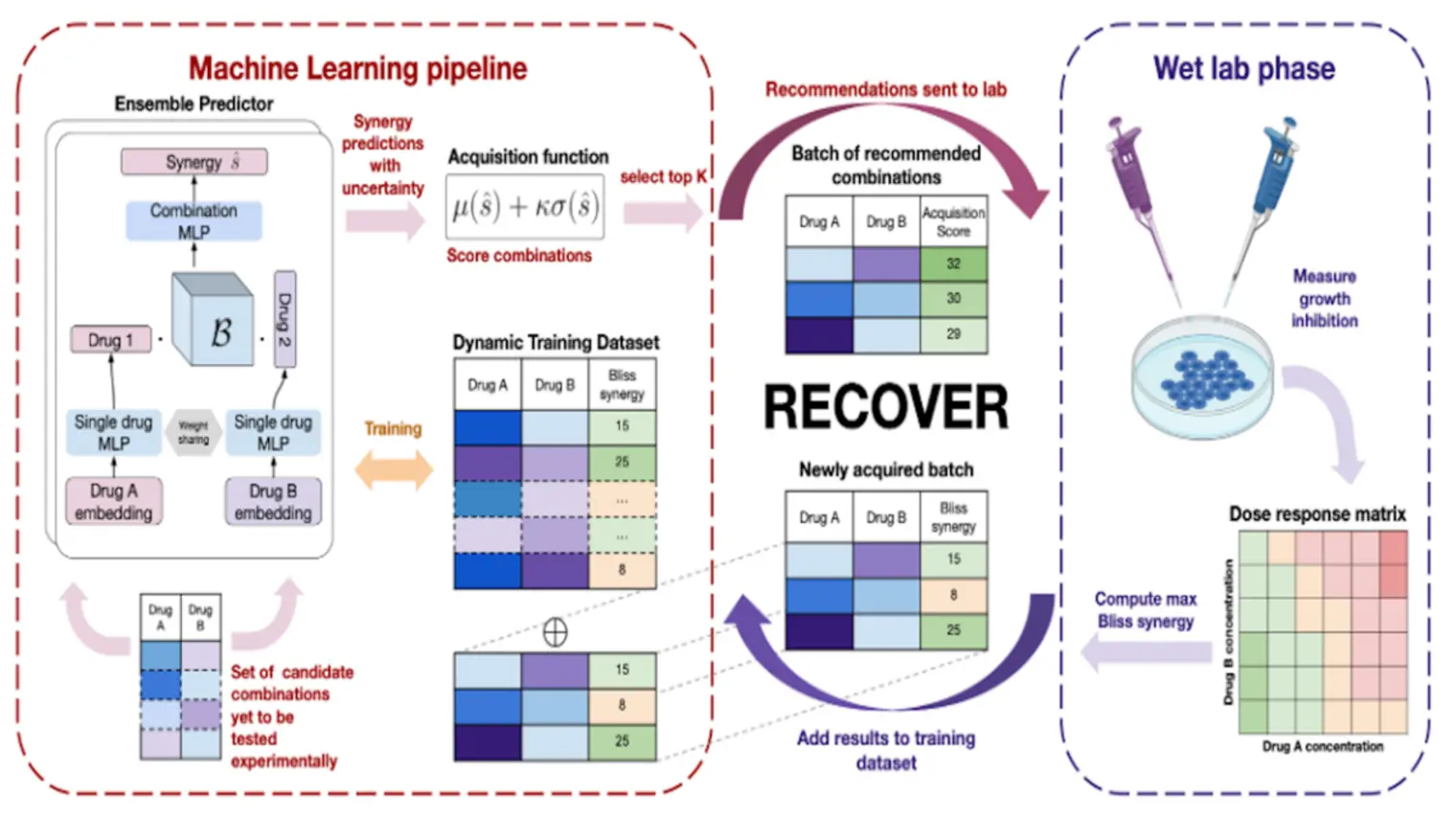
RECOVER identifies synergistic drug combinations in vitro through sequential model optimization
Thomas Gaudelet
Andrew Anighoro
Torsten Gross
Francisco Martínez-Peña
Eileen L. Tang
M.S. Suraj
Cristian Regep
Jeremy B.R. Hayter
Nicholas Valiante
Mike Tyers
Charles E.S. Roberts
Michael M. Bronstein
Luke L. Lairson
Jake P. Taylor-King
GEO-Bench: Toward Foundation Models for Earth Monitoring
Alexandre Lacoste
Nils Lehmann
Pau Rodríguez
Evan David Sherwin
Hannah Kerner
Björn Lütjens
Jeremy Irvin
David Dao
Hamed Alemohammad
Mehmet Gunturkun
Dava Newman
Stefano Ermon
Xiao Xiang Zhu
Recent progress in self-supervision has shown that pre-training large neural networks on vast amounts of unsupervised data can lead to subst… (voir plus)antial increases in generalization to downstream tasks. Such models, recently coined foundation models, have been transformational to the field of natural language processing. Variants have also been proposed for image data, but their applicability to remote sensing tasks is limited. To stimulate the development of foundation models for Earth monitoring, we propose a benchmark comprised of six classification and six segmentation tasks, which were carefully curated and adapted to be both relevant to the field and well-suited for model evaluation. We accompany this benchmark with a robust methodology for evaluating models and reporting aggregated results to enable a reliable assessment of progress. Finally, we report results for 20 baselines to gain information about the performance of existing models. We believe that this benchmark will be a driver of progress across a variety of Earth monitoring tasks.