


Portrait de Yoshua Bengio

Yoshua Bengio

Membre académique principal
Chaire en IA Canada-CIFAR
Professeur titulaire, Université de Montréal, Département d'informatique et de recherche opérationnelle
Fondateur et Conseiller scientifique, Équipe de direction
Sujets de recherche
Apprentissage automatique médical
Apprentissage de représentations
Apprentissage par renforcement
Apprentissage profond
Causalité
Modèles génératifs
Modèles probabilistes
Modélisation moléculaire
Neurosciences computationnelles
Raisonnement
Réseaux de neurones en graphes
Réseaux de neurones récurrents
Théorie de l'apprentissage automatique
Traitement du langage naturel

Biographie

*Pour toute demande média, veuillez écrire à medias@mila.quebec.

Pour plus d’information, contactez Cassidy MacNeil, adjointe principale et responsable des opérations cassidy.macneil@mila.quebec.

Reconnu comme une sommité mondiale en intelligence artificielle, Yoshua Bengio s’est surtout distingué par son rôle de pionnier en apprentissage profond, ce qui lui a valu le prix A. M. Turing 2018, le « prix Nobel de l’informatique », avec Geoffrey Hinton et Yann LeCun. Il est professeur titulaire à l’Université de Montréal, fondateur et conseiller scientifique de Mila – Institut québécois d’intelligence artificielle, et codirige en tant que senior fellow le programme Apprentissage automatique, apprentissage biologique de l'Institut canadien de recherches avancées (CIFAR). Il occupe également la fonction de conseiller spécial et directeur scientifique fondateur d’IVADO.

En 2018, il a été l’informaticien qui a recueilli le plus grand nombre de nouvelles citations au monde. En 2019, il s’est vu décerner le prestigieux prix Killam. Depuis 2022, il détient le plus grand facteur d’impact (h-index) en informatique à l’échelle mondiale. Il est fellow de la Royal Society de Londres et de la Société royale du Canada, et officier de l’Ordre du Canada.

Soucieux des répercussions sociales de l’IA et de l’objectif que l’IA bénéficie à tous, il a contribué activement à la Déclaration de Montréal pour un développement responsable de l’intelligence artificielle.

Étudiants actuels

Collaborateur·rice alumni - McGill
Collaborateur·rice de recherche - Cambridge University
Superviseur⋅e principal⋅e :
Doctorat - UdeM
Visiteur de recherche indépendant
Co-superviseur⋅e :
Collaborateur·rice de recherche - N/A
Superviseur⋅e principal⋅e :
Doctorat - UdeM
Collaborateur·rice de recherche - KAIST
Collaborateur·rice alumni - UdeM
Co-superviseur⋅e :
Visiteur de recherche indépendant
Superviseur⋅e principal⋅e :
Doctorat - UdeM
Co-superviseur⋅e :
Doctorat - UdeM
Doctorat - UdeM
Superviseur⋅e principal⋅e :
Collaborateur·rice alumni - UdeM
Postdoctorat - UdeM
Superviseur⋅e principal⋅e :
Postdoctorat - UdeM
Superviseur⋅e principal⋅e :
Collaborateur·rice alumni
Collaborateur·rice alumni - UdeM
Doctorat - UdeM
Co-superviseur⋅e :
Doctorat - UdeM
Superviseur⋅e principal⋅e :
Visiteur de recherche indépendant - UdeM
Doctorat - UdeM
Superviseur⋅e principal⋅e :
Collaborateur·rice de recherche - Ying Wu Coll of Computing
Collaborateur·rice de recherche - University of Waterloo
Superviseur⋅e principal⋅e :
Collaborateur·rice alumni - Max-Planck-Institute for Intelligent Systems
Collaborateur·rice de recherche - UdeM
Co-superviseur⋅e :
Doctorat - UdeM
Postdoctorat - UdeM
Postdoctorat - UdeM
Doctorat - UdeM
Superviseur⋅e principal⋅e :
Collaborateur·rice alumni - UdeM
Postdoctorat
Co-superviseur⋅e :
Collaborateur·rice alumni - Polytechnique
Co-superviseur⋅e :
Doctorat - UdeM
Co-superviseur⋅e :
Collaborateur·rice de recherche
Superviseur⋅e principal⋅e :
Collaborateur·rice alumni - UdeM
Co-superviseur⋅e :
Doctorat - UdeM
Superviseur⋅e principal⋅e :
Collaborateur·rice de recherche
Collaborateur·rice de recherche - UdeM
Doctorat - McGill
Superviseur⋅e principal⋅e :
Doctorat - UdeM
Superviseur⋅e principal⋅e :
Collaborateur·rice alumni - McGill
Superviseur⋅e principal⋅e :

Publications

Temporal Latent Bottleneck: Synthesis of Fast and Slow Processing Mechanisms in Sequence Learning
Nitesh B. Gundavarapu
Nan Rosemary Ke
Recurrent neural networks have a strong inductive bias towards learning temporally compressed representations, as the entire history of a se… (voir plus)quence is represented by a single vector. By contrast, Transformers have little inductive bias towards learning temporally compressed representations, as they allow for attention over all previously computed elements in a sequence. Having a more compressed representation of a sequence may be beneficial for generalization, as a high-level representation may be more easily re-used and re-purposed and will contain fewer irrelevant details. At the same time, excessive compression of representations comes at the cost of expressiveness. We propose a solution which divides computation into two streams. A slow stream that is recurrent in nature aims to learn a specialized and compressed representation, by forcing chunks of
Trajectory balance: Improved credit assignment in GFlowNets
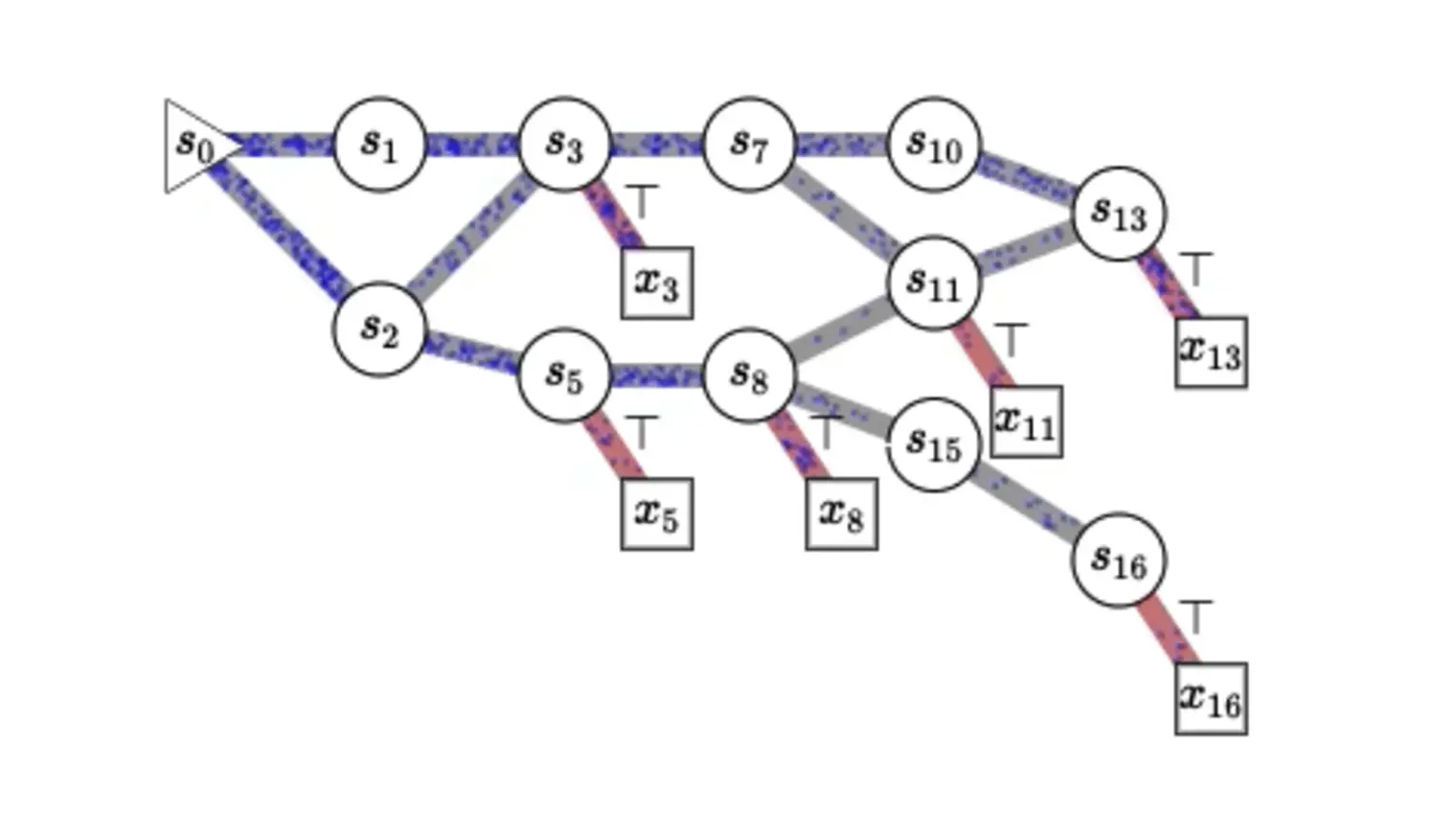
Generative flow networks (GFlowNets) are a method for learning a stochastic policy for generating compositional objects, such as graphs or s… (voir plus)trings, from a given unnormalized density by sequences of actions, where many possible action sequences may lead to the same object. We find previously proposed learning objectives for GFlowNets, flow matching and detailed balance, which are analogous to temporal difference learning, to be prone to inefficient credit propagation across long action sequences. We thus propose a new learning objective for GFlowNets, trajectory balance, as a more efficient alternative to previously used objectives. We prove that any global minimizer of the trajectory balance objective can define a policy that samples exactly from the target distribution. In experiments on four distinct domains, we empirically demonstrate the benefits of the trajectory balance objective for GFlowNet convergence, diversity of generated samples, and robustness to long action sequences and large action spaces.
Unifying Likelihood-Free Inference with Black-Box Optimization and Beyond
Black-box optimization formulations for biological sequence design have drawn recent attention due to their promising potential impact on th… (voir plus)e pharmaceutical industry. In this work, we propose to unify two seemingly distinct worlds: likelihood-free inference and black-box optimization, under one probabilistic framework. In tandem, we provide a recipe for constructing various sequence design methods based on this framework. We show how previous optimization approaches can be "reinvented" in our framework, and further propose new probabilistic black-box optimization algorithms. Extensive experiments on sequence design application illustrate the benefits of the proposed methodology.
Weakly Supervised Representation Learning with Sparse Perturbations
Jason Hartford
The theory of representation learning aims to build methods that provably invert the data generating process with minimal domain knowledge o… (voir plus)r any source of supervision. Most prior approaches require strong distributional assumptions on the latent variables and weak supervision (auxiliary information such as timestamps) to provide provable identification guarantees. In this work, we show that if one has weak supervision from observations generated by sparse perturbations of the latent variables--e.g. images in a reinforcement learning environment where actions move individual sprites--identification is achievable under unknown continuous latent distributions. We show that if the perturbations are applied only on mutually exclusive blocks of latents, we identify the latents up to those blocks. We also show that if these perturbation blocks overlap, we identify latents up to the smallest blocks shared across perturbations. Consequently, if there are blocks that intersect in one latent variable only, then such latents are identified up to permutation and scaling. We propose a natural estimation procedure based on this theory and illustrate it on low-dimensional synthetic and image-based experiments.
Multi-Domain Balanced Sampling Improves Out-of-Distribution Generalization of Chest X-ray Pathology Prediction Models
Enoch Amoatey Tetteh
Joseph D Viviano
David M. Krueger
Learning models that generalize under different distribution shifts in medical imaging has been a long-standing research challenge. There ha… (voir plus)ve been several proposals for efficient and robust visual representation learning among vision research practitioners, especially in the sensitive and critical biomedical domain. In this paper, we propose an idea for out-of-distribution generalization of chest X-ray pathologies that uses a simple balanced batch sampling technique. We observed that balanced sampling between the multiple training datasets improves the performance over baseline models trained without balancing.
Long-Term Credit Assignment via Model-based Temporal Shortcuts
Effect of diversity in Meta-Learning
Few-shot learning aims to learn representations that can tackle novel tasks given a small number of examples. Recent studies show that task … (voir plus)distribution plays a vital role in the performance of the model. Conventional wisdom is that task diversity should improve the performance of meta-learning. In this work, we find evidence to the contrary; we study different task distributions on a myriad of models and datasets to evaluate the effect of task diversity on meta-learning algorithms. For this experiment, we train on two datasets - Omniglot and miniImageNet and with three broad classes of meta-learning models - Metric-based (i.e., Protonet, Matching Networks), Optimization-based (i.e., MAML, Reptile, and MetaOptNet), and Bayesian meta-learning models (i.e., CNAPs). Our experiments demonstrate that the effect of task diversity on all these algorithms follows a similar trend, and task diversity does not seem to offer any benefits to the learning of the model. Furthermore, we also demonstrate that even a handful of tasks, repeated over multiple batches, would be sufficient to achieve a performance similar to uniform sampling and draws into question the need for additional tasks to create better models.
GFlowNet Foundations
Generative Flow Networks (GFlowNets) have been introduced as a method to sample a diverse set of candidates in an active learning context, w… (voir plus)ith a training objective that makes them approximately sample in proportion to a given reward function. In this paper, we show a number of additional theoretical properties of GFlowNets. They can be used to estimate joint probability distributions and the corresponding marginal distributions where some variables are unspecified and, of particular interest, can represent distributions over composite objects like sets and graphs. GFlowNets amortize the work typically done by computationally expensive MCMC methods in a single but trained generative pass. They could also be used to estimate partition functions and free energies, conditional probabilities of supersets (supergraphs) given a subset (subgraph), as well as marginal distributions over all supersets (supergraphs) of a given set (graph). We introduce variations enabling the estimation of entropy and mutual information, sampling from a Pareto frontier, connections to reward-maximizing policies, and extensions to stochastic environments, continuous actions and modular energy functions.
Gradient Starvation: A Learning Proclivity in Neural Networks
We identify and formalize a fundamental gradient descent phenomenon resulting in a learning proclivity in over-parameterized neural networks… (voir plus). Gradient Starvation arises when cross-entropy loss is minimized by capturing only a subset of features relevant for the task, despite the presence of other predictive features that fail to be discovered. This work provides a theoretical explanation for the emergence of such feature imbalance in neural networks. Using tools from Dynamical Systems theory, we identify simple properties of learning dynamics during gradient descent that lead to this imbalance, and prove that such a situation can be expected given certain statistical structure in training data. Based on our proposed formalism, we develop guarantees for a novel regularization method aimed at decoupling feature learning dynamics, improving accuracy and robustness in cases hindered by gradient starvation. We illustrate our findings with simple and real-world out-of-distribution (OOD) generalization experiments.
Neural Production Systems
Nan Rosemary Ke
Charles Blundell
Philippe Beaudoin
Nicolas Heess
Michael Mozer
Visual environments are structured, consisting of distinct objects or entities. These entities have properties -- both visible and latent --… (voir plus) that determine the manner in which they interact with one another. To partition images into entities, deep-learning researchers have proposed structural inductive biases such as slot-based architectures. To model interactions among entities, equivariant graph neural nets (GNNs) are used, but these are not particularly well suited to the task for two reasons. First, GNNs do not predispose interactions to be sparse, as relationships among independent entities are likely to be. Second, GNNs do not factorize knowledge about interactions in an entity-conditional manner. As an alternative, we take inspiration from cognitive science and resurrect a classic approach, production systems, which consist of a set of rule templates that are applied by binding placeholder variables in the rules to specific entities. Rules are scored on their match to entities, and the best fitting rules are applied to update entity properties. In a series of experiments, we demonstrate that this architecture achieves a flexible, dynamic flow of control and serves to factorize entity-specific and rule-based information. This disentangling of knowledge achieves robust future-state prediction in rich visual environments, outperforming state-of-the-art methods using GNNs, and allows for the extrapolation from simple (few object) environments to more complex environments.
The Causal-Neural Connection: Expressiveness, Learnability, and Inference
Kevin Xia
Kai-Zhan Lee
Elias Bareinboim
One of the central elements of any causal inference is an object called structural causal model (SCM), which represents a collection of mech… (voir plus)anisms and exogenous sources of random variation of the system under investigation (Pearl, 2000). An important property of many kinds of neural networks is universal approximability: the ability to approximate any function to arbitrary precision. Given this property, one may be tempted to surmise that a collection of neural nets is capable of learning any SCM by training on data generated by that SCM. In this paper, we show this is not the case by disentangling the notions of expressivity and learnability. Specifically, we show that the causal hierarchy theorem (Thm. 1, Bareinboim et al., 2020), which describes the limits of what can be learned from data, still holds for neural models. For instance, an arbitrarily complex and expressive neural net is unable to predict the effects of interventions given observational data alone. Given this result, we introduce a special type of SCM called a neural causal model (NCM), and formalize a new type of inductive bias to encode structural constraints necessary for performing causal inferences. Building on this new class of models, we focus on solving two canonical tasks found in the literature known as causal identification and estimation. Leveraging the neural toolbox, we develop an algorithm that is both sufficient and necessary to determine whether a causal effect can be learned from data (i.e., causal identifiability); it then estimates the effect whenever identifiability holds (causal estimation). Simulations corroborate the proposed approach.
Problèmes associés au déploiement des modèles fondés sur l’apprentissage machine en santé
Tianshi Cao
Joseph D Viviano
Michael Fralick
Marzyeh Ghassemi
Muhammad Mamdani
Russell Greiner