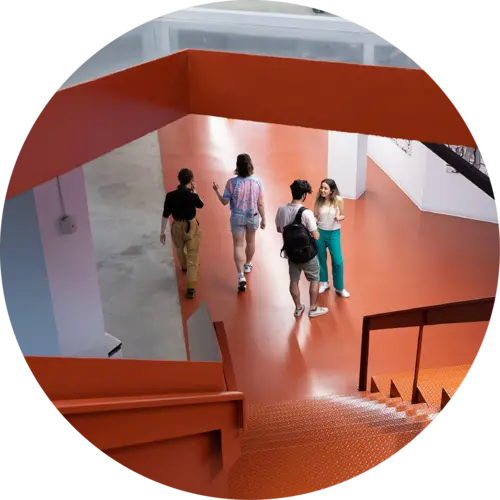
Portrait de Yoshua Bengio

Yoshua Bengio

Membre académique principal
Chaire en IA Canada-CIFAR
Professeur titulaire, Université de Montréal, Département d'informatique et de recherche opérationnelle
Fondateur et Conseiller scientifique, Équipe de direction
Sujets de recherche
Apprentissage automatique médical
Apprentissage de représentations
Apprentissage par renforcement
Apprentissage profond
Causalité
Modèles génératifs
Modèles probabilistes
Modélisation moléculaire
Neurosciences computationnelles
Raisonnement
Réseaux de neurones en graphes
Réseaux de neurones récurrents
Théorie de l'apprentissage automatique
Traitement du langage naturel

Biographie

*Pour toute demande média, veuillez écrire à medias@mila.quebec.

Pour plus d’information, contactez Cassidy MacNeil, adjointe principale et responsable des opérations cassidy.macneil@mila.quebec.

Reconnu comme une sommité mondiale en intelligence artificielle, Yoshua Bengio s’est surtout distingué par son rôle de pionnier en apprentissage profond, ce qui lui a valu le prix A. M. Turing 2018, le « prix Nobel de l’informatique », avec Geoffrey Hinton et Yann LeCun. Il est professeur titulaire à l’Université de Montréal, fondateur et conseiller scientifique de Mila – Institut québécois d’intelligence artificielle, et codirige en tant que senior fellow le programme Apprentissage automatique, apprentissage biologique de l'Institut canadien de recherches avancées (CIFAR). Il occupe également la fonction de conseiller spécial et directeur scientifique fondateur d’IVADO.

En 2018, il a été l’informaticien qui a recueilli le plus grand nombre de nouvelles citations au monde. En 2019, il s’est vu décerner le prestigieux prix Killam. Depuis 2022, il détient le plus grand facteur d’impact (h-index) en informatique à l’échelle mondiale. Il est fellow de la Royal Society de Londres et de la Société royale du Canada, et officier de l’Ordre du Canada.

Soucieux des répercussions sociales de l’IA et de l’objectif que l’IA bénéficie à tous, il a contribué activement à la Déclaration de Montréal pour un développement responsable de l’intelligence artificielle.

Étudiants actuels

Collaborateur·rice alumni - McGill
Collaborateur·rice de recherche - Cambridge University
Superviseur⋅e principal⋅e :
Doctorat - UdeM
Visiteur de recherche indépendant
Co-superviseur⋅e :
Collaborateur·rice de recherche - N/A
Superviseur⋅e principal⋅e :
Doctorat - UdeM
Collaborateur·rice de recherche - KAIST
Collaborateur·rice alumni - UdeM
Co-superviseur⋅e :
Visiteur de recherche indépendant
Superviseur⋅e principal⋅e :
Doctorat - UdeM
Co-superviseur⋅e :
Doctorat - UdeM
Doctorat - UdeM
Superviseur⋅e principal⋅e :
Collaborateur·rice alumni - UdeM
Postdoctorat - UdeM
Superviseur⋅e principal⋅e :
Postdoctorat - UdeM
Superviseur⋅e principal⋅e :
Collaborateur·rice alumni
Collaborateur·rice alumni - UdeM
Doctorat - UdeM
Co-superviseur⋅e :
Doctorat - UdeM
Superviseur⋅e principal⋅e :
Visiteur de recherche indépendant - UdeM
Doctorat - UdeM
Superviseur⋅e principal⋅e :
Collaborateur·rice de recherche - Ying Wu Coll of Computing
Collaborateur·rice de recherche - University of Waterloo
Superviseur⋅e principal⋅e :
Collaborateur·rice alumni - Max-Planck-Institute for Intelligent Systems
Collaborateur·rice de recherche - UdeM
Co-superviseur⋅e :
Doctorat - UdeM
Postdoctorat - UdeM
Postdoctorat - UdeM
Doctorat - UdeM
Superviseur⋅e principal⋅e :
Collaborateur·rice alumni - UdeM
Postdoctorat
Co-superviseur⋅e :
Collaborateur·rice alumni - Polytechnique
Co-superviseur⋅e :
Doctorat - UdeM
Co-superviseur⋅e :
Collaborateur·rice de recherche
Superviseur⋅e principal⋅e :
Collaborateur·rice alumni - UdeM
Co-superviseur⋅e :
Doctorat - UdeM
Superviseur⋅e principal⋅e :
Doctorat - UdeM
Collaborateur·rice de recherche
Collaborateur·rice de recherche - UdeM
Doctorat - McGill
Superviseur⋅e principal⋅e :
Doctorat - UdeM
Superviseur⋅e principal⋅e :
Collaborateur·rice alumni - McGill
Superviseur⋅e principal⋅e :

Publications

COVI White Paper-Version 1.1
H. Alsdurf
T. Deleu
Prateek Gupta
Daphne Ippolito
R. Janda
Max Jarvie
Tyler Kolody
S. Krastev
Robert Obryk
D. Pilat
Nasim Rahaman
I. Rish
J. Rousseau
Abhinav Sharma
B. Struck … (voir 3 de plus)
Yun William Yu
GraphMix: Improved Training of Graph Neural Networks for Semi-Supervised Learning
We present GraphMix , a regularized training scheme for Graph Neural Network based semi-supervised object classification, leveraging the re… (voir plus)cent advances in the regularization of classical deep neural networks. Specifically, we pro-pose a unified approach in which we train a fully-connected network jointly with the graph neural network via parameter sharing, interpolation-based regularization and self-predicted-targets. Our proposed method is architecture agnostic in the sense that it can be applied to any variant of graph neural networks which applies a parametric transformation to the features of the graph nodes. Despite its simplicity, with GraphMix we can consistently improve results and achieve or closely match state-of-the-art performance using even simpler architectures such as Graph Convolutional Networks, across three established graph benchmarks: Cora, Citeseer and Pubmed citation network datasets, as well as three newly proposed datasets :Cora-Full, Co-author-CS and Co-author-Physics.
Hybrid Models for Learning to Branch
Prateek Gupta
Maxime Gasse
Elias B. Khalil
M. Pawan Kumar
M. Pawan Kumar
Andrea Lodi
A recent Graph Neural Network (GNN) approach for learning to branch has been shown to successfully reduce the running time of branch-and-bou… (voir plus)nd algorithms for Mixed Integer Linear Programming (MILP). While the GNN relies on a GPU for inference, MILP solvers are purely CPU-based. This severely limits its application as many practitioners may not have access to high-end GPUs. In this work, we ask two key questions. First, in a more realistic setting where only a CPU is available, is the GNN model still competitive? Second, can we devise an alternate computationally inexpensive model that retains the predictive power of the GNN architecture? We answer the first question in the negative, and address the second question by proposing a new hybrid architecture for efficient branching on CPU machines. The proposed architecture combines the expressive power of GNNs with computationally inexpensive multi-layer perceptrons (MLP) for branching. We evaluate our methods on four classes of MILP problems, and show that they lead to up to 26% reduction in solver running time compared to state-of-the-art methods without a GPU, while extrapolating to harder problems than it was trained on. The code for this project is publicly available at https://github.com/pg2455/Hybrid-learn2branch.
Joint Learning of Generative Translator and Classifier for Visually Similar Classes
Byungin Yoo
Junmo Kim
In this paper, we propose a Generative Translation Classification Network (GTCN) for improving visual classification accuracy in settings wh… (voir plus)ere classes are visually similar and data is scarce. For this purpose, we propose joint learning from a scratch to train a classifier and a generative stochastic translation network end-to-end. The translation network is used to perform on-line data augmentation across classes, whereas previous works have mostly involved domain adaptation. To help the model further benefit from this data-augmentation, we introduce an adaptive fade-in loss and a quadruplet loss. We perform experiments on multiple datasets to demonstrate the proposed method’s performance in varied settings. Of particular interest, training on 40% of the dataset is enough for our model to surpass the performance of baselines trained on the full dataset. When our architecture is trained on the full dataset, we achieve comparable performance with state-of-the-art methods despite using a light-weight architecture.
Learning Classical Planning Transition Functions by Deep Neural Networks
Michaela Urbanovská
Ian G Goodfellow
Learning to Combine Top-Down and Bottom-Up Signals in Recurrent Neural Networks with Attention over Modules
Robust perception relies on both bottom-up and top-down signals. Bottom-up signals consist of what's directly observed through sensation. To… (voir plus)p-down signals consist of beliefs and expectations based on past experience and short-term memory, such as how the phrase `peanut butter and~...' will be completed. The optimal combination of bottom-up and top-down information remains an open question, but the manner of combination must be dynamic and both context and task dependent. To effectively utilize the wealth of potential top-down information available, and to prevent the cacophony of intermixed signals in a bidirectional architecture, mechanisms are needed to restrict information flow. We explore deep recurrent neural net architectures in which bottom-up and top-down signals are dynamically combined using attention. Modularity of the architecture further restricts the sharing and communication of information. Together, attention and modularity direct information flow, which leads to reliable performance improvements in perceptual and language tasks, and in particular improves robustness to distractions and noisy data. We demonstrate on a variety of benchmarks in language modeling, sequential image classification, video prediction and reinforcement learning that the \emph{bidirectional} information flow can improve results over strong baselines.
Learning Long-term Dependencies Using Cognitive Inductive Biases in Self-attention RNNs
Attention and self-attention mechanisms, inspired by cognitive processes, are now central to state-of-the-art deep learning on sequential ta… (voir plus)sks. However, most recent progress hinges on heuristic approaches that rely on considerable memory and computational resources that scale poorly. In this work, we propose a relevancy screening mechanism, inspired by the cognitive process of memory consolidation, that allows for a scalable use of sparse self-attention with recurrence. We use simple numerical experiments to demonstrate that this mechanism helps enable recurrent systems on generalization and transfer learning tasks. Based on our results, we propose a concrete direction of research to improve scalability and generalization of attentive recurrent networks.
Learning the Arrow of Time for Problems in Reinforcement Learning
Nasim Rahaman
Steffen Wolf
Roman Remme
Meta Attention Networks: Meta Learning Attention To Modulate Information Between Sparsely Interacting Recurrent Modules
Decomposing knowledge into interchangeable pieces promises a generalization advantage when, at some level of representation, the learner is … (voir plus)likely to be faced with situations requiring novel combinations of existing pieces of knowledge or computation. We hypothesize that such a decomposition of knowledge is particularly relevant for higher levels of representation as we see this at work in human cognition and natural language in the form of systematicity or systematic generalization. To study these ideas, we propose a particular training framework in which we assume that the pieces of knowledge an agent needs, as well as its reward function are stationary and can be re-used across tasks and changes in distribution. As the learner is confronted with variations in experiences, the attention selects which modules should be adapted and the parameters of those selected modules are adapted fast, while the parameters of attention mechanisms are updated slowly as meta-parameters. We find that both the meta-learning and the modular aspects of the proposed system greatly help achieve faster learning in experiments with reinforcement learning setup involving navigation in a partially observed grid world.
A Meta-Transfer Objective for Learning to Disentangle Causal Mechanisms
Nasim Rahaman
Nan Rosemary Ke
Christopher Pal
We propose to meta-learn causal structures based on how fast a learner adapts to new distributions arising from sparse distributional change… (voir plus)s, e.g. due to interventions, actions of agents and other sources of non-stationarities. We show that under this assumption, the correct causal structural choices lead to faster adaptation to modified distributions because the changes are concentrated in one or just a few mechanisms when the learned knowledge is modularized appropriately. This leads to sparse expected gradients and a lower effective number of degrees of freedom needing to be relearned while adapting to the change. It motivates using the speed of adaptation to a modified distribution as a meta-learning objective. We demonstrate how this can be used to determine the cause-effect relationship between two observed variables. The distributional changes do not need to correspond to standard interventions (clamping a variable), and the learner has no direct knowledge of these interventions. We show that causal structures can be parameterized via continuous variables and learned end-to-end. We then explore how these ideas could be used to also learn an encoder that would map low-level observed variables to unobserved causal variables leading to faster adaptation out-of-distribution, learning a representation space where one can satisfy the assumptions of independent mechanisms and of small and sparse changes in these mechanisms due to actions and non-stationarities.
N-BEATS: Neural Basis Expansion Analysis for Interpretable Time Series Forecasting
Boris N. Oreshkin
Dmitri Carpov
We focus on solving the univariate times series point forecasting problem using deep learning. We propose a deep neural architecture based o… (voir plus)n backward and forward residual links and a very deep stack of fully-connected layers. The architecture has a number of desirable properties, being interpretable, applicable without modification to a wide array of target domains, and fast to train. We test the proposed architecture on several well-known datasets, including M3, M4 and TOURISM competition datasets containing time series from diverse domains. We demonstrate state-of-the-art performance for two configurations of N-BEATS for all the datasets, improving forecast accuracy by 11% over a statistical benchmark and by 3% over last year's winner of the M4 competition, a domain-adjusted hand-crafted hybrid between neural network and statistical time series models. The first configuration of our model does not employ any time-series-specific components and its performance on heterogeneous datasets strongly suggests that, contrarily to received wisdom, deep learning primitives such as residual blocks are by themselves sufficient to solve a wide range of forecasting problems. Finally, we demonstrate how the proposed architecture can be augmented to provide outputs that are interpretable without considerable loss in accuracy.
PAST DSAA KEYNOTE SPEAKERS
An important challenge in the field of exponential random graphs (ERGs) is the fitting of non-trivial ERGs on large graphs. By utilizing fas… (voir plus)t matrix block-approximation techniques, we propose an approximative framework to such non-trivial ERGs that result in dyadic independence (i.e., edge independent) distributions, while being able to meaningfully model local information of the graph (e.g., degrees) as well as global information (e.g., clustering coefficient, assortativity, etc.) if desired. This allows one to efficiently generate random networks with similar properties as an observed network, and the models can be used for several downstream tasks such as link prediction. Our methods are scalable to sparse graphs consisting of millions of nodes. Empirical evaluation demonstrates competitiveness in terms of both speed and accuracy with state-of-the-art methods—which are typically based on embedding the graph into some lowdimensional space— for link prediction, showcasing the potential of a more direct and interpretable probablistic model for this task.