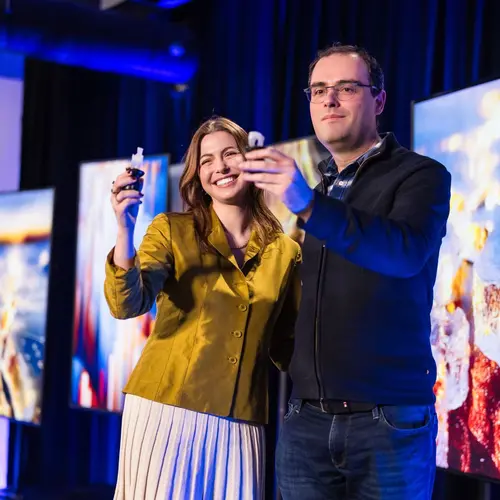
Join us on the Venture Scientist Bootcamp, a full time, 4-month incubator at Mila, built specifically for deep tech founders with elite STEM backgrounds. You have until November 21, 2026 to apply!
Offered by Mila and the Public Policy Forum, this program is designed to equip policy and decision makers with the tools to navigate the opportunities and risks of AI. The next cohort will be held in English on November 5-6, 2026, in Ottawa.
We use cookies to analyze the browsing and usage of our website and to personalize your experience. You can disable these technologies at any time, but this may limit certain functionalities of the site. Read our Privacy Policy for more information.
Setting cookies
You can enable and disable the types of cookies you wish to accept. However certain choices you make could affect the services offered on our sites (e.g. suggestions, personalised ads, etc.).
Essential cookies
These cookies are necessary for the operation of the site and cannot be deactivated. (Still active)
Analytics cookies
Do you accept the use of cookies to measure the audience of our sites?
Multimedia Player
Do you accept the use of cookies to display and allow you to watch the video content hosted by our partners (YouTube, etc.)?
Superforecasters are people that make forecasts that are statistically better than the average person; they offer an interesting testbed for… (see more) persona modelling.
In this preliminary work, we investigate whether large language models (LLMs) can faithfully model superforecaster-like personas making similar forecasts and generating similar rationales behind the forecasts.
When we compare LLM-generated responses to the ground truth responses of superforecasters, we find that few-shot prompting generates numerically closer forecasts than instruction-prompting baselines.
We also measure the similarity of generated and real rationales, finding that the rationales generated based on examples are judged more similar to those of superforecasters than instruction-prompting baselines.
However, an analysis of the reasoning patterns in the rationales shows significant differences between human and LLM forecasters, pointing to a gap between stylistic imitation and deep reasoning similarity.
These preliminary results raise several interesting questions about how getting superforecaster-like behaviour from LLMs actually works, and open new avenues to explore for improving the forecasting behaviour of LLMs.
2026-08-02
Social_Sim @ Conference on Language Modeling (poster)
Lacuna is a research map for machine learning that uses LLMs to turn papers and scholarly metadata into markdown summaries, concept elements… (see more), research directions, and research proposals. Each item keeps links to the primary source records and papers that support it. We release the map with web, markdown, and MCP interfaces. Across LitSearch, Multi-XScience-CS/ML, and ScholarQA-CS-ML, Lacuna outperforms OpenScholar with the strongest gains on LitSearch retrieval (Recall@10 0.538 vs. 0.424 for OpenScholar v3). We also evaluate Lacuna Deep Research, a multi-stage report agent over the map, on 25 ReportBench-ML survey tasks: Lacuna Deep Research reaches 0.052 citation F1, 0.339 citation precision, 99 expert-reference hits, and 7.82/10 RACE report quality, while GPT-Researcher reaches 0.039 F1, 0.290 precision, 72 hits, and 5.24/10 RACE.
Research problem formulation is the cognitive task of turning a vague scientific idea into a testable hypothesis. \textbf{Lacuna} is a resea… (see more)rch map that supports this process for machine learning, using LLMs to turn papers and scholarly metadata into markdown summaries, concept elements, research directions, author and venue pages, and research proposals. Each item keeps links to the primary source records and papers that support it.
We release the map with web, markdown, and MCP interfaces, plus scripts for reproducing the agent run. On a theorem-proving seed idea, the agent reaches a research proposal in 85.5 seconds and 7 tool calls, vs.\ 289.2 seconds and 27 tool calls for a sequential-PDF baseline.
On ScholarQA-CS-ML, an ML/AI subset of the OpenScholar benchmark, Lacuna-GPT-4o scores 0.694 under the ScholarQABench rubric judge, compared with 0.672 for the OpenScholar-GPT-4o baseline on the same questions.
2026-05-31
AI4Research @ International Conference on Machine Learning (poster)
Detecting individual tree crowns in tropical forests is essential to study these complex and crucial ecosystems impacted by human interventi… (see more)ons and climate change. However, tropical crowns vary widely in size, structure, and pattern and are largely overlapping and intertwined, requiring advanced remote sensing methods applied to high-resolution imagery. Despite growing interest in tropical tree crown detection, annotated datasets remain scarce, hindering robust model development. We introduce SelvaBox, the largest open‑access dataset for tropical tree crown detection in high-resolution drone imagery. It spans three countries and contains more than
2025-12-31
International Conference on Learning Representations (Accept (Poster))
The Delphi method is a structured forecasting process that engages experts in iterative prediction and reflection. Each round, experts submi… (see more)t forecasts to a mediator, receive an aggregated and synthesized response highlighting key arguments, and update their forecasts based on collective insight. However, Delphi panels are labour intensive, slow and hard to reproduce, requiring diverse knowledgeable participants to engage periodically across weeks or months. To address these constraints, we propose **DeLLMphi**, a forecasting method that replaces human experts and mediators with LLMs. We show (i) that providing example superforecaster reasoning traces and predictions helps to elicit more accurate forecasts from LLM experts, (ii) that the mediator plays the crucial role of surfacing different lines of reasoning and points of disagreement, and (iii) that multiple rounds and experts lead to better forecasts, showing that multi-turn interaction is key to DeLLMphi.
The COVID-19 pandemic has spurred an unprecedented demand for interventions that can reduce disease spread without excessively restricting d… (see more)aily activity, given negative impacts on mental health and economic outcomes. Digital contact tracing (DCT) apps have emerged as a component of the epidemic management toolkit. Existing DCT apps typically recommend quarantine to all digitally-recorded contacts of test-confirmed cases. Over-reliance on testing may, however, impede the effectiveness of such apps, since by the time cases are confirmed through testing, onward transmissions are likely to have occurred. Furthermore, most cases are infectious over a short period; only a subset of their contacts are likely to become infected. These apps do not fully utilize data sources to base their predictions of transmission risk during an encounter, leading to recommendations of quarantine to many uninfected people and associated slowdowns in economic activity. This phenomenon, commonly termed as “pingdemic,” may additionally contribute to reduced compliance to public health measures. In this work, we propose a novel DCT framework, Proactive Contact Tracing (PCT), which uses multiple sources of information (e.g. self-reported symptoms, received messages from contacts) to estimate app users’ infectiousness histories and provide behavioral recommendations. PCT methods are by design proactive, predicting spread before it occurs. We present an interpretable instance of this framework, the Rule-based PCT algorithm, designed via a multi-disciplinary collaboration among epidemiologists, computer scientists, and behavior experts. Finally, we develop an agent-based model that allows us to compare different DCT methods and evaluate their performance in negotiating the trade-off between epidemic control and restricting population mobility. Performing extensive sensitivity analysis across user behavior, public health policy, and virological parameters, we compare Rule-based PCT to i) binary contact tracing (BCT), which exclusively relies on test results and recommends a fixed-duration quarantine, and ii) household quarantine (HQ). Our results suggest that both BCT and Rule-based PCT improve upon HQ, however, Rule-based PCT is more efficient at controlling spread of disease than BCT across a range of scenarios. In terms of cost-effectiveness, we show that Rule-based PCT pareto-dominates BCT, as demonstrated by a decrease in Disability Adjusted Life Years, as well as Temporary Productivity Loss. Overall, we find that Rule-based PCT outperforms existing approaches across a varying range of parameters. By leveraging anonymized infectiousness estimates received from digitally-recorded contacts, PCT is able to notify potentially infected users earlier than BCT methods and prevent onward transmissions. Our results suggest that PCT-based applications could be a useful tool in managing future epidemics.
Different types of mental rotation tests have been used extensively in psychology to understand human visual reasoning and perception. Under… (see more)standing what an object or visual scene would look like from another viewpoint is a challenging problem that is made even harder if it must be performed from a single image. We explore a controlled setting whereby questions are posed about the properties of a scene if that scene was observed from another viewpoint. To do this we have created a new version of the CLEVR dataset that we call CLEVR Mental Rotation Tests (CLEVR-MRT). Using CLEVR-MRT we examine standard methods, show how they fall short, then explore novel neural architectures that involve inferring volumetric representations of a scene. These volumes can be manipulated via camera-conditioned transformations to answer the question. We examine the efficacy of different model variants through rigorous ablations and demonstrate the efficacy of volumetric representations.
Recent work has seen the development of general purpose neural architectures that can be trained to perform tasks across diverse data modali… (see more)ties. General purpose models typically make few assumptions about the underlying data-structure and are known to perform well in the large-data regime. At the same time, there has been growing interest in modular neural architectures that represent the data using sparsely interacting modules. These models can be more robust out-of-distribution, computationally efficient, and capable of sample-efficient adaptation to new data. However, they tend to make domain-specific assumptions about the data, and present challenges in how module behavior (i.e., parameterization) and connectivity (i.e., their layout) can be jointly learned. In this work, we introduce a general purpose, yet modular neural architecture called Neural Attentive Circuits (NACs) that jointly learns the parameterization and a sparse connectivity of neural modules without using domain knowledge. NACs are best understood as the combination of two systems that are jointly trained end-to-end: one that determines the module configuration and the other that executes it on an input. We demonstrate qualitatively that NACs learn diverse and meaningful module configurations on the NLVR2 dataset without additional supervision. Quantitatively, we show that by incorporating modularity in this way, NACs improve upon a strong non-modular baseline in terms of low-shot adaptation on CIFAR and CUBs dataset by about 10%, and OOD robustness on Tiny ImageNet-R by about 2.5%. Further, we find that NACs can achieve an 8x speedup at inference time while losing less than 3% performance. Finally, we find NACs to yield competitive results on diverse data modalities spanning point-cloud classification, symbolic processing and text-classification from ASCII bytes, thereby confirming its general purpose nature.
2022-11-28
Conference on Neural Information Processing Systems (Accept)