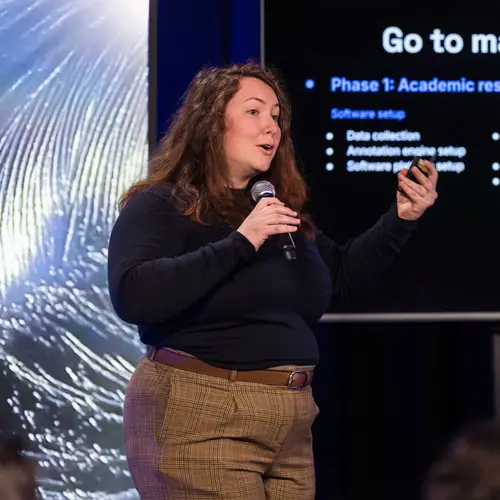
The upcoming meeting at Mila on February 12 will deepen the understanding of the issues surrounding AI safety and foster the exchange of best practices between academic and industry researchers.
Learn how to leverage generative AI to support and improve your productivity at work. The next cohort will take place online on February 24 and 26, 2026.
We use cookies to analyze the browsing and usage of our website and to personalize your experience. You can disable these technologies at any time, but this may limit certain functionalities of the site. Read our Privacy Policy for more information.
Setting cookies
You can enable and disable the types of cookies you wish to accept. However certain choices you make could affect the services offered on our sites (e.g. suggestions, personalised ads, etc.).
Essential cookies
These cookies are necessary for the operation of the site and cannot be deactivated. (Still active)
Analytics cookies
Do you accept the use of cookies to measure the audience of our sites?
Multimedia Player
Do you accept the use of cookies to display and allow you to watch the video content hosted by our partners (YouTube, etc.)?
Machine unlearning, which involves erasing knowledge about a \emph{forget set} from a trained model, can prove to be
costly and infeasible … (see more)using existing techniques. We propose a low-compute unlearning technique based on a discrete representational bottleneck. We show that the proposed technique efficiently unlearns the forget set and incurs negligible damage to the model's performance on the rest of the dataset. We evaluate the proposed technique on the problem of class unlearning using four datasets: CIFAR-10, CIFAR-100, LACUNA-100 and ImageNet-1k. We compare the proposed technique to SCRUB, a state-of-the-art approach which uses knowledge distillation for unlearning. Across all four datasets, the proposed technique performs as well as, if not better than SCRUB while incurring almost no computational cost.
The goal of object-centric representation learning is to decompose visual scenes into a structured representation that isolates the entities… (see more) into individual vectors. Recent successes have shown that object-centric representation learning can be scaled to real-world scenes by utilizing features from pre-trained foundation models like DINO. However, so far, these object-centric methods have mostly been applied in-distribution, with models trained and evaluated on the same dataset. This is in contrast to the underlying foundation models, which have been shown to be applicable to a wide range of data and tasks. Thus, in this work, we answer the question of whether current real-world capable object-centric methods exhibit similar levels of transferability by introducing a benchmark comprising seven different synthetic and real-world datasets. We analyze the factors influencing performance under transfer and find that training on diverse real-world images improves generalization to unseen scenarios. Furthermore, inspired by the success of task-specific fine-tuning in foundation models, we introduce a novel fine-tuning strategy to adapt pre-trained vision encoders for the task of object discovery. We find that the proposed approach results in state-of-the-art performance for unsupervised object discovery, exhibiting strong zero-shot transfer to unseen datasets.
Current LLM training positions mathematical reasoning as a core capability. With publicly available sources fully tapped, there is unmet dem… (see more)and for diverse and challenging math questions. Relying solely on human experts is both time-consuming and costly, while LLM-generated questions often lack the requisite diversity and difficulty. We present a design framework that combines the strengths of LLMs with a human-in-the-loop approach to generate a diverse array of challenging math questions. We leverage LLM metacognition skills [Didolkar et al., 2024] of a strong LLM to extract core"skills"from existing math datasets. These skills serve as the basis for generating novel and difficult questions by prompting the LLM with random pairs of core skills. The use of two different skills within each question makes finding such questions an"out of distribution"task for both LLMs and humans. Our pipeline employs LLMs to iteratively generate and refine questions and solutions through multiturn prompting. Human annotators then verify and further refine the questions, with their efficiency enhanced via further LLM interactions. Applying this pipeline on skills extracted from the MATH dataset [Hendrycks et al., 2021] resulted in MATH
The goal of object-centric representation learning is to decompose visual scenes into a structured representation that isolates the entities… (see more). Recent successes have shown that object-centric representation learning can be scaled to real-world scenes by utilizing pre-trained self-supervised features. However, so far, object-centric methods have mostly been applied in-distribution, with models trained and evaluated on the same dataset. This is in contrast to the wider trend in machine learning towards general-purpose models directly applicable to unseen data and tasks. Thus, in this work, we study current object-centric methods through the lens of zero-shot generalization by introducing a benchmark comprising eight different synthetic and real-world datasets. We analyze the factors influencing zero-shot performance and find that training on diverse real-world images improves transferability to unseen scenarios. Furthermore, inspired by the success of task-specific fine-tuning in foundation models, we introduce a novel fine-tuning strategy to adapt pre-trained vision encoders for the task of object discovery. We find that the proposed approach results in state-of-the-art performance for unsupervised object discovery, exhibiting strong zero-shot transfer to unseen datasets.