Portrait de Yoshua Bengio

Yoshua Bengio

Membre académique principal
Chaire en IA Canada-CIFAR
Professeur titulaire, Université de Montréal, Département d'informatique et de recherche opérationnelle
Fondateur et Conseiller scientifique, Équipe de direction
Sujets de recherche
Apprentissage automatique médical
Apprentissage de représentations
Apprentissage par renforcement
Apprentissage profond
Causalité
Modèles génératifs
Modèles probabilistes
Modélisation moléculaire
Neurosciences computationnelles
Raisonnement
Réseaux de neurones en graphes
Réseaux de neurones récurrents
Théorie de l'apprentissage automatique
Traitement du langage naturel

Biographie

*Pour toute demande média, veuillez écrire à medias@mila.quebec.

Pour plus d’information, contactez Cassidy MacNeil, adjointe principale et responsable des opérations cassidy.macneil@mila.quebec.

Reconnu comme une sommité mondiale en intelligence artificielle, Yoshua Bengio s’est surtout distingué par son rôle de pionnier en apprentissage profond, ce qui lui a valu le prix A. M. Turing 2018, le « prix Nobel de l’informatique », avec Geoffrey Hinton et Yann LeCun. Il est professeur titulaire à l’Université de Montréal, fondateur et conseiller scientifique de Mila – Institut québécois d’intelligence artificielle, et codirige en tant que senior fellow le programme Apprentissage automatique, apprentissage biologique de l'Institut canadien de recherches avancées (CIFAR). Il occupe également la fonction de conseiller spécial et directeur scientifique fondateur d’IVADO.

En 2018, il a été l’informaticien qui a recueilli le plus grand nombre de nouvelles citations au monde. En 2019, il s’est vu décerner le prestigieux prix Killam. Depuis 2022, il détient le plus grand facteur d’impact (h-index) en informatique à l’échelle mondiale. Il est fellow de la Royal Society de Londres et de la Société royale du Canada, et officier de l’Ordre du Canada.

Soucieux des répercussions sociales de l’IA et de l’objectif que l’IA bénéficie à tous, il a contribué activement à la Déclaration de Montréal pour un développement responsable de l’intelligence artificielle.

Étudiants actuels

Collaborateur·rice alumni - McGill
Collaborateur·rice de recherche - Cambridge University
Superviseur⋅e principal⋅e :
Doctorat - UdeM
Visiteur de recherche indépendant
Co-superviseur⋅e :
Collaborateur·rice de recherche - N/A
Superviseur⋅e principal⋅e :
Doctorat - UdeM
Collaborateur·rice de recherche - KAIST
Collaborateur·rice alumni - UdeM
Co-superviseur⋅e :
Visiteur de recherche indépendant
Superviseur⋅e principal⋅e :
Doctorat - UdeM
Co-superviseur⋅e :
Doctorat - UdeM
Doctorat - UdeM
Superviseur⋅e principal⋅e :
Collaborateur·rice alumni - UdeM
Postdoctorat - UdeM
Superviseur⋅e principal⋅e :
Postdoctorat - UdeM
Superviseur⋅e principal⋅e :
Collaborateur·rice alumni
Collaborateur·rice alumni - UdeM
Doctorat - UdeM
Co-superviseur⋅e :
Doctorat - UdeM
Superviseur⋅e principal⋅e :
Doctorat - UdeM
Superviseur⋅e principal⋅e :
Visiteur de recherche indépendant - UdeM
Doctorat - UdeM
Superviseur⋅e principal⋅e :
Collaborateur·rice de recherche - Ying Wu Coll of Computing
Collaborateur·rice de recherche - University of Waterloo
Superviseur⋅e principal⋅e :
Collaborateur·rice alumni - Max-Planck-Institute for Intelligent Systems
Collaborateur·rice de recherche - UdeM
Co-superviseur⋅e :
Doctorat - UdeM
Postdoctorat - UdeM
Visiteur de recherche indépendant - UdeM
Postdoctorat - UdeM
Doctorat - UdeM
Superviseur⋅e principal⋅e :
Collaborateur·rice alumni - UdeM
Postdoctorat
Co-superviseur⋅e :
Collaborateur·rice alumni - Polytechnique
Co-superviseur⋅e :
Doctorat - UdeM
Co-superviseur⋅e :
Collaborateur·rice de recherche
Superviseur⋅e principal⋅e :
Collaborateur·rice alumni - UdeM
Co-superviseur⋅e :
Doctorat - UdeM
Superviseur⋅e principal⋅e :
Collaborateur·rice de recherche
Collaborateur·rice de recherche - UdeM
Doctorat - McGill
Superviseur⋅e principal⋅e :
Doctorat - UdeM
Superviseur⋅e principal⋅e :
Collaborateur·rice alumni - McGill
Superviseur⋅e principal⋅e :

Publications

Object centric architectures enable efficient causal representation learning
Jason Hartford
Yang Zhang
Causal representation learning has showed a variety of settings in which we can disentangle latent variables with identifiability guarantees… (voir plus) (up to some reasonable equivalence class). Common to all of these approaches is the assumption that (1) the latent variables are represented as
PhyloGFN: Phylogenetic inference with generative flow networks
Pre-Training and Fine-Tuning Generative Flow Networks
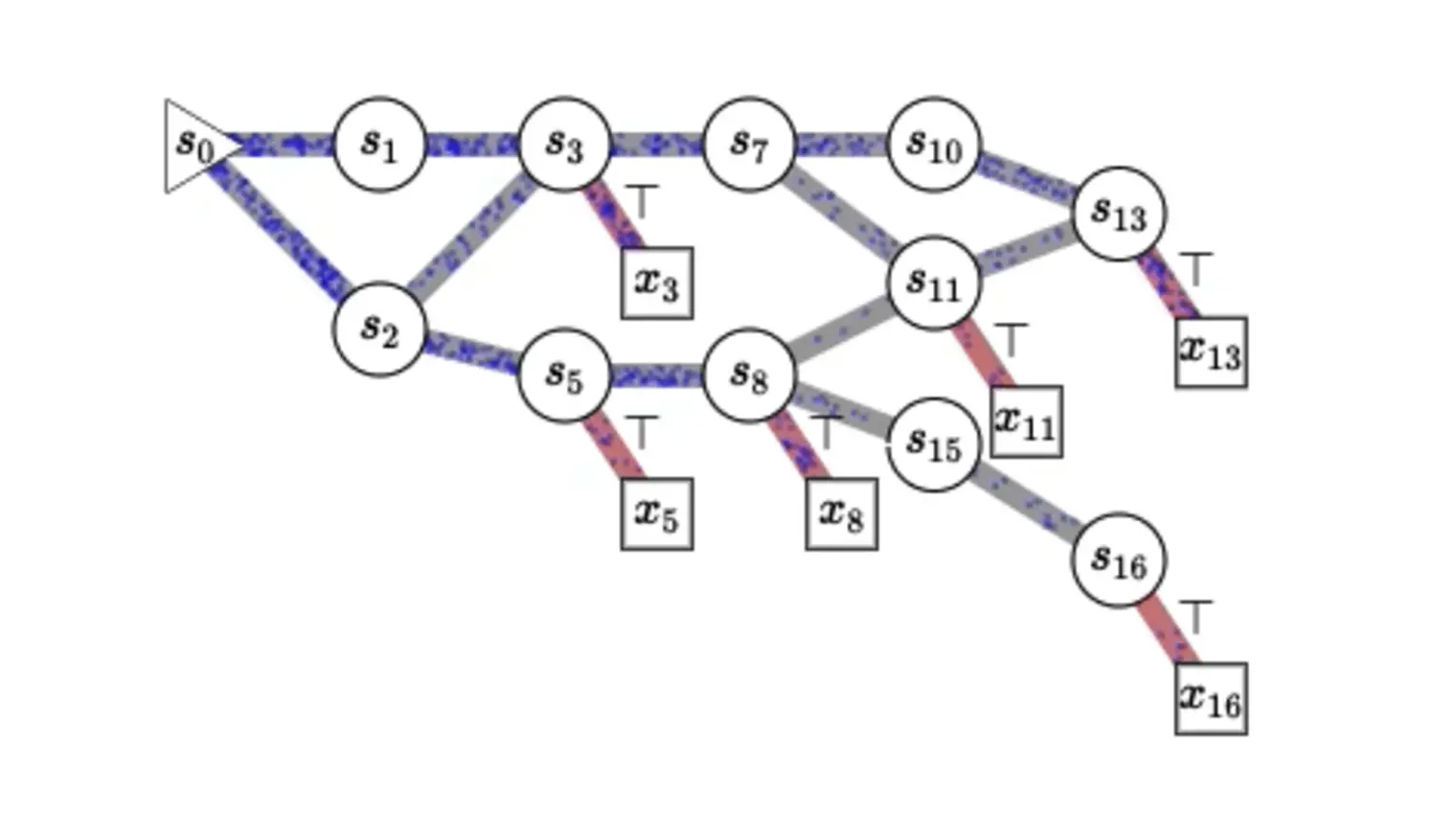
Generative Flow Networks (GFlowNets) are amortized samplers that learn stochastic policies to sequentially generate compositional objects fr… (voir plus)om a given unnormalized reward distribution. They can generate diverse sets of high-reward objects, which is an important consideration in scientific discovery tasks. However, as they are typically trained from a given extrinsic reward function, it remains an important open challenge about how to leverage the power of pre-training and train GFlowNets in an unsupervised fashion for efficient adaptation to downstream tasks. Inspired by recent successes of unsupervised pre-training in various domains, we introduce a novel approach for reward-free pre-training of GFlowNets. By framing the training as a self-supervised problem, we propose an outcome-conditioned GFlowNet (OC-GFN) that learns to explore the candidate space. Specifically, OC-GFN learns to reach any targeted outcomes, akin to goal-conditioned policies in reinforcement learning. We show that the pre-trained OC-GFN model can allow for a direct extraction of a policy capable of sampling from any new reward functions in downstream tasks. Nonetheless, adapting OC-GFN on a downstream task-specific reward involves an intractable marginalization over possible outcomes. We propose a novel way to approximate this marginalization by learning an amortized predictor enabling efficient fine-tuning. Extensive experimental results validate the efficacy of our approach, demonstrating the effectiveness of pre-training the OC-GFN, and its ability to swiftly adapt to downstream tasks and discover modes more efficiently. This work may serve as a foundation for further exploration of pre-training strategies in the context of GFlowNets.
Tree Cross Attention
Frederick Tung
Hossein Hajimirsadeghi
Mohamed Osama Ahmed
Cross Attention is a popular method for retrieving information from a set of context tokens for making predictions. At inference time, for e… (voir plus)ach prediction, Cross Attention scans the full set of
On diffusion models for amortized inference: Benchmarking and improving stochastic control and sampling
We study the problem of training diffusion models to sample from a distribution with a given unnormalized density or energy function. We ben… (voir plus)chmark several diffusion-structured inference methods, including simulation-based variational approaches and off-policy methods (continuous generative flow networks). Our results shed light on the relative advantages of existing algorithms while bringing into question some claims from past work. We also propose a novel exploration strategy for off-policy methods, based on local search in the target space with the use of a replay buffer, and show that it improves the quality of samples on a variety of target distributions. Our code for the sampling methods and benchmarks studied is made public at https://github.com/GFNOrg/gfn-diffusion as a base for future work on diffusion models for amortized inference.
Foundational Challenges in Assuring Alignment and Safety of Large Language Models
Usman Anwar
Abulhair Saparov
Javier Rando
Daniel Paleka
Miles Turpin
Peter Hase
Ekdeep Singh Lubana
Erik Jenner
Stephen Casper
Oliver Sourbut
Benjamin L. Edelman
Zhaowei Zhang
Mario Günther
Anton Korinek
Jose Hernandez-Orallo
Lewis Hammond
Eric J Bigelow
Alexander Pan
Lauro Langosco
Tomasz Korbak … (voir 22 de plus)
Heidi Chenyu Zhang
Ruiqi Zhong
Sean O hEigeartaigh
Gabriel Recchia
Giulio Corsi
Markus Anderljung
Lilian Edwards
Aleksandar Petrov
Christian Schroeder de Witt
Sumeet Ramesh Motwani
Danqi Chen
Philip Torr
Samuel Albanie
Jakob Nicolaus Foerster
Florian Tramèr
He He
Atoosa Kasirzadeh
Yejin Choi
Foundational Challenges in Assuring Alignment and Safety of Large Language Models
Usman Anwar
Abulhair Saparov
Javier Rando
Daniel Paleka
Miles Turpin
Peter Hase
Ekdeep Singh Lubana
Erik Jenner
Stephen Casper
Oliver Sourbut
Benjamin L. Edelman
Zhaowei Zhang
Mario Günther
Anton Korinek
Jose Hernandez-Orallo
Lewis Hammond
Eric J Bigelow
Alexander Pan
Lauro Langosco
Tomasz Korbak … (voir 22 de plus)
Heidi Chenyu Zhang
Ruiqi Zhong
Sean O hEigeartaigh
Gabriel Recchia
Giulio Corsi
Markus Anderljung
Lilian Edwards
Aleksandar Petrov
Christian Schroeder de Witt
Sumeet Ramesh Motwani
Danqi Chen
Philip Torr
Samuel Albanie
Jakob Nicolaus Foerster
Florian Tramèr
He He
Atoosa Kasirzadeh
Yejin Choi
Local Search GFlowNets.
PhAST: Physics-Aware, Scalable, and Task-specific GNNs for Accelerated Catalyst Design
Simulation-Free Schrödinger Bridges via Score and Flow Matching
We present simulation-free score and flow matching ([SF]…
A Hitchhiker's Guide to Geometric GNNs for 3D Atomic Systems
Alexandre AGM Duval
Simon V. Mathis
Chaitanya K. Joshi
Santiago Miret
Fragkiskos D. Malliaros
Taco Cohen
Pietro Lio’
Michael M. Bronstein