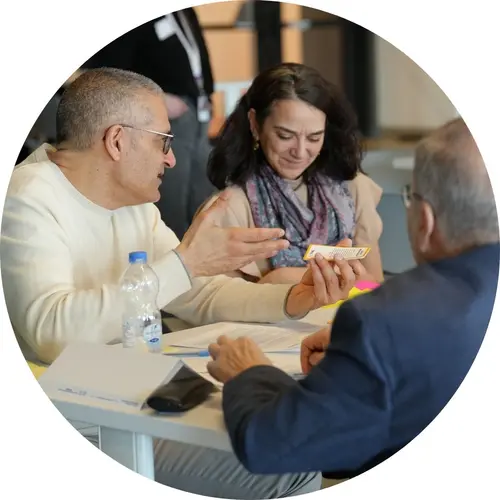



Portrait de Yoshua Bengio

Yoshua Bengio

Membre académique principal
Chaire en IA Canada-CIFAR
Professeur titulaire, Université de Montréal, Département d'informatique et de recherche opérationnelle
Fondateur et Conseiller scientifique, Équipe de direction
Sujets de recherche
Apprentissage automatique médical
Apprentissage de représentations
Apprentissage par renforcement
Apprentissage profond
Causalité
Modèles génératifs
Modèles probabilistes
Modélisation moléculaire
Neurosciences computationnelles
Raisonnement
Réseaux de neurones en graphes
Réseaux de neurones récurrents
Théorie de l'apprentissage automatique
Traitement du langage naturel

Biographie

*Pour toute demande média, veuillez écrire à medias@mila.quebec.

Pour plus d’information, contactez Cassidy MacNeil, adjointe principale et responsable des opérations cassidy.macneil@mila.quebec.

Reconnu comme une sommité mondiale en intelligence artificielle, Yoshua Bengio s’est surtout distingué par son rôle de pionnier en apprentissage profond, ce qui lui a valu le prix A. M. Turing 2018, le « prix Nobel de l’informatique », avec Geoffrey Hinton et Yann LeCun. Il est professeur titulaire à l’Université de Montréal, fondateur et conseiller scientifique de Mila – Institut québécois d’intelligence artificielle, et codirige en tant que senior fellow le programme Apprentissage automatique, apprentissage biologique de l'Institut canadien de recherches avancées (CIFAR). Il occupe également la fonction de conseiller spécial et directeur scientifique fondateur d’IVADO.

En 2018, il a été l’informaticien qui a recueilli le plus grand nombre de nouvelles citations au monde. En 2019, il s’est vu décerner le prestigieux prix Killam. Depuis 2022, il détient le plus grand facteur d’impact (h-index) en informatique à l’échelle mondiale. Il est fellow de la Royal Society de Londres et de la Société royale du Canada, et officier de l’Ordre du Canada.

Soucieux des répercussions sociales de l’IA et de l’objectif que l’IA bénéficie à tous, il a contribué activement à la Déclaration de Montréal pour un développement responsable de l’intelligence artificielle.

Étudiants actuels

Collaborateur·rice alumni - McGill
Collaborateur·rice de recherche - Cambridge University
Superviseur⋅e principal⋅e :
Doctorat - UdeM
Visiteur de recherche indépendant
Co-superviseur⋅e :
Collaborateur·rice de recherche - N/A
Superviseur⋅e principal⋅e :
Doctorat - UdeM
Collaborateur·rice de recherche - KAIST
Collaborateur·rice alumni - UdeM
Co-superviseur⋅e :
Visiteur de recherche indépendant
Superviseur⋅e principal⋅e :
Doctorat - UdeM
Co-superviseur⋅e :
Doctorat - UdeM
Doctorat - UdeM
Superviseur⋅e principal⋅e :
Collaborateur·rice alumni - UdeM
Postdoctorat - UdeM
Superviseur⋅e principal⋅e :
Postdoctorat - UdeM
Superviseur⋅e principal⋅e :
Collaborateur·rice alumni
Collaborateur·rice alumni - UdeM
Doctorat - UdeM
Co-superviseur⋅e :
Doctorat - UdeM
Superviseur⋅e principal⋅e :
Visiteur de recherche indépendant - UdeM
Doctorat - UdeM
Superviseur⋅e principal⋅e :
Collaborateur·rice de recherche - Ying Wu Coll of Computing
Collaborateur·rice de recherche - University of Waterloo
Superviseur⋅e principal⋅e :
Collaborateur·rice alumni - Max-Planck-Institute for Intelligent Systems
Collaborateur·rice de recherche - UdeM
Co-superviseur⋅e :
Doctorat - UdeM
Postdoctorat - UdeM
Postdoctorat - UdeM
Doctorat - UdeM
Superviseur⋅e principal⋅e :
Collaborateur·rice alumni - UdeM
Postdoctorat
Co-superviseur⋅e :
Collaborateur·rice alumni - Polytechnique
Co-superviseur⋅e :
Doctorat - UdeM
Co-superviseur⋅e :
Collaborateur·rice de recherche
Superviseur⋅e principal⋅e :
Collaborateur·rice alumni - UdeM
Co-superviseur⋅e :
Doctorat - UdeM
Superviseur⋅e principal⋅e :
Collaborateur·rice de recherche
Collaborateur·rice de recherche - UdeM
Doctorat - McGill
Superviseur⋅e principal⋅e :
Doctorat - UdeM
Superviseur⋅e principal⋅e :
Collaborateur·rice alumni - McGill
Superviseur⋅e principal⋅e :

Publications

Introduction to NIPS 2017 Competition Track
Sergio Escalera
Markus Weimer
Mikhail Burtsev
Valentin Malykh
Varvara Logacheva
Iulian V. Serban
Alexander Rudnicky
Alan W. Black
Shrimai Prabhumoye
Łukasz Kidziński
Sharada Prasanna Mohanty
Carmichael F. Ong
Jennifer L. Hicks
Sergey Levine
Marcel Salathé
Scott Delp
Iker Huerga
Alexander Grigorenko … (voir 19 de plus)
Leifur Thorbergsson
Anasuya Das
Kyla Nemitz
Jenna Sandker
Stephen King
Alexander S. Ecker
Leon A. Gatys
Matthias Bethge
Jordan Boyd-Graber
Shi Feng
Pedro Rodriguez
Mohit Iyyer
He He
Hal Daumé III
Sean McGregor
Amir Banifatemi
Alexey Kurakin
Ian G Goodfellow
The First Conversational Intelligence Challenge
Mikhail Burtsev
Varvara Logacheva
Valentin Malykh
Iulian V. Serban
Shrimai Prabhumoye
Alan W. Black
Alexander Rudnicky
Convergence Properties of Deep Neural Networks on Separable Data
Remi Tachet des Combes
Samira Shabanian
While a lot of progress has been made in recent years, the dynamics of learning in deep nonlinear neural networks remain to this day largely… (voir plus) misunderstood. In this work, we study the case of binary classification and prove various properties of learning in such networks under strong assumptions such as linear separability of the data. Extending existing results from the linear case, we confirm empirical observations by proving that the classification error also follows a sigmoidal shape in nonlinear architectures. We show that given proper initialization, learning expounds parallel independent modes and that certain regions of parameter space might lead to failed training. We also demonstrate that input norm and features’ frequency in the dataset lead to distinct convergence speeds which might shed some light on the generalization capabilities of deep neural networks. We provide a comparison between the dynamics of learning with cross-entropy and hinge losses, which could prove useful to understand recent progress in the training of generative adversarial networks. Finally, we identify a phenomenon that we baptize gradient starvation where the most frequent features in a dataset prevent the learning of other less frequent but equally informative features.
Deep Graph Infomax
William Fedus
William L. Hamilton
Pietro Lio
R Devon Hjelm
We present Deep Graph Infomax (DGI), a general approach for learning node representations within graph-structured data in an unsupervised ma… (voir plus)nner. DGI relies on maximizing mutual information between patch representations and corresponding high-level summaries of graphs---both derived using established graph convolutional network architectures. The learnt patch representations summarize subgraphs centered around nodes of interest, and can thus be reused for downstream node-wise learning tasks. In contrast to most prior approaches to unsupervised learning with GCNs, DGI does not rely on random walk objectives, and is readily applicable to both transductive and inductive learning setups. We demonstrate competitive performance on a variety of node classification benchmarks, which at times even exceeds the performance of supervised learning.
DEFactor: Differentiable Edge Factorization-based Probabilistic Graph Generation
Mohamed Ahmed
Marwin Segler
Amir Saffari
Generating novel molecules with optimal properties is a crucial step in many industries such as drug discovery. Recently, deep generative mo… (voir plus)dels have shown a promising way of performing de-novo molecular design. Although graph generative models are currently available they either have a graph size dependency in their number of parameters, limiting their use to only very small graphs or are formulated as a sequence of discrete actions needed to construct a graph, making the output graph non-differentiable w.r.t the model parameters, therefore preventing them to be used in scenarios such as conditional graph generation. In this work we propose a model for conditional graph generation that is computationally efficient and enables direct optimisation of the graph. We demonstrate favourable performance of our model on prototype-based molecular graph conditional generation tasks.
EnGAN: Latent Space MCMC and Maximum Entropy Generators for Energy-based Models
Learning powerful policies and better dynamics models by encouraging consistency
Learning of Sophisticated Curriculums by viewing them as Graphs over Tasks
Modeling the Long Term Future in Model-Based Reinforcement Learning
Nan Rosemary Ke
Amanpreet Singh
Devi Parikh
Dhruv Batra
Probabilistic Planning with Sequential Monte Carlo Methods
Valentin Thomas
Cyril Ibrahim
Reinforced Imitation Learning from Observations
Towards the Latent Transcriptome
In this work we propose a method to compute continuous embeddings for kmers from raw RNA-seq data, in a reference-free fashion. We report th… (voir plus)at our model captures information of both DNA sequence similarity as well as DNA sequence abundance in the embedding latent space. We confirm the quality of these vectors by comparing them to known gene sub-structures and report that the latent space recovers exon information from raw RNA-Seq data from acute myeloid leukemia patients. Furthermore we show that this latent space allows the detection of genomic abnormalities such as translocations as well as patient-specific mutations, making this representation space both useful for visualization as well as analysis.