

Portrait de Yoshua Bengio

Yoshua Bengio

Membre académique principal
Chaire en IA Canada-CIFAR
Professeur titulaire, Université de Montréal
Sujets de recherche
Apprentissage automatique médical
Apprentissage de représentations
Apprentissage par renforcement
Apprentissage profond
Causalité
Modèles génératifs
Modèles probabilistes
Modélisation moléculaire
Neurosciences computationnelles
Raisonnement
Réseaux de neurones en graphes
Réseaux de neurones récurrents
Théorie de l'apprentissage automatique
Traitement du langage naturel

Biographie

*Pour toute demande média, veuillez écrire à medias@mila.quebec.

Pour plus d’information, contactez Cassidy MacNeil, adjointe principale et responsable des opérations cassidy.macneil@mila.quebec.

Reconnu comme une sommité mondiale en intelligence artificielle, Yoshua Bengio s’est surtout distingué par son rôle de pionnier en apprentissage profond, ce qui lui a valu le prix A. M. Turing 2018, le « prix Nobel de l’informatique », avec Geoffrey Hinton et Yann LeCun. Il est professeur titulaire à l’Université de Montréal, fondateur et conseiller scientifique de Mila – Institut québécois d’intelligence artificielle, et codirige en tant que senior fellow le programme Apprentissage automatique, apprentissage biologique de l'Institut canadien de recherches avancées (CIFAR). Il occupe également la fonction de conseiller spécial et directeur scientifique fondateur d’IVADO.

En 2018, il a été l’informaticien qui a recueilli le plus grand nombre de nouvelles citations au monde. En 2019, il s’est vu décerner le prestigieux prix Killam. Depuis 2022, il détient le plus grand facteur d’impact (h-index) en informatique à l’échelle mondiale. Il est fellow de la Royal Society de Londres et de la Société royale du Canada, et officier de l’Ordre du Canada.

Soucieux des répercussions sociales de l’IA et de l’objectif que l’IA bénéficie à tous, il a contribué activement à la Déclaration de Montréal pour un développement responsable de l’intelligence artificielle.

Étudiants actuels

Collaborateur·rice de recherche - Cambridge University
Superviseur⋅e principal⋅e :
Collaborateur·rice de recherche - KAIST
Collaborateur·rice alumni - UdeM
Postdoctorat - UdeM
Superviseur⋅e principal⋅e :
Collaborateur·rice de recherche - UdeM
Collaborateur·rice de recherche - KOREA ADVANCED INSTITUTE OF SCIENCE AND TECHNOLOGY
Collaborateur·rice de recherche - s.o.
Doctorat - UdeM
Superviseur⋅e principal⋅e :
Visiteur de recherche indépendant - UdeM
Collaborateur·rice de recherche - Ying Wu Coll of Computing
Collaborateur·rice de recherche - University of Waterloo
Superviseur⋅e principal⋅e :
Doctorat - UdeM
Superviseur⋅e principal⋅e :
Collaborateur·rice alumni - UdeM
Co-superviseur⋅e :
Collaborateur·rice de recherche - University of Cambridge
Collaborateur·rice alumni - UdeM
Co-superviseur⋅e :
Collaborateur·rice de recherche - UdeM
Doctorat - McGill
Superviseur⋅e principal⋅e :
Collaborateur·rice alumni - McGill
Superviseur⋅e principal⋅e :

Publications

Trajectory balance: Improved credit assignment in GFlowNets
Esmeralda S. Whitammer
Chen Sun
Generative flow networks (GFlowNets) are a method for learning a stochastic policy for generating compositional objects, such as graphs or s… (voir plus)trings, from a given unnormalized density by sequences of actions, where many possible action sequences may lead to the same object. We find previously proposed learning objectives for GFlowNets, flow matching and detailed balance, which are analogous to temporal difference learning, to be prone to inefficient credit propagation across long action sequences. We thus propose a new learning objective for GFlowNets, trajectory balance, as a more efficient alternative to previously used objectives. We prove that any global minimizer of the trajectory balance objective can define a policy that samples exactly from the target distribution. In experiments on four distinct domains, we empirically demonstrate the benefits of the trajectory balance objective for GFlowNet convergence, diversity of generated samples, and robustness to long action sequences and large action spaces.
Weakly Supervised Representation Learning with Sparse Perturbations
Jason Hartford
The theory of representation learning aims to build methods that provably invert the data generating process with minimal domain knowledge o… (voir plus)r any source of supervision. Most prior approaches require strong distributional assumptions on the latent variables and weak supervision (auxiliary information such as timestamps) to provide provable identification guarantees. In this work, we show that if one has weak supervision from observations generated by sparse perturbations of the latent variables--e.g. images in a reinforcement learning environment where actions move individual sprites--identification is achievable under unknown continuous latent distributions. We show that if the perturbations are applied only on mutually exclusive blocks of latents, we identify the latents up to those blocks. We also show that if these perturbation blocks overlap, we identify latents up to the smallest blocks shared across perturbations. Consequently, if there are blocks that intersect in one latent variable only, then such latents are identified up to permutation and scaling. We propose a natural estimation procedure based on this theory and illustrate it on low-dimensional synthetic and image-based experiments.
Graph-Based Active Machine Learning Method for Diverse and Novel Antimicrobial Peptides Generation and Selection
Bonaventure F. P. Dossou
Dianbo Liu
Almer M. van der Sloot
Roger Palou
Michael Tyers
As antibiotic-resistant bacterial strains are rapidly spreading worldwide, infections caused by these strains are emerging as a global crisi… (voir plus)s causing the death of millions of people every year. Antimicrobial Peptides (AMPs) are one of the candidates to tackle this problem because of their potential diversity, and ability to favorably modulate the host immune response. However, large-scale screening of new AMP candidates is expensive, time-consuming, and now affordable in developing countries, which need the treatments the most. In this work, we propose a novel active machine learning-based framework that statistically minimizes the number of wet-lab experiments needed to design new AMPs, while ensuring a high diversity and novelty of generated AMPs sequences, in multi-rounds of wet-lab AMP screening settings. Combining recurrent neural network models and a graph-based filter (GraphCC), our proposed approach delivers novel and diverse candidates and demonstrates better performances according to our defined metrics.
Object-centric causal representation learning
Posterior samples of source galaxies in strong gravitational lenses with score-based priors
Inferring accurate posteriors for high-dimensional representations of the brightness of gravitationally-lensed sources is a major challenge,… (voir plus) in part due to the difficulties of accurately quantifying the priors. Here, we report the use of a score-based model to encode the prior for the inference of undistorted images of background galaxies. This model is trained on a set of high-resolution images of undistorted galaxies. By adding the likelihood score to the prior score and using a reverse-time stochastic differential equation solver, we obtain samples from the posterior. Our method produces independent posterior samples and models the data almost down to the noise level. We show how the balance between the likelihood and the prior meet our expectations in an experiment with out-of-distribution data.
Bayesian learning of Causal Structure and Mechanisms with GFlowNets and Variational Bayes
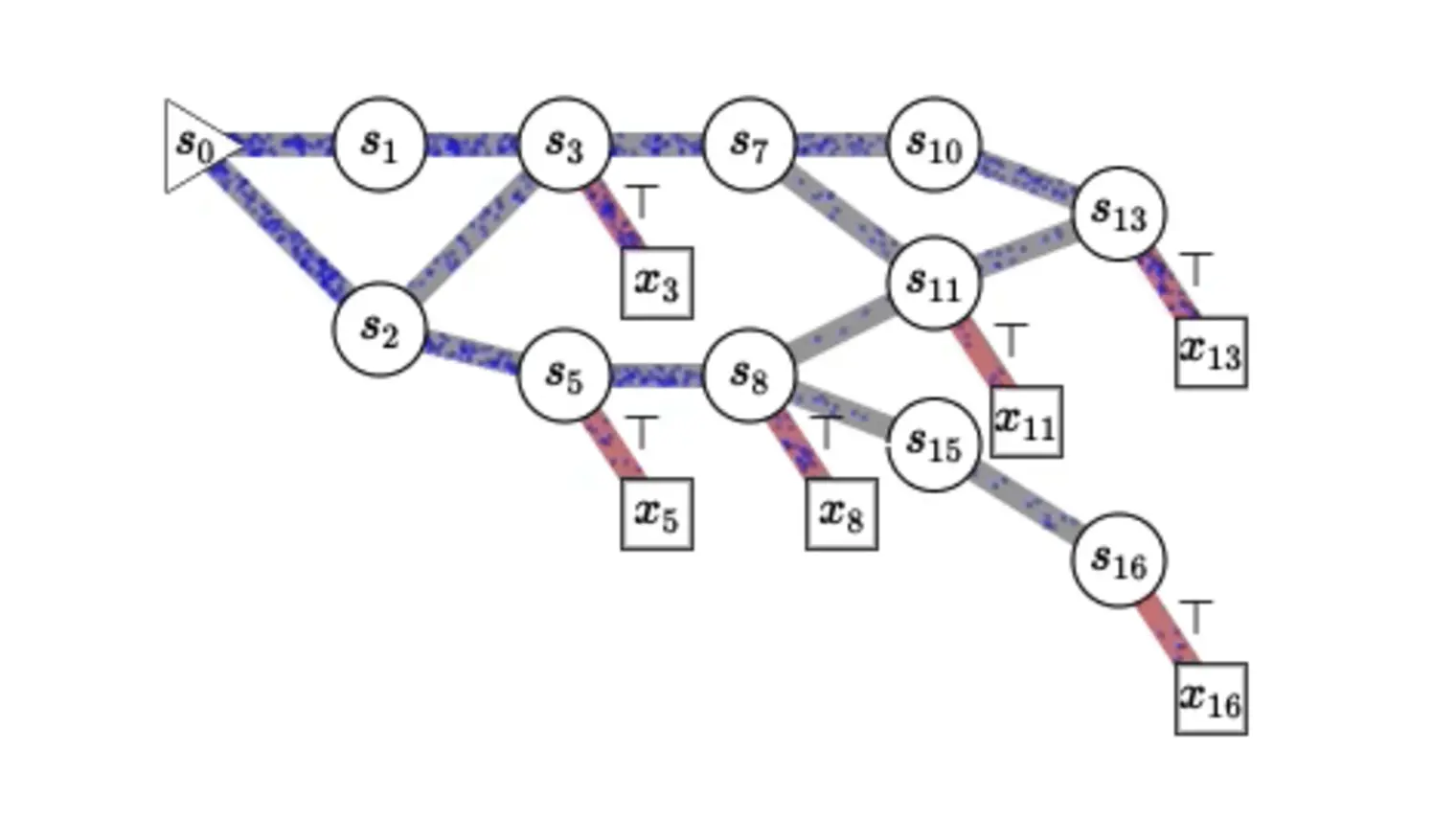
Bayesian causal structure learning aims to learn a posterior distribution over directed acyclic graphs (DAGs), and the mechanisms that defin… (voir plus)e the relationship between parent and child variables. By taking a Bayesian approach, it is possible to reason about the uncertainty of the causal model. The notion of modelling the uncertainty over models is particularly crucial for causal structure learning since the model could be unidentifiable when given only a finite amount of observational data. In this paper, we introduce a novel method to jointly learn the structure and mechanisms of the causal model using Variational Bayes, which we call Variational Bayes-DAG-GFlowNet (VBG). We extend the method of Bayesian causal structure learning using GFlowNets to learn not only the posterior distribution over the structure, but also the parameters of a linear-Gaussian model. Our results on simulated data suggest that VBG is competitive against several baselines in modelling the posterior over DAGs and mechanisms, while offering several advantages over existing methods, including the guarantee to sample acyclic graphs, and the flexibility to generalize to non-linear causal mechanisms.
A General-Purpose Neural Architecture for Geospatial Systems
Nasim Rahaman
Francesco Locatello
Alexandre Lacoste
Li Erran Li
Bernhard Schölkopf
Consistent Training via Energy-Based GFlowNets for Modeling Discrete Joint Distributions
Moksh J. Jain
Payel Das
Generative Flow Networks (GFlowNets) have demonstrated significant performance improvements for generating diverse discrete objects …
Discrete Factorial Representations as an Abstraction for Goal Conditioned Reinforcement Learning
Hongyu Zang
Xin Li
Romain Laroche
Remi Tachet des Combes
Efficient Queries Transformer Neural Processes
Hossein Hajimirsadeghi
Mohamed Osama Ahmed
FL Games: A federated learning framework for distribution shifts
Federated learning aims to train predictive models for data that is distributed across clients, under the orchestration of a server. However… (voir plus), participating clients typically each hold data from a different distribution, whereby predictive models with strong in-distribution generalization can fail catastrophically on unseen domains. In this work, we argue that in order to generalize better across non-i.i.d. clients, it is imperative to only learn correlations that are stable and invariant across domains. We propose FL Games, a game-theoretic framework for federated learning for learning causal features that are invariant across clients. While training to achieve the Nash equilibrium, the traditional best response strategy suffers from high-frequency oscillations. We demonstrate that FL Games effectively resolves this challenge and exhibits smooth performance curves. Further, FL Games scales well in the number of clients, requires significantly fewer communication rounds, and is agnostic to device heterogeneity. Through empirical evaluation, we demonstrate that FL Games achieves high out-of-distribution performance on various benchmarks.
Inductive biases for deep learning of higher-level cognition