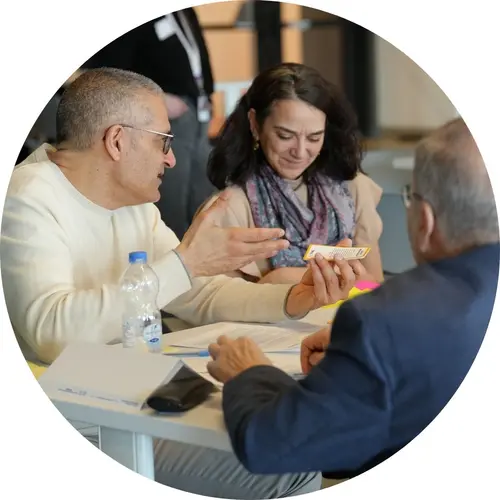



Portrait de Yoshua Bengio

Yoshua Bengio

Membre académique principal
Chaire en IA Canada-CIFAR
Professeur titulaire, Université de Montréal, Département d'informatique et de recherche opérationnelle
Fondateur et Conseiller scientifique, Équipe de direction
Sujets de recherche
Apprentissage automatique médical
Apprentissage de représentations
Apprentissage par renforcement
Apprentissage profond
Causalité
Modèles génératifs
Modèles probabilistes
Modélisation moléculaire
Neurosciences computationnelles
Raisonnement
Réseaux de neurones en graphes
Réseaux de neurones récurrents
Théorie de l'apprentissage automatique
Traitement du langage naturel

Biographie

*Pour toute demande média, veuillez écrire à medias@mila.quebec.

Pour plus d’information, contactez Cassidy MacNeil, adjointe principale et responsable des opérations cassidy.macneil@mila.quebec.

Reconnu comme une sommité mondiale en intelligence artificielle, Yoshua Bengio s’est surtout distingué par son rôle de pionnier en apprentissage profond, ce qui lui a valu le prix A. M. Turing 2018, le « prix Nobel de l’informatique », avec Geoffrey Hinton et Yann LeCun. Il est professeur titulaire à l’Université de Montréal, fondateur et conseiller scientifique de Mila – Institut québécois d’intelligence artificielle, et codirige en tant que senior fellow le programme Apprentissage automatique, apprentissage biologique de l'Institut canadien de recherches avancées (CIFAR). Il occupe également la fonction de conseiller spécial et directeur scientifique fondateur d’IVADO.

En 2018, il a été l’informaticien qui a recueilli le plus grand nombre de nouvelles citations au monde. En 2019, il s’est vu décerner le prestigieux prix Killam. Depuis 2022, il détient le plus grand facteur d’impact (h-index) en informatique à l’échelle mondiale. Il est fellow de la Royal Society de Londres et de la Société royale du Canada, et officier de l’Ordre du Canada.

Soucieux des répercussions sociales de l’IA et de l’objectif que l’IA bénéficie à tous, il a contribué activement à la Déclaration de Montréal pour un développement responsable de l’intelligence artificielle.

Étudiants actuels

Collaborateur·rice alumni - McGill
Collaborateur·rice de recherche - Cambridge University
Superviseur⋅e principal⋅e :
Doctorat - UdeM
Visiteur de recherche indépendant
Co-superviseur⋅e :
Collaborateur·rice de recherche - N/A
Superviseur⋅e principal⋅e :
Doctorat - UdeM
Collaborateur·rice de recherche - KAIST
Collaborateur·rice alumni - UdeM
Co-superviseur⋅e :
Visiteur de recherche indépendant
Superviseur⋅e principal⋅e :
Doctorat - UdeM
Co-superviseur⋅e :
Doctorat - UdeM
Doctorat - UdeM
Superviseur⋅e principal⋅e :
Collaborateur·rice alumni - UdeM
Postdoctorat - UdeM
Superviseur⋅e principal⋅e :
Postdoctorat - UdeM
Superviseur⋅e principal⋅e :
Collaborateur·rice alumni
Collaborateur·rice alumni - UdeM
Doctorat - UdeM
Co-superviseur⋅e :
Doctorat - UdeM
Superviseur⋅e principal⋅e :
Visiteur de recherche indépendant - UdeM
Doctorat - UdeM
Superviseur⋅e principal⋅e :
Collaborateur·rice de recherche - Ying Wu Coll of Computing
Collaborateur·rice de recherche - University of Waterloo
Superviseur⋅e principal⋅e :
Collaborateur·rice alumni - Max-Planck-Institute for Intelligent Systems
Collaborateur·rice de recherche - UdeM
Co-superviseur⋅e :
Doctorat - UdeM
Postdoctorat - UdeM
Postdoctorat - UdeM
Doctorat - UdeM
Superviseur⋅e principal⋅e :
Collaborateur·rice alumni - UdeM
Postdoctorat
Co-superviseur⋅e :
Collaborateur·rice alumni - Polytechnique
Co-superviseur⋅e :
Doctorat - UdeM
Co-superviseur⋅e :
Collaborateur·rice de recherche
Superviseur⋅e principal⋅e :
Collaborateur·rice alumni - UdeM
Co-superviseur⋅e :
Doctorat - UdeM
Superviseur⋅e principal⋅e :
Collaborateur·rice de recherche
Collaborateur·rice de recherche - UdeM
Doctorat - McGill
Superviseur⋅e principal⋅e :
Doctorat - UdeM
Superviseur⋅e principal⋅e :
Collaborateur·rice alumni - McGill
Superviseur⋅e principal⋅e :

Publications

Université de Montréal Balancing Signals for Semi-Supervised Sequence Learning
Ya Xu
Christopher Pal
Training recurrent neural networks (RNNs) on long sequences using backpropagation through time (BPTT) remains a fundamental challenge. It ha… (voir plus)s been shown that adding a local unsupervised loss term into the optimization objective makes the training of RNNs on long sequences more effective. While the importance of an unsupervised task can in principle be controlled by a coefficient in the objective function, the gradients with respect to the unsupervised loss term still influence all the hidden state dimensions, which might cause important information about the supervised task to be degraded or erased. Compared to existing semi-supervised sequence learning methods, this thesis focuses upon a traditionally overlooked mechanism – an architecture with explicitly designed private and shared hidden units designed to mitigate the detrimental influence of the auxiliary unsupervised loss over the main supervised task. We achieve this by dividing the RNN hidden space into a private space for the supervised task or a shared space for both the supervised and unsupervised tasks. We present extensive experiments with the proposed framework on several long sequence modeling benchmark datasets. Results indicate that the proposed framework can yield performance gains in RNN models where long term dependencies are notoriously challenging to deal with.
S UPPLEMENTARY M ATERIAL - L EARNING T O N AVIGATE T HE S YNTHETICALLY A CCESSIBLE C HEMICAL S PACE U SING R EINFORCEMENT L EARNING
Sai Krishna
Gottipati
B. Sattarov
Sufeng Niu
Yashaswi Pathak
Haoran Wei
Karam M. J. Thomas
Simon R. Blackburn
Connor Wilson. Coley
A. Chandar
While updating the critic network, we multiply the normal random noise vector with policy noise of 0.2 and then clip it in the range -0.2 to… (voir plus) 0.2. This clipped policy noise is added to the action at the next time step a′ computed by the target actor networks f and π. The actor networks (f and π networks), target critic and target actor networks are updated once every two updates to the critic network.
Your GAN is Secretly an Energy-based Model and You Should Use Discriminator Driven Latent Sampling
Tong Che
Jascha Sohl-Dickstein
Yuan Cao
We show that the sum of the implicit generator log-density …
Learning from Learning Machines: Optimisation, Rules, and Social Norms
There is an analogy between machine learning systems and economic entities in that they are both adaptive, and their behaviour is specified … (voir plus)in a more-or-less explicit way. It appears that the area of AI that is most analogous to the behaviour of economic entities is that of morally good decision-making, but it is an open question as to how precisely moral behaviour can be achieved in an AI system. This paper explores the analogy between these two complex systems, and we suggest that a clearer understanding of this apparent analogy may help us forward in both the socio-economic domain and the AI domain: known results in economics may help inform feasible solutions in AI safety, but also known results in AI may inform economic policy. If this claim is correct, then the recent successes of deep learning for AI suggest that more implicit specifications work better than explicit ones for solving such problems.
CLOSURE: Assessing Systematic Generalization of CLEVR Models
Timothy J. O'Donnell
Shikhar Murty
Philippe Beaudoin
The CLEVR dataset of natural-looking questions about 3D-rendered scenes has recently received much attention from the research community. A … (voir plus)number of models have been proposed for this task, many of which achieved very high accuracies of around 97-99%. In this work, we study how systematic the generalization of such models is, that is to which extent they are capable of handling novel combinations of known linguistic constructs. To this end, we test models' understanding of referring expressions based on matching object properties (such as e.g. "the object that is the same size as the red ball") in novel contexts. Our experiments on the thereby constructed CLOSURE benchmark show that state-of-the-art models often do not exhibit systematicity after being trained on CLEVR. Surprisingly, we find that an explicitly compositional Neural Module Network model also generalizes badly on CLOSURE, even when it has access to the ground-truth programs at test time. We improve the NMN's systematic generalization by developing a novel Vector-NMN module architecture with vector-valued inputs and outputs. Lastly, we investigate the extent to which few-shot transfer learning can help models that are pretrained on CLEVR to adapt to CLOSURE. Our few-shot learning experiments contrast the adaptation behavior of the models with intermediate discrete programs with that of the end-to-end continuous models.
Applying Knowledge Transfer for Water Body Segmentation in Peru
Jessenia Gonzalez
César Beltrán
Artificial Intelligence Based Cloud Distributor (AI-CD): Probing Low Cloud Distribution with Generative Adversarial Neural Networks
T. Yuan
H. Song
David Hall
Automated curriculum generation for Policy Gradients from Demonstrations
Tell, Draw, and Repeat: Generating and Modifying Images Based on Continual Linguistic Instruction
Alaaeldin El-Nouby
Shikhar Sharma
Hannes Schulz
Layla El Asri
Graham W. Taylor
Conditional text-to-image generation is an active area of research, with many possible applications. Existing research has primarily focused… (voir plus) on generating a single image from available conditioning information in one step. One practical extension beyond one-step generation is a system that generates an image iteratively, conditioned on ongoing linguistic input or feedback. This is significantly more challenging than one-step generation tasks, as such a system must understand the contents of its generated images with respect to the feedback history, the current feedback, as well as the interactions among concepts present in the feedback history. In this work, we present a recurrent image generation model which takes into account both the generated output up to the current step as well as all past instructions for generation. We show that our model is able to generate the background, add new objects, and apply simple transformations to existing objects. We believe our approach is an important step toward interactive generation. Code and data is available at: https://www.microsoft.com/en-us/research/project/generative-neural-visual-artist-geneva/ .
Interactive Language Learning by Question Answering
Xingdi Yuan
Christopher Pal
Adam Trischler
Humans observe and interact with the world to acquire knowledge. However, most existing machine reading comprehension (MRC) tasks miss the i… (voir plus)nteractive, information-seeking component of comprehension. Such tasks present models with static documents that contain all necessary information, usually concentrated in a single short substring. Thus, models can achieve strong performance through simple word- and phrase-based pattern matching. We address this problem by formulating a novel text-based question answering task: Question Answering with Interactive Text (QAit). In QAit, an agent must interact with a partially observable text-based environment to gather information required to answer questions. QAit poses questions about the existence, location, and attributes of objects found in the environment. The data is built using a text-based game generator that defines the underlying dynamics of interaction with the environment. We propose and evaluate a set of baseline models for the QAit task that includes deep reinforcement learning agents. Experiments show that the task presents a major challenge for machine reading systems, while humans solve it with relative ease.
A deep learning framework for neuroscience
Blake Aaron Richards
Timothy P Lillicrap
Philippe Beaudoin
Rafal Bogacz
Amelia Christensen
Claudia Clopath
Rui Ponte Costa
Archy de Berker
Surya Ganguli
Colleen J Gillon
Danijar Hafner
Adam Kepecs
Nikolaus Kriegeskorte
Peter Latham
Grace W. Lindsay
Kenneth D. Miller
Richard Naud
Christopher C. Pack
Panayiota Poirazi … (voir 12 de plus)
Pieter Roelfsema
João Sacramento
Andrew Saxe
Anna C. Schapiro
Walter Senn
Greg Wayne
Daniel Yamins
Friedemann Zenke
Denis Therien
Konrad Paul Kording
Icentia11K: An Unsupervised Representation Learning Dataset for Arrhythmia Subtype Discovery
We release the largest public ECG dataset of continuous raw signals for representation learning containing 11 thousand patients and 2 billio… (voir plus)n labelled beats. Our goal is to enable semi-supervised ECG models to be made as well as to discover unknown subtypes of arrhythmia and anomalous ECG signal events. To this end, we propose an unsupervised representation learning task, evaluated in a semi-supervised fashion. We provide a set of baselines for different feature extractors that can be built upon. Additionally, we perform qualitative evaluations on results from PCA embeddings, where we identify some clustering of known subtypes indicating the potential for representation learning in arrhythmia sub-type discovery.