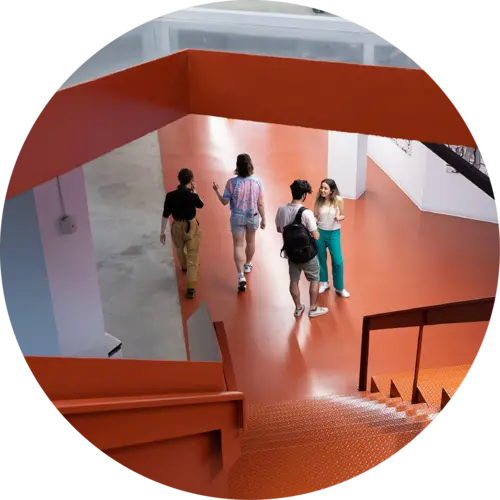
Portrait de Yoshua Bengio

Yoshua Bengio

Membre académique principal
Chaire en IA Canada-CIFAR
Professeur titulaire, Université de Montréal, Département d'informatique et de recherche opérationnelle
Sujets de recherche
Apprentissage automatique médical
Apprentissage de représentations
Apprentissage par renforcement
Apprentissage profond
Causalité
Modèles génératifs
Modèles probabilistes
Modélisation moléculaire
Neurosciences computationnelles
Raisonnement
Réseaux de neurones en graphes
Réseaux de neurones récurrents
Théorie de l'apprentissage automatique
Traitement du langage naturel

Biographie

*Pour toute demande média, veuillez écrire à medias@mila.quebec.

Pour plus d’information, contactez Cassidy MacNeil, adjointe principale et responsable des opérations cassidy.macneil@mila.quebec.

Reconnu comme une sommité mondiale en intelligence artificielle, Yoshua Bengio s’est surtout distingué par son rôle de pionnier en apprentissage profond, ce qui lui a valu le prix A. M. Turing 2018, le « prix Nobel de l’informatique », avec Geoffrey Hinton et Yann LeCun. Il est professeur titulaire à l’Université de Montréal, fondateur et conseiller scientifique de Mila – Institut québécois d’intelligence artificielle, et codirige en tant que senior fellow le programme Apprentissage automatique, apprentissage biologique de l'Institut canadien de recherches avancées (CIFAR). Il occupe également la fonction de conseiller spécial et directeur scientifique fondateur d’IVADO.

En 2018, il a été l’informaticien qui a recueilli le plus grand nombre de nouvelles citations au monde. En 2019, il s’est vu décerner le prestigieux prix Killam. Depuis 2022, il détient le plus grand facteur d’impact (h-index) en informatique à l’échelle mondiale. Il est fellow de la Royal Society de Londres et de la Société royale du Canada, et officier de l’Ordre du Canada.

Soucieux des répercussions sociales de l’IA et de l’objectif que l’IA bénéficie à tous, il a contribué activement à la Déclaration de Montréal pour un développement responsable de l’intelligence artificielle.

Étudiants actuels

Collaborateur·rice de recherche - Cambridge University
Superviseur⋅e principal⋅e :
Collaborateur·rice de recherche - N/A
Superviseur⋅e principal⋅e :
Collaborateur·rice de recherche - KAIST
Collaborateur·rice alumni - UdeM
Collaborateur·rice de recherche - UdeM
Postdoctorat - UdeM
Superviseur⋅e principal⋅e :
Stagiaire de recherche - KOREA ADVANCED INSTITUTE OF SCIENCE AND TECHNOLOGY
Collaborateur·rice de recherche - s.o.
Doctorat - UdeM
Superviseur⋅e principal⋅e :
Visiteur de recherche indépendant - UdeM
Collaborateur·rice de recherche - Ying Wu Coll of Computing
Collaborateur·rice de recherche - University of Waterloo
Superviseur⋅e principal⋅e :
Doctorat - UdeM
Superviseur⋅e principal⋅e :
Collaborateur·rice alumni - UdeM
Co-superviseur⋅e :
Collaborateur·rice de recherche - University of Cambridge
Collaborateur·rice alumni - UdeM
Co-superviseur⋅e :
Collaborateur·rice de recherche - UdeM
Doctorat - McGill
Superviseur⋅e principal⋅e :

Publications

A Walk with SGD
Exploring why stochastic gradient descent (SGD) based optimization methods train deep neural networks (DNNs) that generalize well has become… (voir plus) an active area of research. Towards this end, we empirically study the dynamics of SGD when training over-parametrized DNNs. Specifically we study the DNN loss surface along the trajectory of SGD by interpolating the loss surface between parameters from consecutive \textit{iterations} and tracking various metrics during training. We find that the loss interpolation between parameters before and after a training update is roughly convex with a minimum (\textit{valley floor}) in between for most of the training. Based on this and other metrics, we deduce that during most of the training, SGD explores regions in a valley by bouncing off valley walls at a height above the valley floor. This 'bouncing off walls at a height' mechanism helps SGD traverse larger distance for small batch sizes and large learning rates which we find play qualitatively different roles in the dynamics. While a large learning rate maintains a large height from the valley floor, a small batch size injects noise facilitating exploration. We find this mechanism is crucial for generalization because the valley floor has barriers and this exploration above the valley floor allows SGD to quickly travel far away from the initialization point (without being affected by barriers) and find flatter regions, corresponding to better generalization.
Generalization in Machine Learning via Analytical Learning Theory
This paper introduces a novel measure-theoretic theory for machine learning that does not require statistical assumptions. Based on this the… (voir plus)ory, a new regularization method in deep learning is derived and shown to outperform previous methods in CIFAR-10, CIFAR-100, and SVHN. Moreover, the proposed theory provides a theoretical basis for a family of practically successful regularization methods in deep learning. We discuss several consequences of our results on one-shot learning, representation learning, deep learning, and curriculum learning. Unlike statistical learning theory, the proposed learning theory analyzes each problem instance individually via measure theory, rather than a set of problem instances via statistics. As a result, it provides different types of results and insights when compared to statistical learning theory.
Towards Understanding Generalization via Analytical Learning Theory
This paper introduces a novel measure-theoretic theory for machine learning that does not require statistical assumptions. Based on this the… (voir plus)ory, a new regularization method in deep learning is derived and shown to outperform previous methods in CIFAR-10, CIFAR-100, and SVHN. Moreover, the proposed theory provides a theoretical basis for a family of practically successful regularization methods in deep learning. We discuss several consequences of our results on one-shot learning, representation learning, deep learning, and curriculum learning. Unlike statistical learning theory, the proposed learning theory analyzes each problem instance individually via measure theory, rather than a set of problem instances via statistics. As a result, it provides different types of results and insights when compared to statistical learning theory.
Boundary Seeking GANs
R Devon Hjelm
Athul Jacob
Adam Trischler
Gerry Che
Combining Model-based and Model-free RL via Multi-step Control Variates
Tong Che
Yuchen Lu
George Tucker
Surya Bhupatiraju
Shane Gu
Sergey Levine
Learning Generative Models with Locally Disentangled Latent Factors
Finding Flatter Minima with SGD
Stanisław Jastrzębski
Amos Storkey
Graph Priors for Deep Neural Networks
In this work we explore how gene-gene interaction graphs can be used as a prior for the representation of a model to construct features base… (voir plus)d on known interactions between genes. Most existing machine learning work on graphs focuses on building models when data is confined to a graph structure. In this work we focus on using the information from a graph to build better representations in our models. We use the percolate task, determining if a path exists across a grid for a set of node values, as a proxy for gene pathways. We create variants of the percolate task to explore where existing methods fail. We test the limits of existing methods in order to determine what can be improved when applying these methods to a real task. This leads us to propose new methods based on Graph Convolutional Networks (GCN) that use pooling and dropout to deal with noise in the graph prior.
SGD S MOOTHS THE S HARPEST D IRECTIONS
Stanisław Jastrzębski
Amos Storkey
Stochastic gradient descent (SGD) is able to find regions that generalize well, even in drastically over-parametrized models such as deep ne… (voir plus)ural networks. We observe that noise in SGD controls the spectral norm and conditioning of the Hessian throughout the training. We hypothesize the cause of this phenomenon is due to the dynamics of neurons saturating their non-linearity along the largest curvature directions, thus leading to improved conditioning.
Extending the Framework of Equilibrium Propagation to General Dynamics
A Deep Reinforcement Learning Chatbot (Short Version)
We present MILABOT: a deep reinforcement learning chatbot developed by the Montreal Institute for Learning Algorithms (MILA) for the Amazon … (voir plus)Alexa Prize competition. MILABOT is capable of conversing with humans on popular small talk topics through both speech and text. The system consists of an ensemble of natural language generation and retrieval models, including neural network and template-based models. By applying reinforcement learning to crowdsourced data and real-world user interactions, the system has been trained to select an appropriate response from the models in its ensemble. The system has been evaluated through A/B testing with real-world users, where it performed significantly better than other systems. The results highlight the potential of coupling ensemble systems with deep reinforcement learning as a fruitful path for developing real-world, open-domain conversational agents.
A3T: Adversarially Augmented Adversarial Training
Recent research showed that deep neural networks are highly sensitive to so-called adversarial perturbations, which are tiny perturbations o… (voir plus)f the input data purposely designed to fool a machine learning classifier. Most classification models, including deep learning models, are highly vulnerable to adversarial attacks. In this work, we investigate a procedure to improve adversarial robustness of deep neural networks through enforcing representation invariance. The idea is to train the classifier jointly with a discriminator attached to one of its hidden layer and trained to filter the adversarial noise. We perform preliminary experiments to test the viability of the approach and to compare it to other standard adversarial training methods.