Portrait de Yoshua Bengio

Yoshua Bengio

Membre académique principal
Chaire en IA Canada-CIFAR
Professeur titulaire, Université de Montréal, Département d'informatique et de recherche opérationnelle
Sujets de recherche
Apprentissage automatique médical
Apprentissage de représentations
Apprentissage par renforcement
Apprentissage profond
Causalité
Modèles génératifs
Modèles probabilistes
Modélisation moléculaire
Neurosciences computationnelles
Raisonnement
Réseaux de neurones en graphes
Réseaux de neurones récurrents
Théorie de l'apprentissage automatique
Traitement du langage naturel

Biographie

*Pour toute demande média, veuillez écrire à medias@mila.quebec.

Pour plus d’information, contactez Cassidy MacNeil, adjointe principale et responsable des opérations cassidy.macneil@mila.quebec.

Reconnu comme une sommité mondiale en intelligence artificielle, Yoshua Bengio s’est surtout distingué par son rôle de pionnier en apprentissage profond, ce qui lui a valu le prix A. M. Turing 2018, le « prix Nobel de l’informatique », avec Geoffrey Hinton et Yann LeCun. Il est professeur titulaire à l’Université de Montréal, fondateur et conseiller scientifique de Mila – Institut québécois d’intelligence artificielle, et codirige en tant que senior fellow le programme Apprentissage automatique, apprentissage biologique de l'Institut canadien de recherches avancées (CIFAR). Il occupe également la fonction de conseiller spécial et directeur scientifique fondateur d’IVADO.

En 2018, il a été l’informaticien qui a recueilli le plus grand nombre de nouvelles citations au monde. En 2019, il s’est vu décerner le prestigieux prix Killam. Depuis 2022, il détient le plus grand facteur d’impact (h-index) en informatique à l’échelle mondiale. Il est fellow de la Royal Society de Londres et de la Société royale du Canada, et officier de l’Ordre du Canada.

Soucieux des répercussions sociales de l’IA et de l’objectif que l’IA bénéficie à tous, il a contribué activement à la Déclaration de Montréal pour un développement responsable de l’intelligence artificielle.

Étudiants actuels

Collaborateur·rice de recherche - Cambridge University
Superviseur⋅e principal⋅e :
Collaborateur·rice de recherche - N/A
Superviseur⋅e principal⋅e :
Collaborateur·rice de recherche - KAIST
Collaborateur·rice alumni - UdeM
Collaborateur·rice de recherche - UdeM
Postdoctorat - UdeM
Superviseur⋅e principal⋅e :
Stagiaire de recherche - KOREA ADVANCED INSTITUTE OF SCIENCE AND TECHNOLOGY
Collaborateur·rice de recherche - s.o.
Doctorat - UdeM
Superviseur⋅e principal⋅e :
Visiteur de recherche indépendant - UdeM
Collaborateur·rice de recherche - Ying Wu Coll of Computing
Collaborateur·rice de recherche - University of Waterloo
Superviseur⋅e principal⋅e :
Doctorat - UdeM
Superviseur⋅e principal⋅e :
Collaborateur·rice alumni - UdeM
Co-superviseur⋅e :
Collaborateur·rice de recherche - University of Cambridge
Collaborateur·rice alumni - UdeM
Co-superviseur⋅e :
Collaborateur·rice de recherche - UdeM
Doctorat - McGill
Superviseur⋅e principal⋅e :

Publications

Learning What Matters: Steering Diffusion via Spectrally Anisotropic Forward Noise
Berton Earnshaw
Jason Hartford
Monte Carlo Tree Diffusion for System 2 Planning
Jaesik Yoon
Hyeonseo Cho
Doojin Baek
Diffusion models have recently emerged as a powerful tool for planning. However, unlike Monte Carlo Tree Search (MCTS)-whose performance nat… (voir plus)urally improves with inference-time computation scaling-standard diffusion-based planners offer only limited avenues for the scalability. In this paper, we introduce Monte Carlo Tree Diffusion (MCTD), a novel framework that integrates the generative strength of diffusion models with the adaptive search capabilities of MCTS. Our method reconceptualizes denoising as a tree-structured process, allowing partially denoised plans to be iteratively evaluated, pruned, and refined. By selectively expanding promising trajectories while retaining the flexibility to revisit and improve suboptimal branches, MCTD achieves the benefits of MCTS such as controlling exploration-exploitation trade-offs within the diffusion framework. Empirical results on challenging long-horizon tasks show that MCTD outperforms diffusion baselines, yielding higher-quality solutions as inference-time computation increases.
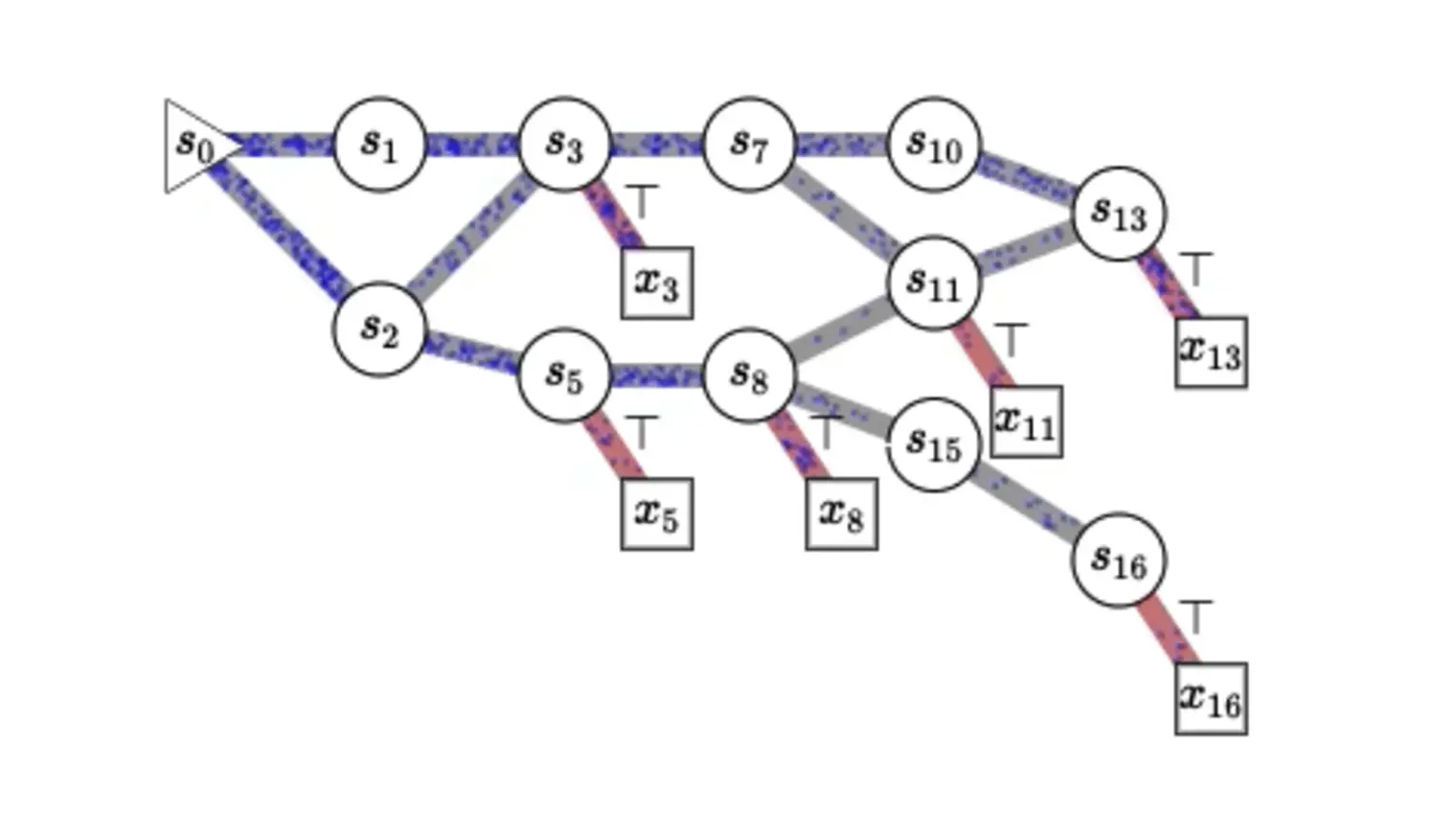
Rejecting Hallucinated State Targets during Planning
Mingde Zhao
Romain Laroche
In planning processes of computational decision-making agents, generative or predictive models are often used as "generators" to propose "ta… (voir plus)rgets" representing sets of expected or desirable states. Unfortunately, learned models inevitably hallucinate infeasible targets that can cause delusional behaviors and safety concerns. We first investigate the kinds of infeasible targets that generators can hallucinate. Then, we devise a strategy to identify and reject infeasible targets by learning a target feasibility evaluator. To ensure that the evaluator is robust and non-delusional, we adopted a design choice combining off-policy compatible learning rule, distributional architecture, and data augmentation based on hindsight relabeling. Attaching to a planning agent, the designed evaluator learns by observing the agent's interactions with the environment and the targets produced by its generator, without the need to change the agent or its generator. Our controlled experiments show significant reductions in delusional behaviors and performance improvements for various kinds of existing agents.
Towards a Formal Theory of Representational Compositionality
HVAC-SPICE: Value-Uncertainty In-Context RL with Thompson Sampling for Zero-Shot HVAC Control
Urban buildings consume 40\% of global energy, yet most rely on inefficient rule-based HVAC systems due to the impracticality of deploying a… (voir plus)dvanced controllers across diverse building stock. In-context reinforcement learning (ICRL) offers promise for rapid deployment without per-building training, but standard supervised learning objectives that maximise likelihood of training actions inherit behaviour-policy bias and provide weak exploration under the distribution shifts common when transferring across buildings and climates. We present SPICE (Sampling Policies In-Context with Ensemble uncertainty), a novel ICRL method specifically designed for zero-shot building control that addresses these fundamental limitations. SPICE introduces two key methodological innovations: (i) a propensity-corrected, return-aware training objective that prioritises high-advantage, high-uncertainty actions to enable improvement beyond suboptimal training demonstrations, and (ii) lightweight value ensembles with randomised priors that provide explicit uncertainty estimates for principled episode-level Thompson sampling. At deployment, SPICE samples one value head per episode and acts greedily, resulting in temporally coherent exploration without test-time gradients or building-specific models. We establish a comprehensive experimental protocol using the HOT dataset to evaluate SPICE across diverse building types and climate zones, focusing on the energy efficiency, occupant comfort, and zero-shot transfer capabilities that are critical for urban-scale deployment.
Recursive Self-Aggregation Unlocks Deep Thinking in Large Language Models
Test-time scaling methods improve the capabilities of large language models (LLMs) by increasing the amount of compute used during inference… (voir plus) to make a prediction. Inference-time compute can be scaled in parallel by choosing among multiple independent solutions or sequentially through self-refinement. We propose Recursive Self-Aggregation (RSA), a test-time scaling method inspired by evolutionary methods that combines the benefits of both parallel and sequential scaling. Each step of RSA refines a population of candidate reasoning chains through aggregation of subsets to yield a population of improved solutions, which are then used as the candidate pool for the next iteration. RSA exploits the rich information embedded in the reasoning chains -- not just the final answers -- and enables bootstrapping from partially correct intermediate steps within different chains of thought. Empirically, RSA delivers substantial performance gains with increasing compute budgets across diverse tasks, model families and sizes. Notably, RSA enables Qwen3-4B-Instruct-2507 to achieve competitive performance with larger reasoning models, including DeepSeek-R1 and o3-mini (high), while outperforming purely parallel and sequential scaling strategies across AIME-25, HMMT-25, Reasoning Gym, LiveCodeBench-v6, and SuperGPQA. We further demonstrate that training the model to combine solutions via a novel aggregation-aware reinforcement learning approach yields significant performance gains. Code available at https://github.com/HyperPotatoNeo/RSA.
Active Attacks: Red-teaming LLMs via Adaptive Environments
Pierre-Luc St-Charles
Jinkyoo Park
Graph Dreamer: Temporal Graph World Models for Sample-Efficient and Generalisable Reinforcement Learning
Low Compute Unlearning via Sparse Representations
Ashish Malik
Michael Curtis Mozer
Sanjeev Arora
Machine unlearning, which involves erasing knowledge about a \emph{forget set} from a trained model, can prove to be costly and infeasible … (voir plus)using existing techniques. We propose a low-compute unlearning technique based on a discrete representational bottleneck. We show that the proposed technique efficiently unlearns the forget set and incurs negligible damage to the model's performance on the rest of the dataset. We evaluate the proposed technique on the problem of class unlearning using four datasets: CIFAR-10, CIFAR-100, LACUNA-100 and ImageNet-1k. We compare the proposed technique to SCRUB, a state-of-the-art approach which uses knowledge distillation for unlearning. Across all four datasets, the proposed technique performs as well as, if not better than SCRUB while incurring almost no computational cost.
Illusions of AI consciousness
The belief that AI is conscious is not without risk
Relative Trajectory Balance is equivalent to Trust-PCL
The Singapore Consensus on Global AI Safety Research Priorities
Luke Ong
Stuart Russell
Dawn Song
Max Tegmark
Lan Xue
Ya-Qin Zhang
Stephen Casper
Wan Sie Lee
Vanessa Wilfred
Vidhisha Balachandran
Fazl Barez
Michael Belinsky
Imane Bello
Malo Bourgon
Mark Brakel
Simeon Campos
Duncan Cass-Beggs … (voir 68 de plus)
Jiahao Chen
Rumman Chowdhury
Kuan Chua Seah
Jeff Clune
Juntao Dai
Agnes Delaborde
Francisco Eiras
Joshua Engels
Jinyu Fan
Adam Gleave
Noah Goodman
Fynn Heide
Johannes Heidecke
Dan Hendrycks
Cyrus Hodes
Bryan Low Kian Hsiang
Minlie Huang
Sami Jawhar
Wang Jingyu
Adam Tauman Kalai
Meindert Kamphuis
Mohan Kankanhalli
Subhash Kantamneni
Mathias Bonde Kirk
Thomas Kwa
Jeffrey Ladish
Kwok-Yan Lam
Wan Lee Sie
Taewhi Lee
Xiaojian Li
Jiajun Liu
Chaochao Lu
Yifan Mai
Richard Mallah
Julian Michael
Nick Moës
Simon Möller
Kihyuk Nam
Kwan Yee Ng
Mark Nitzberg
Besmira Nushi
Seán Ó hÉigeartaigh
Alejandro Ortega
Pierre Peigné
James Petrie
Nayat Sanchez-Pi
Sarah Schwettmann
Buck Shlegeris
Saad Siddiqui
Aradhana Sinha
Martín Soto
Cheston Tan
Dong Ting
William Tjhi
Robert Trager
Brian Tse
Anthony Tung K. H.
Vanessa Wilfred
John Willes
Denise Wong
Wei Xu
Rongwu Xu
Yi Zeng
HongJiang Zhang
Djordje Žikelić
Rapidly improving AI capabilities and autonomy hold significant promise of transformation, but are also driving vigorous debate on how to en… (voir plus)sure that AI is safe, i.e., trustworthy, reliable, and secure. Building a trusted ecosystem is therefore essential – it helps people embrace AI with confidence and gives maximal space for innovation while avoiding backlash. This requires policymakers, industry, researchers and the broader public to collectively work toward securing positive outcomes from AI’s development. AI safety research is a key dimension. Given that the state of science today for building trustworthy AI does not fully cover all risks, accelerated investment in research is required to keep pace with commercially driven growth in system capabilities. Goals: The 2025 Singapore Conference on AI (SCAI): International Scientific Exchange on AI Safety aims to support research in this important space by bringing together AI scientists across geographies to identify and synthesise research priorities in AI safety. The result, The Singapore Consensus on Global AI Safety Research Priorities, builds on the International AI Safety Report-A (IAISR) chaired by Yoshua Bengio and backed by 33 governments. By adopting a defence-in-depth model, this document organises AI safety research domains into three types: challenges with creating trustworthy AI systems (Development), challenges with evaluating their risks (Assessment), and challenges with monitoring and intervening after deployment (Control). Through the Singapore Consensus, we hope to globally facilitate meaningful conversations between AI scientists and AI policymakers for maximally beneficial outcomes. Our goal is to enable more impactful R&D efforts to rapidly develop safety and evaluation mechanisms and foster a trusted ecosystem where AI is harnessed for the public good.