Portrait de Yoshua Bengio

Yoshua Bengio

Membre académique principal
Chaire en IA Canada-CIFAR
Professeur titulaire, Université de Montréal, Département d'informatique et de recherche opérationnelle
Sujets de recherche
Apprentissage automatique médical
Apprentissage de représentations
Apprentissage par renforcement
Apprentissage profond
Causalité
Modèles génératifs
Modèles probabilistes
Modélisation moléculaire
Neurosciences computationnelles
Raisonnement
Réseaux de neurones en graphes
Réseaux de neurones récurrents
Théorie de l'apprentissage automatique
Traitement du langage naturel

Biographie

*Pour toute demande média, veuillez écrire à medias@mila.quebec.

Pour plus d’information, contactez Cassidy MacNeil, adjointe principale et responsable des opérations cassidy.macneil@mila.quebec.

Reconnu comme une sommité mondiale en intelligence artificielle, Yoshua Bengio s’est surtout distingué par son rôle de pionnier en apprentissage profond, ce qui lui a valu le prix A. M. Turing 2018, le « prix Nobel de l’informatique », avec Geoffrey Hinton et Yann LeCun. Il est professeur titulaire à l’Université de Montréal, fondateur et conseiller scientifique de Mila – Institut québécois d’intelligence artificielle, et codirige en tant que senior fellow le programme Apprentissage automatique, apprentissage biologique de l'Institut canadien de recherches avancées (CIFAR). Il occupe également la fonction de conseiller spécial et directeur scientifique fondateur d’IVADO.

En 2018, il a été l’informaticien qui a recueilli le plus grand nombre de nouvelles citations au monde. En 2019, il s’est vu décerner le prestigieux prix Killam. Depuis 2022, il détient le plus grand facteur d’impact (h-index) en informatique à l’échelle mondiale. Il est fellow de la Royal Society de Londres et de la Société royale du Canada, et officier de l’Ordre du Canada.

Soucieux des répercussions sociales de l’IA et de l’objectif que l’IA bénéficie à tous, il a contribué activement à la Déclaration de Montréal pour un développement responsable de l’intelligence artificielle.

Étudiants actuels

Collaborateur·rice de recherche - Cambridge University
Superviseur⋅e principal⋅e :
Collaborateur·rice de recherche - N/A
Superviseur⋅e principal⋅e :
Collaborateur·rice de recherche - KAIST
Collaborateur·rice alumni - UdeM
Postdoctorat - UdeM
Superviseur⋅e principal⋅e :
Collaborateur·rice de recherche - UdeM
Stagiaire de recherche - KOREA ADVANCED INSTITUTE OF SCIENCE AND TECHNOLOGY
Collaborateur·rice de recherche - s.o.
Doctorat - UdeM
Superviseur⋅e principal⋅e :
Visiteur de recherche indépendant - UdeM
Collaborateur·rice de recherche - Ying Wu Coll of Computing
Collaborateur·rice de recherche - University of Waterloo
Superviseur⋅e principal⋅e :
Doctorat - UdeM
Superviseur⋅e principal⋅e :
Collaborateur·rice alumni - UdeM
Co-superviseur⋅e :
Collaborateur·rice de recherche - University of Cambridge
Collaborateur·rice alumni - UdeM
Co-superviseur⋅e :
Collaborateur·rice de recherche - UdeM
Doctorat - McGill
Superviseur⋅e principal⋅e :

Publications

A neuronal least-action principle for real-time learning in cortical circuits
Walter Senn
Dominik Dold
Akos F. Kungl
Benjamin Ellenberger
Jakob Jordan
João Sacramento
Mihai A. Petrovici
One of the most fundamental laws of physics is the principle of least action. Motivated by its predictive power, we introduce a neuronal lea… (voir plus)st-action principle for cortical processing of sensory streams to produce appropriate behavioural outputs in real time. The principle postulates that the voltage dynamics of cortical pyramidal neurons prospectively minimize the local somato-dendritic mismatch error within individual neurons. For motor output neurons, it implies minimizing an instantaneous behavioural error. For deep network neurons, it implies a prospective firing to overcome integration delays and correct for possible output errors right in time. The neuron-specific errors are extracted in the apical dendrites of pyramidal neurons through a cortical microcircuit that tries to explain away the feedback from the periphery, and correct the trajectory on the fly. Any motor output is in a moving equilibrium with the sensory inputs and the motor feedback during the whole sensory-motor trajectory. Ongoing synaptic plasticity reduces the somato-dendritic mismatch error within each cortical neuron and performs gradient descent on the output cost at any moment in time. The neuronal least-action principle offers an axiomatic framework to derive local neuronal and synaptic dynamics for global real-time computation and learning in the brain and in physical substrates in general.
Metacognitive Capabilities of LLMs: An Exploration in Mathematical Problem Solving
Nan Rosemary Ke
Siyuan Guo
Michal Valko
Timothy Lillicrap
Danilo Rezende
Michael Mozer
Sanjeev Arora
Metacognitive knowledge refers to humans' intuitive knowledge of their own thinking and reasoning processes. Today's best LLMs clearly posse… (voir plus)ss some reasoning processes. The paper gives evidence that they also have metacognitive knowledge, including ability to name skills and procedures to apply given a task. We explore this primarily in context of math reasoning, developing a prompt-guided interaction procedure to get a powerful LLM to assign sensible skill labels to math questions, followed by having it perform semantic clustering to obtain coarser families of skill labels. These coarse skill labels look interpretable to humans. To validate that these skill labels are meaningful and relevant to the LLM's reasoning processes we perform the following experiments. (a) We ask GPT-4 to assign skill labels to training questions in math datasets GSM8K and MATH. (b) When using an LLM to solve the test questions, we present it with the full list of skill labels and ask it to identify the skill needed. Then it is presented with randomly selected exemplar solved questions associated with that skill label. This improves accuracy on GSM8k and MATH for several strong LLMs, including code-assisted models. The methodology presented is domain-agnostic, even though this article applies it to math problems.
RGFN: Synthesizable Molecular Generation Using GFlowNets
Andrei Rekesh
Dmytro Shevchuk
Cheng-Hao Liu
Mike Tyers
Robert A. Batey
Generative models hold great promise for small molecule discovery, significantly increasing the size of search space compared to traditional… (voir plus) in silico screening libraries. However, most existing machine learning methods for small molecule generation suffer from poor synthesizability of candidate compounds, making experimental validation difficult. In this paper we propose Reaction-GFlowNet (RGFN), an extension of the GFlowNet framework that operates directly in the space of chemical reactions, thereby allowing out-of-the-box synthesizability while maintaining comparable quality of generated candidates. We demonstrate that with the proposed set of reactions and building blocks, it is possible to obtain a search space of molecules orders of magnitude larger than existing screening libraries coupled with low cost of synthesis. We also show that the approach scales to very large fragment libraries, further increasing the number of potential molecules. We demonstrate the effectiveness of the proposed approach across a range of oracle models, including pretrained proxy models and GPU-accelerated docking.
Trajectory Flow Matching with Applications to Clinical Time Series Modeling
Xi Zhang
Yuan Pu
Yuki Kawamura
Andrew Loza
Dennis L. Shung
Amortizing intractable inference in diffusion models for vision, language, and control
Diffusion models have emerged as effective distribution estimators in vision, language, and reinforcement learning, but their use as priors … (voir plus)in downstream tasks poses an intractable posterior inference problem. This paper studies amortized sampling of the posterior over data,
Improved off-policy training of diffusion samplers
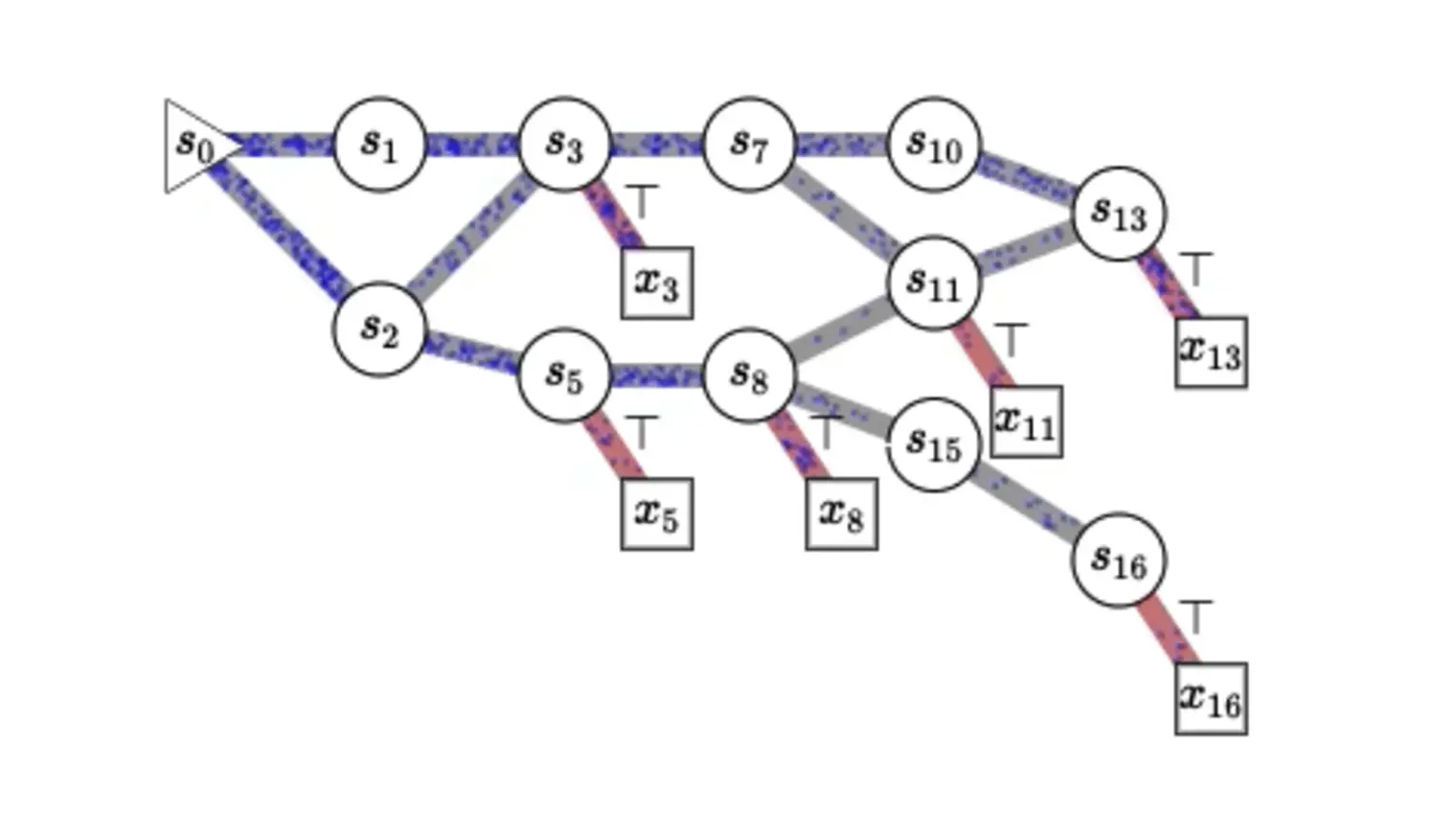
We study the problem of training diffusion models to sample from a distribution with a given unnormalized density or energy function. We ben… (voir plus)chmark several diffusion-structured inference methods, including simulation-based variational approaches and off-policy methods (continuous generative flow networks). Our results shed light on the relative advantages of existing algorithms while bringing into question some claims from past work. We also propose a novel exploration strategy for off-policy methods, based on local search in the target space with the use of a replay buffer, and show that it improves the quality of samples on a variety of target distributions. Our code for the sampling methods and benchmarks studied is made public at https://github.com/GFNOrg/gfn-diffusion as a base for future work on diffusion models for amortized inference.
Imagining and building wise machines: The centrality of AI metacognition
Samuel G. B. Johnson
Amir-Hossein Karimi
Nick Chater
Tobias Gerstenberg
Kate Larson
Sydney Levine
Melanie Mitchell
Iyad Rahwan
Bernhard Schölkopf
Igor Grossmann
Correction: Al content detection in the emerging information ecosystem: new obligations for media and tech companies
Alistair Knott
Dino Pedreschi
Toshiya Jitsuzumi
Susan Leavy
David Eyers
Tapabrata Chakraborti
Andrew Trotman
Sundar Sundareswaran
Ricardo Baeza-Yates
Przemyslaw Biecek
Adrian Weller
Paul D. Teal
Subhadip Basu
Mehmet Haklidir
Virginia Morini
Stuart Russell
A Complexity-Based Theory of Compositionality
Can Safety Fine-Tuning Be More Principled? Lessons Learned from Cybersecurity
David Williams-King
Adam Oberman
As LLMs develop increasingly advanced capabilities, there is an increased need to minimize the harm that could be caused to society by certa… (voir plus)in model outputs; hence, most LLMs have safety guardrails added, for example via fine-tuning. In this paper, we argue the position that current safety fine-tuning is very similar to a traditional cat-and-mouse game (or arms race) between attackers and defenders in cybersecurity. Model jailbreaks and attacks are patched with bandaids to target the specific attack mechanism, but many similar attack vectors might remain. When defenders are not proactively coming up with principled mechanisms, it becomes very easy for attackers to sidestep any new defenses. We show how current defenses are insufficient to prevent new adversarial jailbreak attacks, reward hacking, and loss of control problems. In order to learn from past mistakes in cybersecurity, we draw analogies with historical examples and develop lessons learned that can be applied to LLM safety. These arguments support the need for new and more principled approaches to designing safe models, which are architected for security from the beginning. We describe several such approaches from the AI literature.
Object-Centric Temporal Consistency via Conditional Autoregressive Inductive Biases
Akihiro Nakano
Mircea Tudor Lică
Aniket Rajiv Didolkar
Masahiro Suzuki
Mengmi Zhang
Justin Dauwels
Yutaka Matsuo
AI-Assisted Generation of Difficult Math Questions
Dingli Yu
Kaifeng Lyu
Simon Park
Nan Rosemary Ke
Jiatong Yu
Yinghui He
Michael Curtis Mozer
James Lloyd McClelland
Sanjeev Arora
Current LLM training positions mathematical reasoning as a core capability. With publicly available sources fully tapped, there is unmet dem… (voir plus)and for diverse and challenging math questions. Relying solely on human experts is both time-consuming and costly, while LLM-generated questions often lack the requisite diversity and difficulty. We present a design framework that combines the strengths of LLMs with a human-in-the-loop approach to generate a diverse array of challenging math questions. We leverage LLM metacognition skills [Didolkar et al., 2024] of a strong LLM to extract core"skills"from existing math datasets. These skills serve as the basis for generating novel and difficult questions by prompting the LLM with random pairs of core skills. The use of two different skills within each question makes finding such questions an"out of distribution"task for both LLMs and humans. Our pipeline employs LLMs to iteratively generate and refine questions and solutions through multiturn prompting. Human annotators then verify and further refine the questions, with their efficiency enhanced via further LLM interactions. Applying this pipeline on skills extracted from the MATH dataset [Hendrycks et al., 2021] resulted in MATH