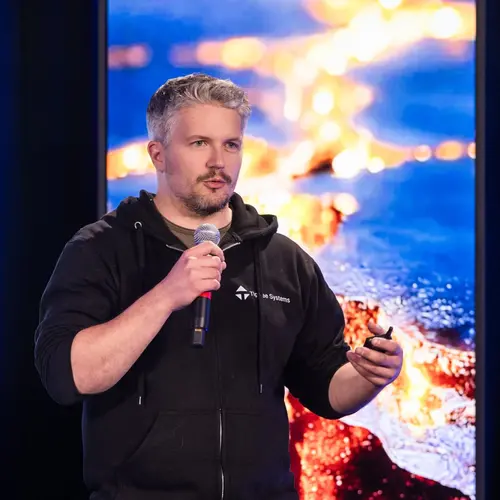

Portrait de Yoshua Bengio

Yoshua Bengio

Membre académique principal
Chaire en IA Canada-CIFAR
Professeur titulaire, Université de Montréal, Département d'informatique et de recherche opérationnelle
Sujets de recherche
Apprentissage automatique médical
Apprentissage de représentations
Apprentissage par renforcement
Apprentissage profond
Causalité
Modèles génératifs
Modèles probabilistes
Modélisation moléculaire
Neurosciences computationnelles
Raisonnement
Réseaux de neurones en graphes
Réseaux de neurones récurrents
Théorie de l'apprentissage automatique
Traitement du langage naturel

Biographie

*Pour toute demande média, veuillez écrire à medias@mila.quebec.

Pour plus d’information, contactez Cassidy MacNeil, adjointe principale et responsable des opérations cassidy.macneil@mila.quebec.

Reconnu comme une sommité mondiale en intelligence artificielle, Yoshua Bengio s’est surtout distingué par son rôle de pionnier en apprentissage profond, ce qui lui a valu le prix A. M. Turing 2018, le « prix Nobel de l’informatique », avec Geoffrey Hinton et Yann LeCun. Il est professeur titulaire à l’Université de Montréal, fondateur et conseiller scientifique de Mila – Institut québécois d’intelligence artificielle, et codirige en tant que senior fellow le programme Apprentissage automatique, apprentissage biologique de l'Institut canadien de recherches avancées (CIFAR). Il occupe également la fonction de conseiller spécial et directeur scientifique fondateur d’IVADO.

En 2018, il a été l’informaticien qui a recueilli le plus grand nombre de nouvelles citations au monde. En 2019, il s’est vu décerner le prestigieux prix Killam. Depuis 2022, il détient le plus grand facteur d’impact (h-index) en informatique à l’échelle mondiale. Il est fellow de la Royal Society de Londres et de la Société royale du Canada, et officier de l’Ordre du Canada.

Soucieux des répercussions sociales de l’IA et de l’objectif que l’IA bénéficie à tous, il a contribué activement à la Déclaration de Montréal pour un développement responsable de l’intelligence artificielle.

Étudiants actuels

Collaborateur·rice de recherche - Cambridge University
Superviseur⋅e principal⋅e :
Collaborateur·rice de recherche - N/A
Superviseur⋅e principal⋅e :
Collaborateur·rice de recherche - KAIST
Collaborateur·rice alumni - UdeM
Postdoctorat - UdeM
Superviseur⋅e principal⋅e :
Collaborateur·rice de recherche - UdeM
Stagiaire de recherche - KOREA ADVANCED INSTITUTE OF SCIENCE AND TECHNOLOGY
Collaborateur·rice de recherche - s.o.
Doctorat - UdeM
Superviseur⋅e principal⋅e :
Visiteur de recherche indépendant - UdeM
Collaborateur·rice de recherche - Ying Wu Coll of Computing
Collaborateur·rice de recherche - University of Waterloo
Superviseur⋅e principal⋅e :
Doctorat - UdeM
Superviseur⋅e principal⋅e :
Collaborateur·rice alumni - UdeM
Co-superviseur⋅e :
Collaborateur·rice de recherche - University of Cambridge
Collaborateur·rice alumni - UdeM
Co-superviseur⋅e :
Collaborateur·rice de recherche - UdeM
Doctorat - McGill
Superviseur⋅e principal⋅e :

Publications

LATTER M INIMA WITH SGD
Stanisław Jastrzębski
Amos Storkey
Learning General Purpose Distributed Sentence Representations via Large Scale Multi-task Learning
Adam Trischler
Christopher Pal
A lot of the recent success in natural language processing (NLP) has been driven by distributed vector representations of words trained on l… (voir plus)arge amounts of text in an unsupervised manner. These representations are typically used as general purpose features for words across a range of NLP problems. However, extending this success to learning representations of sequences of words, such as sentences, remains an open problem. Recent work has explored unsupervised as well as supervised learning techniques with different training objectives to learn general purpose fixed-length sentence representations. In this work, we present a simple, effective multi-task learning framework for sentence representations that combines the inductive biases of diverse training objectives in a single model. We train this model on several data sources with multiple training objectives on over 100 million sentences. Extensive experiments demonstrate that sharing a single recurrent sentence encoder across weakly related tasks leads to consistent improvements over previous methods. We present substantial improvements in the context of transfer learning and low-resource settings using our learned general-purpose representations.
Residual Connections Encourage Iterative Inference
Stanisław Jastrzębski
Tong Che
Residual networks (Resnets) have become a prominent architecture in deep learning. However, a comprehensive understanding of Resnets is stil… (voir plus)l a topic of ongoing research. A recent view argues that Resnets perform iterative refinement of features. We attempt to further expose properties of this aspect. To this end, we study Resnets both analytically and empirically. We formalize the notion of iterative refinement in Resnets by showing that residual connections naturally encourage features of residual blocks to move along the negative gradient of loss as we go from one block to the next. In addition, our empirical analysis suggests that Resnets are able to perform both representation learning and iterative refinement. In general, a Resnet block tends to concentrate representation learning behavior in the first few layers while higher layers perform iterative refinement of features. Finally we observe that sharing residual layers naively leads to representation explosion and counterintuitively, overfitting, and we show that simple existing strategies can help alleviating this problem.
Sparse Attentive Backtracking: Temporal Credit Assignment Through Reminding
Learning long-term dependencies in extended temporal sequences requires credit assignment to events far back in the past. The most common me… (voir plus)thod for training recurrent neural networks, back-propagation through time (BPTT), requires credit information to be propagated backwards through every single step of the forward computation, potentially over thousands or millions of time steps. This becomes computationally expensive or even infeasible when used with long sequences. Importantly, biological brains are unlikely to perform such detailed reverse replay over very long sequences of internal states (consider days, months, or years.) However, humans are often reminded of past memories or mental states which are associated with the current mental state. We consider the hypothesis that such memory associations between past and present could be used for credit assignment through arbitrarily long sequences, propagating the credit assigned to the current state to the associated past state. Based on this principle, we study a novel algorithm which only back-propagates through a few of these temporal skip connections, realized by a learned attention mechanism that associates current states with relevant past states. We demonstrate in experiments that our method matches or outperforms regular BPTT and truncated BPTT in tasks involving particularly long-term dependencies, but without requiring the biologically implausible backward replay through the whole history of states. Additionally, we demonstrate that the proposed method transfers to longer sequences significantly better than LSTMs trained with BPTT and LSTMs trained with full self-attention.
Twin Networks: Matching the Future for Sequence Generation
Nan Rosemary Ke
Adam Trischler
Christopher Pal
We propose a simple technique for encouraging generative RNNs to plan ahead. We train a "backward" recurrent network to generate a given seq… (voir plus)uence in reverse order, and we encourage states of the forward model to predict cotemporal states of the backward model. The backward network is used only during training, and plays no role during sampling or inference. We hypothesize that our approach eases modeling of long-term dependencies by implicitly forcing the forward states to hold information about the longer-term future (as contained in the backward states). We show empirically that our approach achieves 9% relative improvement for a speech recognition task, and achieves significant improvement on a COCO caption generation task.
Dendritic error backpropagation in deep cortical microcircuits
João Sacramento
Rui Ponte Costa
Walter Senn
Animal behaviour depends on learning to associate sensory stimuli with the desired motor command. Understanding how the brain orchestrates t… (voir plus)he necessary synaptic modifications across different brain areas has remained a longstanding puzzle. Here, we introduce a multi-area neuronal network model in which synaptic plasticity continuously adapts the network towards a global desired output. In this model synaptic learning is driven by a local dendritic prediction error that arises from a failure to predict the top-down input given the bottom-up activities. Such errors occur at apical dendrites of pyramidal neurons where both long-range excitatory feedback and local inhibitory predictions are integrated. When local inhibition fails to match excitatory feedback an error occurs which triggers plasticity at bottom-up synapses at basal dendrites of the same pyramidal neurons. We demonstrate the learning capabilities of the model in a number of tasks and show that it approximates the classical error backpropagation algorithm. Finally, complementing this cortical circuit with a disinhibitory mechanism enables attention-like stimulus denoising and generation. Our framework makes several experimental predictions on the function of dendritic integration and cortical microcircuits, is consistent with recent observations of cross-area learning, and suggests a biological implementation of deep learning.
ObamaNet: Photo-realistic lip-sync from text
We present ObamaNet, the first architecture that generates both audio and synchronized photo-realistic lip-sync videos from any new text. Co… (voir plus)ntrary to other published lip-sync approaches, ours is only composed of fully trainable neural modules and does not rely on any traditional computer graphics methods. More precisely, we use three main modules: a text-to-speech network based on Char2Wav, a time-delayed LSTM to generate mouth-keypoints synced to the audio, and a network based on Pix2Pix to generate the video frames conditioned on the keypoints.
Use machine learning to find energy materials.
Phil De Luna
Jennifer N. Wei
Al'an Aspuru-guzik
E. Sargent
Measuring the tendency of CNNs to Learn Surface Statistical Regularities
Deep CNNs are known to exhibit the following peculiarity: on the one hand they generalize extremely well to a test set, while on the other h… (voir plus)and they are extremely sensitive to so-called adversarial perturbations. The extreme sensitivity of high performance CNNs to adversarial examples casts serious doubt that these networks are learning high level abstractions in the dataset. We are concerned with the following question: How can a deep CNN that does not learn any high level semantics of the dataset manage to generalize so well? The goal of this article is to measure the tendency of CNNs to learn surface statistical regularities of the dataset. To this end, we use Fourier filtering to construct datasets which share the exact same high level abstractions but exhibit qualitatively different surface statistical regularities. For the SVHN and CIFAR-10 datasets, we present two Fourier filtered variants: a low frequency variant and a randomly filtered variant. Each of the Fourier filtering schemes is tuned to preserve the recognizability of the objects. Our main finding is that CNNs exhibit a tendency to latch onto the Fourier image statistics of the training dataset, sometimes exhibiting up to a 28% generalization gap across the various test sets. Moreover, we observe that significantly increasing the depth of a network has a very marginal impact on closing the aforementioned generalization gap. Thus we provide quantitative evidence supporting the hypothesis that deep CNNs tend to learn surface statistical regularities in the dataset rather than higher-level abstract concepts.
Design of a Recognition System Automatic Vehicle License Plate through a Convolution Neural Network
P. Rajendra
K. Sudheer
Rahul Boadh
TE Campos
BR Babu
M. Varma
Ian J Goodfellow
Aaron
The present work is a study on the practical application of Learning process (Deep Learning) in the development of a system of Automatic rec… (voir plus)ognition of vehicle license plates. These systems commonly referred to as ALPR (Automatic License Plate Recognition) - are able to recognize the content of vehicles from the images captured by a camera. The system proposed in this work is based on an image classifier developed through supervised learning techniques with convolution neural network. These networks are one of the most profound learning architectures and are specifically designed to solve artificial vision, such as pattern recognition and classification of images. This paper also examines basic processing techniques and Image segmentation - such as smoothing filters, contour detection - necessary for the proposed system to be able to extract the contents of the license plates for further analysis and classification. This paper demonstrates the feasibility of an ALPR system based on a convolution neural network, noting the critical importance it has to design a network architecture and training data set appropriate to the problem to be solved.
Variational Bi-LSTMs
Samira Shabanian
Adam Trischler
Recurrent neural networks like long short-term memory (LSTM) are important architectures for sequential prediction tasks. LSTMs (and RNNs in… (voir plus) general) model sequences along the forward time direction. Bidirectional LSTMs (Bi-LSTMs), which model sequences along both forward and backward directions, generally perform better at such tasks because they capture a richer representation of the data. In the training of Bi-LSTMs, the forward and backward paths are learned independently. We propose a variant of the Bi-LSTM architecture, which we call Variational Bi-LSTM, that creates a dependence between the two paths (during training, but which may be omitted during inference). Our model acts as a regularizer and encourages the two networks to inform each other in making their respective predictions using distinct information. We perform ablation studies to better understand the different components of our model and evaluate the method on various benchmarks, showing state-of-the-art performance.
Learning Normalized Inputs for Iterative Estimation in Medical Image Segmentation
Gabriel Chartrand
Lisa Di Jorio
An Tang
Adriana Romero
Samuel Kadoury
In this paper, we introduce a simple, yet powerful pipeline for medical image segmentation that combines Fully Convolutional Networks (FCNs)… (voir plus) with Fully Convolutional Residual Networks (FC-ResNets). We propose and examine a design that takes particular advantage of recent advances in the understanding of both Convolutional Neural Networks as well as ResNets. Our approach focuses upon the importance of a trainable pre-processing when using FC-ResNets and we show that a low-capacity FCN model can serve as a pre-processor to normalize medical input data. In our image segmentation pipeline, we use FCNs to obtain normalized images, which are then iteratively refined by means of a FC-ResNet to generate a segmentation prediction. As in other fully convolutional approaches, our pipeline can be used off-the-shelf on different image modalities. We show that using this pipeline, we exhibit state-of-the-art performance on the challenging Electron Microscopy benchmark, when compared to other 2D methods. We improve segmentation results on CT images of liver lesions, when contrasting with standard FCN methods. Moreover, when applying our 2D pipeline on a challenging 3D MRI prostate segmentation challenge we reach results that are competitive even when compared to 3D methods. The obtained results illustrate the strong potential and versatility of the pipeline by achieving highly accurate results on multi-modality images from different anatomical regions and organs.