Portrait de Yoshua Bengio

Yoshua Bengio

Membre académique principal
Chaire en IA Canada-CIFAR
Professeur titulaire, Université de Montréal, Département d'informatique et de recherche opérationnelle
Sujets de recherche
Apprentissage automatique médical
Apprentissage de représentations
Apprentissage par renforcement
Apprentissage profond
Causalité
Modèles génératifs
Modèles probabilistes
Modélisation moléculaire
Neurosciences computationnelles
Raisonnement
Réseaux de neurones en graphes
Réseaux de neurones récurrents
Théorie de l'apprentissage automatique
Traitement du langage naturel

Biographie

*Pour toute demande média, veuillez écrire à medias@mila.quebec.

Pour plus d’information, contactez Cassidy MacNeil, adjointe principale et responsable des opérations cassidy.macneil@mila.quebec.

Reconnu comme une sommité mondiale en intelligence artificielle, Yoshua Bengio s’est surtout distingué par son rôle de pionnier en apprentissage profond, ce qui lui a valu le prix A. M. Turing 2018, le « prix Nobel de l’informatique », avec Geoffrey Hinton et Yann LeCun. Il est professeur titulaire à l’Université de Montréal, fondateur et conseiller scientifique de Mila – Institut québécois d’intelligence artificielle, et codirige en tant que senior fellow le programme Apprentissage automatique, apprentissage biologique de l'Institut canadien de recherches avancées (CIFAR). Il occupe également la fonction de conseiller spécial et directeur scientifique fondateur d’IVADO.

En 2018, il a été l’informaticien qui a recueilli le plus grand nombre de nouvelles citations au monde. En 2019, il s’est vu décerner le prestigieux prix Killam. Depuis 2022, il détient le plus grand facteur d’impact (h-index) en informatique à l’échelle mondiale. Il est fellow de la Royal Society de Londres et de la Société royale du Canada, et officier de l’Ordre du Canada.

Soucieux des répercussions sociales de l’IA et de l’objectif que l’IA bénéficie à tous, il a contribué activement à la Déclaration de Montréal pour un développement responsable de l’intelligence artificielle.

Étudiants actuels

Collaborateur·rice de recherche - Cambridge University
Superviseur⋅e principal⋅e :
Collaborateur·rice de recherche - N/A
Superviseur⋅e principal⋅e :
Collaborateur·rice de recherche - KAIST
Collaborateur·rice alumni - UdeM
Postdoctorat - UdeM
Superviseur⋅e principal⋅e :
Collaborateur·rice de recherche - UdeM
Stagiaire de recherche - KOREA ADVANCED INSTITUTE OF SCIENCE AND TECHNOLOGY
Collaborateur·rice de recherche - s.o.
Doctorat - UdeM
Superviseur⋅e principal⋅e :
Visiteur de recherche indépendant - UdeM
Collaborateur·rice de recherche - Ying Wu Coll of Computing
Collaborateur·rice de recherche - University of Waterloo
Superviseur⋅e principal⋅e :
Doctorat - UdeM
Superviseur⋅e principal⋅e :
Collaborateur·rice alumni - UdeM
Co-superviseur⋅e :
Collaborateur·rice de recherche - University of Cambridge
Collaborateur·rice alumni - UdeM
Co-superviseur⋅e :
Collaborateur·rice de recherche - UdeM
Doctorat - McGill
Superviseur⋅e principal⋅e :

Publications

Causal Inference in Gene Regulatory Networks with GFlowNet: Towards Scalability in Large Systems
Trang Nguyen
Dianbo Liu
Understanding causal relationships within Gene Regulatory Networks (GRNs) is essential for unraveling the gene interactions in cellular proc… (voir plus)esses. However, causal discovery in GRNs is a challenging problem for multiple reasons including the existence of cyclic feedback loops and uncertainty that yields diverse possible causal structures. Previous works in this area either ignore cyclic dynamics (assume acyclic structure) or struggle with scalability. We introduce Swift-DynGFN as a novel framework that enhances causal structure learning in GRNs while addressing scalability concerns. Specifically, Swift-DynGFN exploits gene-wise independence to boost parallelization and to lower computational cost. Experiments on real single-cell RNA velocity and synthetic GRN datasets showcase the advancement in learning causal structure in GRNs and scalability in larger systems.
Leveraging Diffusion Disentangled Representations to Mitigate Shortcuts in Underspecified Visual Tasks
Alexander Rubinstein
Armand Mihai Nicolicioiu
Damien Teney
Spurious correlations in the data, where multiple cues are predictive of the target labels, often lead to shortcut learning phenomena, where… (voir plus) a model may rely on erroneous, easy-to-learn, cues while ignoring reliable ones. In this work, we propose an ensemble diversification framework exploiting the generation of synthetic counterfactuals using Diffusion Probabilistic Models (DPMs). We discover that DPMs have the inherent capability to represent multiple visual cues independently, even when they are largely correlated in the training data. We leverage this characteristic to encourage model diversity and empirically show the efficacy of the approach with respect to several diversification objectives. We show that diffusion-guided diversification can lead models to avert attention from shortcut cues, achieving ensemble diversity performance comparable to previous methods requiring additional data collection.
AI and Catastrophic Risk
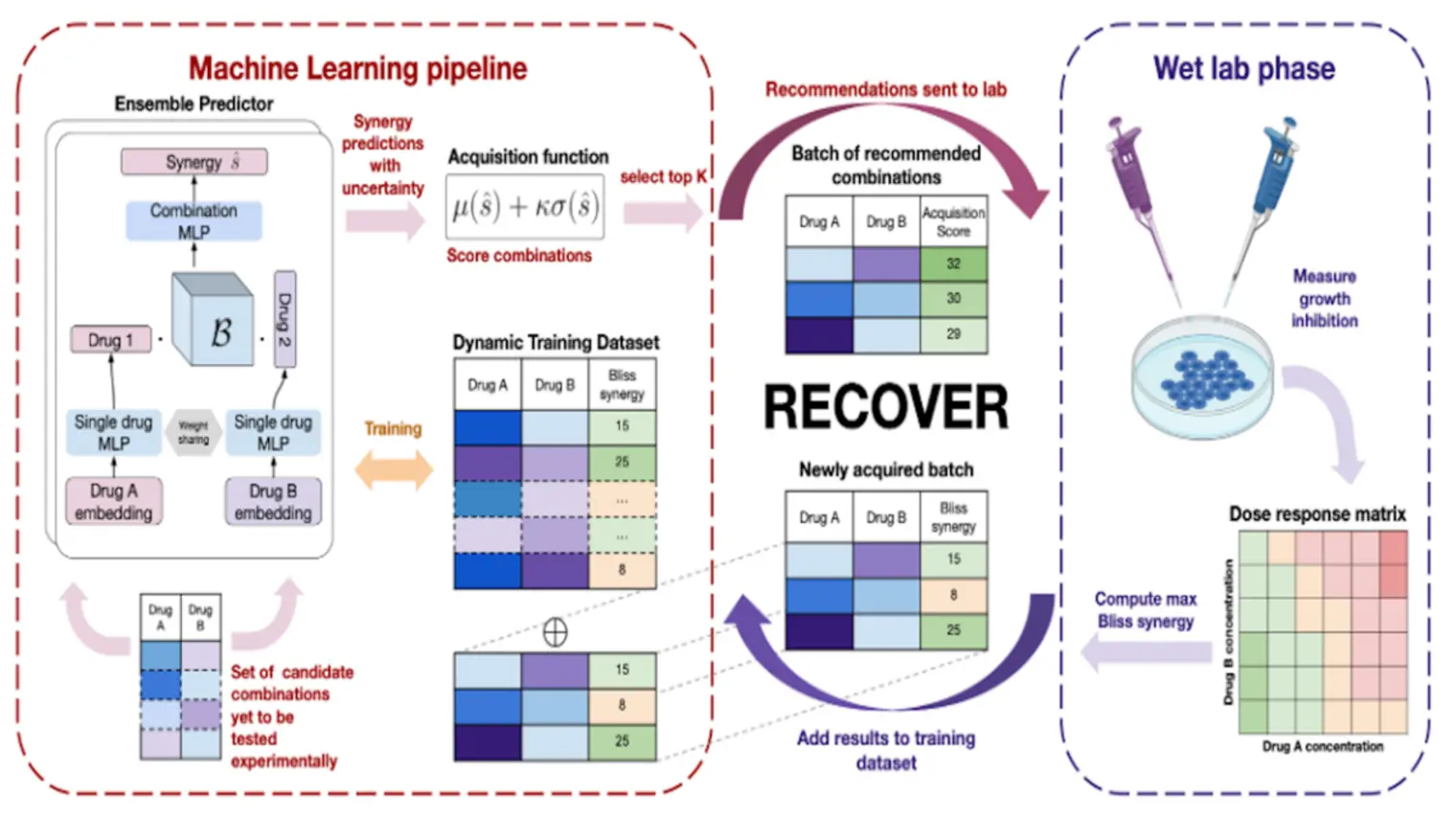
RECOVER identifies synergistic drug combinations in vitro through sequential model optimization
Thomas Gaudelet
Andrew Anighoro
Torsten Gross
Francisco Martínez-Peña
Eileen L. Tang
M.S. Suraj
Cristian Regep
Jeremy B.R. Hayter
Nicholas Valiante
Mike Tyers
Charles E.S. Roberts
Michael M. Bronstein
Luke L. Lairson
Jake P. Taylor-King
HyenaDNA: Long-Range Genomic Sequence Modeling at Single Nucleotide Resolution
Eric Nguyen
Michael Poli
Marjan Faizi
Armin W Thomas
Callum Birch-Sykes
Michael Wornow
Aman Patel
Clayton M. Rabideau
Stefano Ermon
Stephen Baccus
Christopher Re
Laughing Hyena Distillery: Extracting Compact Recurrences From Convolutions
Michael Poli
Daniel Y Fu
Hermann Kumbong
Rom Nishijima Parnichkun
Aman Timalsina
David W. Romero
Quinn McIntyre
Beidi Chen
Atri Rudra
Ce Zhang
Christopher Re
Stefano Ermon
Recent advances in attention-free sequence models rely on convolutions as alternatives to the attention operator at the core of Transformers… (voir plus). In particular, long convolution sequence models have achieved state-of-the-art performance in many domains, but incur a significant cost during auto-regressive inference workloads -- naively requiring a full pass (or caching of activations) over the input sequence for each generated token -- similarly to attention-based models. In this paper, we seek to enable
Neural Causal Structure Discovery from Interventions
Nan Rosemary Ke
Bernhard Schölkopf
Michael Curtis Mozer
Christopher Pal
Recent promising results have generated a surge of interest in continuous optimization methods for causal discovery from observational data.… (voir plus) However, there are theoretical limitations on the identifiability of underlying structures obtained solely from observational data. Interventional data, on the other hand, provides richer information about the underlying data-generating process. Nevertheless, extending and applying methods designed for observational data to include interventions is a challenging problem. To address this issue, we propose a general framework based on neural networks to develop models that incorporate both observational and interventional data. Notably, our method can handle the challenging and realistic scenario where the identity of the intervened upon variable is unknown. We evaluate our proposed approach in the context of graph recovery, both de novo and from a partially-known edge set. Our method achieves strong benchmark results on various structure learning tasks, including structure recovery of synthetic graphs as well as standard graphs from the Bayesian Network Repository.
Consciousness in Artificial Intelligence: Insights from the Science of Consciousness
Patrick Mark Butlin
Run Long
Jonathan C. P. Birch
Axel Constant
George Deane
S. Fleming
C. Frith
Xuanxiu Ji
Ryota Kanai
C. Klein
Grace W. Lindsay
Matthias Michel
Liad Mudrik
Megan A. K. Peters
Eric Schwitzgebel
Jonathan Simon
Rufin Vanrullen
Scientific discovery in the age of artificial intelligence
Hanchen Wang
Tianfan Fu
Yuanqi Du
Wenhao Gao
Kexin Huang
Ziming Liu
Payal Chandak
Peter Van Katwyk
Andreea Deac
Animashree Anandkumar
K. Bergen
Carla P. Gomes
Shirley Ho
Pushmeet Kohli
Joan Lasenby
Jure Leskovec
Tie-Yan Liu
A. Manrai
Debora Susan Marks … (voir 10 de plus)
Bharath Ramsundar
Le Song
Jimeng Sun
MAX WELLING
Linfeng Zhang
Connor Wilson. Coley
Marinka Žitnik
Discrete Key-Value Bottleneck
Nasim Rahaman
Michael Mozer
Bernhard Schölkopf
Deep neural networks perform well on classification tasks where data streams are i.i.d. and labeled data is abundant. Challenges emerge with… (voir plus) non-stationary training data streams such as continual learning. One powerful approach that has addressed this challenge involves pre-training of large encoders on volumes of readily available data, followed by task-specific tuning. Given a new task, however, updating the weights of these encoders is challenging as a large number of weights needs to be fine-tuned, and as a result, they forget information about the previous tasks. In the present work, we propose a model architecture to address this issue, building upon a discrete bottleneck containing pairs of separate and learnable key-value codes. Our paradigm will be to encode; process the representation via a discrete bottleneck; and decode. Here, the input is fed to the pre-trained encoder, the output of the encoder is used to select the nearest keys, and the corresponding values are fed to the decoder to solve the current task. The model can only fetch and re-use a sparse number of these key-value pairs during inference, enabling localized and context-dependent model updates. We theoretically investigate the ability of the discrete key-value bottleneck to minimize the effect of learning under distribution shifts and show that it reduces the complexity of the hypothesis class. We empirically verify the proposed method under challenging class-incremental learning scenarios and show that the proposed model - without any task boundaries - reduces catastrophic forgetting across a wide variety of pre-trained models, outperforming relevant baselines on this task.
Equivariance with Learned Canonicalization Functions
Sékou-Oumar Kaba
Arnab Kumar Mondal
Symmetry-based neural networks often constrain the architecture in order to achieve invariance or equivariance to a group of transformations… (voir plus). In this paper, we propose an alternative that avoids this architectural constraint by learning to produce canonical representations of the data. These canonicalization functions can readily be plugged into non-equivariant backbone architectures. We offer explicit ways to implement them for some groups of interest. We show that this approach enjoys universality while providing interpretable insights. Our main hypothesis, supported by our empirical results, is that learning a small neural network to perform canonicalization is better than using predefined heuristics. Our experiments show that learning the canonicalization function is competitive with existing techniques for learning equivariant functions across many tasks, including image classification,
FAENet: Frame Averaging Equivariant GNN for Materials Modeling
Alex Hernandez Garcia
Santiago Miret
Fragkiskos D. Malliaros
Applications of machine learning techniques for materials modeling typically involve functions known to be equivariant or invariant to speci… (voir plus)fic symmetries. While graph neural networks (GNNs) have proven successful in such tasks, they enforce symmetries via the model architecture, which often reduces their expressivity, scalability and comprehensibility. In this paper, we introduce (1) a flexible framework relying on stochastic frame-averaging (SFA) to make any model E(3)-equivariant or invariant through data transformations. (2) FAENet: a simple, fast and expressive GNN, optimized for SFA, that processes geometric information without any symmetrypreserving design constraints. We prove the validity of our method theoretically and empirically demonstrate its superior accuracy and computational scalability in materials modeling on the OC20 dataset (S2EF, IS2RE) as well as common molecular modeling tasks (QM9, QM7-X). A package implementation is available at https://faenet.readthedocs.io.