

Portrait de Yoshua Bengio

Yoshua Bengio

Membre académique principal
Chaire en IA Canada-CIFAR
Professeur titulaire, Université de Montréal
Sujets de recherche
Apprentissage automatique médical
Apprentissage de représentations
Apprentissage par renforcement
Apprentissage profond
Causalité
Modèles génératifs
Modèles probabilistes
Modélisation moléculaire
Neurosciences computationnelles
Raisonnement
Réseaux de neurones en graphes
Réseaux de neurones récurrents
Théorie de l'apprentissage automatique
Traitement du langage naturel

Biographie

*Pour toute demande média, veuillez écrire à medias@mila.quebec.

Pour plus d’information, contactez Cassidy MacNeil, adjointe principale et responsable des opérations cassidy.macneil@mila.quebec.

Reconnu comme une sommité mondiale en intelligence artificielle, Yoshua Bengio s’est surtout distingué par son rôle de pionnier en apprentissage profond, ce qui lui a valu le prix A. M. Turing 2018, le « prix Nobel de l’informatique », avec Geoffrey Hinton et Yann LeCun. Il est professeur titulaire à l’Université de Montréal, fondateur et conseiller scientifique de Mila – Institut québécois d’intelligence artificielle, et codirige en tant que senior fellow le programme Apprentissage automatique, apprentissage biologique de l'Institut canadien de recherches avancées (CIFAR). Il occupe également la fonction de conseiller spécial et directeur scientifique fondateur d’IVADO.

En 2018, il a été l’informaticien qui a recueilli le plus grand nombre de nouvelles citations au monde. En 2019, il s’est vu décerner le prestigieux prix Killam. Depuis 2022, il détient le plus grand facteur d’impact (h-index) en informatique à l’échelle mondiale. Il est fellow de la Royal Society de Londres et de la Société royale du Canada, et officier de l’Ordre du Canada.

Soucieux des répercussions sociales de l’IA et de l’objectif que l’IA bénéficie à tous, il a contribué activement à la Déclaration de Montréal pour un développement responsable de l’intelligence artificielle.

Étudiants actuels

Collaborateur·rice de recherche - Cambridge University
Superviseur⋅e principal⋅e :
Collaborateur·rice de recherche - KAIST
Collaborateur·rice alumni - UdeM
Postdoctorat - UdeM
Superviseur⋅e principal⋅e :
Collaborateur·rice de recherche - UdeM
Collaborateur·rice de recherche - KOREA ADVANCED INSTITUTE OF SCIENCE AND TECHNOLOGY
Collaborateur·rice de recherche - s.o.
Doctorat - UdeM
Superviseur⋅e principal⋅e :
Visiteur de recherche indépendant - UdeM
Collaborateur·rice de recherche - Ying Wu Coll of Computing
Collaborateur·rice de recherche - University of Waterloo
Superviseur⋅e principal⋅e :
Doctorat - UdeM
Superviseur⋅e principal⋅e :
Collaborateur·rice alumni - UdeM
Co-superviseur⋅e :
Collaborateur·rice de recherche - University of Cambridge
Collaborateur·rice alumni - UdeM
Co-superviseur⋅e :
Collaborateur·rice de recherche - UdeM
Doctorat - McGill
Superviseur⋅e principal⋅e :
Collaborateur·rice alumni - McGill
Superviseur⋅e principal⋅e :

Publications

YOUR AUTOREGRESSIVE GENERATIVE MODEL CAN BE BETTER IF YOU TREAT IT AS AN ENERGY-BASED ONE
Yezhen Wang
Tong Che
Bin Li
Kaitao Song
Hengzhi Pei
Dongsheng Li
On Neural Architecture Inductive Biases for Relational Tasks
Current deep learning approaches have shown good in-distribution generalization performance, but struggle with out-of-distribution generaliz… (voir plus)ation. This is especially true in the case of tasks involving abstract relations like recognizing rules in sequences, as we find in many intelligence tests. Recent work has explored how forcing relational representations to remain distinct from sensory representations, as it seems to be the case in the brain, can help artificial systems. Building on this work, we further explore and formalize the advantages afforded by 'partitioned' representations of relations and sensory details, and how this inductive bias can help recompose learned relational structure in newly encountered settings. We introduce a simple architecture based on similarity scores which we name Compositional Relational Network (CoRelNet). Using this model, we investigate a series of inductive biases that ensure abstract relations are learned and represented distinctly from sensory data, and explore their effects on out-of-distribution generalization for a series of relational psychophysics tasks. We find that simple architectural choices can outperform existing models in out-of-distribution generalization. Together, these results show that partitioning relational representations from other information streams may be a simple way to augment existing network architectures' robustness when performing out-of-distribution relational computations.
Agnostic Physics-Driven Deep Learning
Siddhartha Mishra
Yann Ollivier
Coordinating Policies Among Multiple Agents via an Intelligent Communication Channel
Dianbo Liu
Tianmin Shu
Michael Curtis Mozer
Nicolas Heess
In Multi-Agent Reinforcement Learning (MARL), specialized channels are often introduced that allow agents to communicate directly with one a… (voir plus)nother. In this paper, we propose an alternative approach whereby agents communicate through an intelligent facilitator that learns to sift through and interpret signals provided by all agents to improve the agents’ collective performance. To ensure that this facilitator does not become a centralized controller, agents are incentivized to reduce their dependence on the messages it conveys, and the messages can only influence the selection of a policy from a fixed set, not instantaneous actions given the policy. We demonstrate the strength of this architecture over existing baselines on several cooperative MARL environments.
Bayesian Structure Learning with Generative Flow Networks
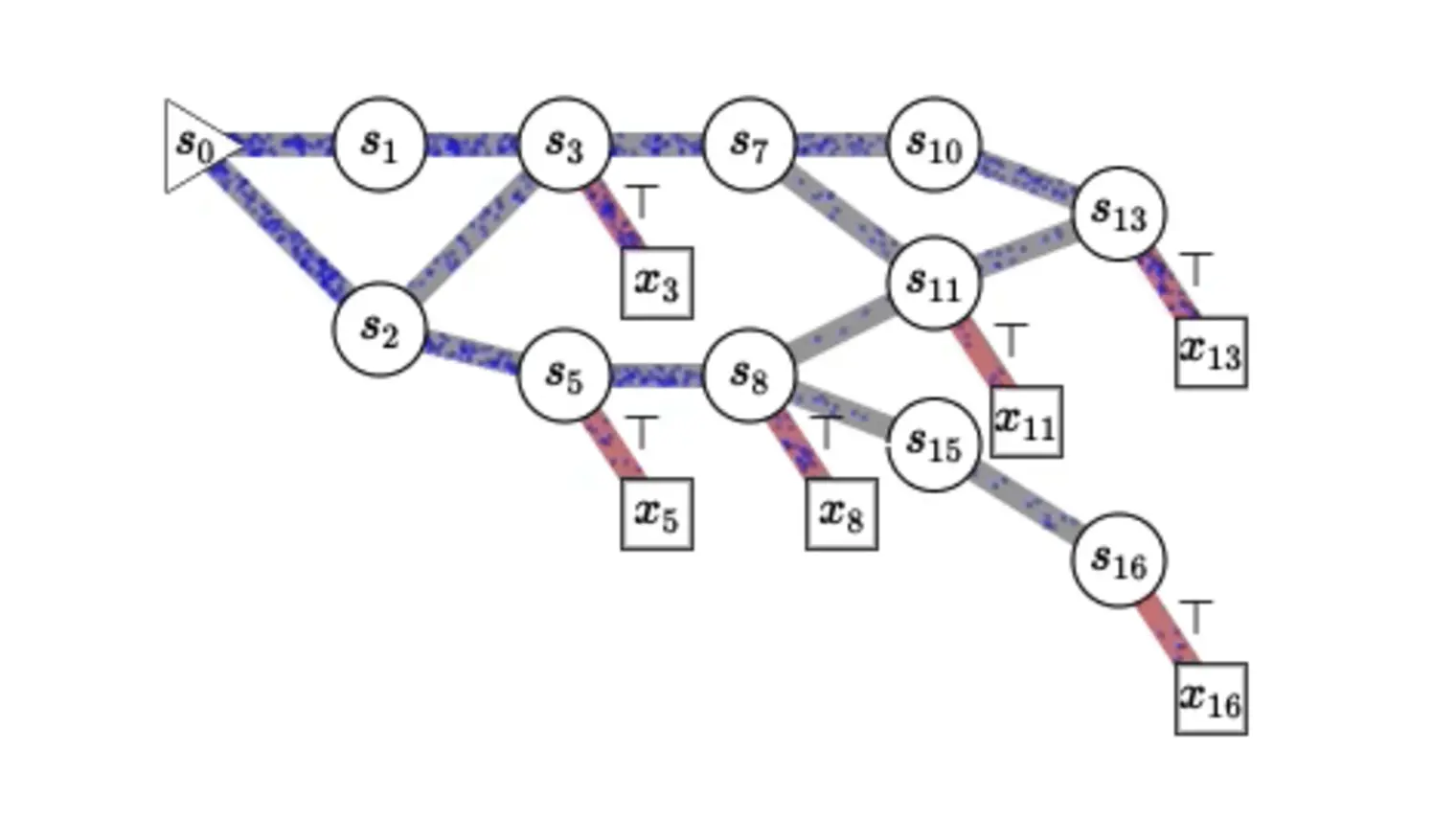
In Bayesian structure learning, we are interested in inferring a distribution over the directed acyclic graph (DAG) structure of Bayesian ne… (voir plus)tworks, from data. Defining such a distribution is very challenging, due to the combinatorially large sample space, and approximations based on MCMC are often required. Recently, a novel class of probabilistic models, called Generative Flow Networks (GFlowNets), have been introduced as a general framework for generative modeling of discrete and composite objects, such as graphs. In this work, we propose to use a GFlowNet as an alternative to MCMC for approximating the posterior distribution over the structure of Bayesian networks, given a dataset of observations. Generating a sample DAG from this approximate distribution is viewed as a sequential decision problem, where the graph is constructed one edge at a time, based on learned transition probabilities. Through evaluation on both simulated and real data, we show that our approach, called DAG-GFlowNet, provides an accurate approximation of the posterior over DAGs, and it compares favorably against other methods based on MCMC or variational inference.
Temporal Abstractions-Augmented Temporally Contrastive Learning: An Alternative to the Laplacian in RL
Marlos C. Machado
Mingde Zhao
Sainbayar Sukhbaatar
Alessandro Lazaric
Ludovic Denoyer
In reinforcement learning, the graph Laplacian has proved to be a valuable tool in the task-agnostic setting, with applications ranging from… (voir plus) skill discovery to reward shaping. Recently, learning the Laplacian representation has been framed as the optimization of a temporally-contrastive objective to overcome its computational limitations in large (or continuous) state spaces. However, this approach requires uniform access to all states in the state space, overlooking the exploration problem that emerges during the representation learning process. In this work, we propose an alternative method that is able to recover, in a non-uniform-prior setting, the expressiveness and the desired properties of the Laplacian representation. We do so by combining the representation learning with a skill-based covering policy, which provides a better training distribution to extend and refine the representation. We also show that a simple augmentation of the representation objective with the learned temporal abstractions improves dynamics-awareness and helps exploration. We find that our method succeeds as an alternative to the Laplacian in the non-uniform setting and scales to challenging continuous control environments. Finally, even if our method is not optimized for skill discovery, the learned skills can successfully solve difficult continuous navigation tasks with sparse rewards, where standard skill discovery approaches are no so effective.
FedILC: Weighted Geometric Mean and Invariant Gradient Covariance for Federated Learning on Non-IID Data
Mike He Zhu
Lena Nehale Ezzine
Dianbo Liu
Chunked Autoregressive GAN for Conditional Waveform Synthesis
Conditional waveform synthesis models learn a distribution of audio waveforms given conditioning such as text, mel-spectrograms, or MIDI. Th… (voir plus)ese systems employ deep generative models that model the waveform via either sequential (autoregressive) or parallel (non-autoregressive) sampling. Generative adversarial networks (GANs) have become a common choice for non-autoregressive waveform synthesis. However, state-of-the-art GAN-based models produce artifacts when performing mel-spectrogram inversion. In this paper, we demonstrate that these artifacts correspond with an inability for the generator to learn accurate pitch and periodicity. We show that simple pitch and periodicity conditioning is insufficient for reducing this error relative to using autoregression. We discuss the inductive bias that autoregression provides for learning the relationship between instantaneous frequency and phase, and show that this inductive bias holds even when autoregressively sampling large chunks of the waveform during each forward pass. Relative to prior state-of-the-art GAN-based models, our proposed model, Chunked Autoregressive GAN (CARGAN) reduces pitch error by 40-60%, reduces training time by 58%, maintains a fast generation speed suitable for real-time or interactive applications, and maintains or improves subjective quality.
ClimateGAN: Raising Climate Change Awareness by Generating Images of Floods
Alexandra Luccioni
Mélisande Teng
Gautier Cosne
Adrien Juraver
Climate change is a major threat to humanity, and the actions required to prevent its catastrophic consequences include changes in both poli… (voir plus)cy-making and individual behaviour. However, taking action requires understanding the effects of climate change, even though they may seem abstract and distant. Projecting the potential consequences of extreme climate events such as flooding in familiar places can help make the abstract impacts of climate change more concrete and encourage action. As part of a larger initiative to build a website that projects extreme climate events onto user-chosen photos, we present our solution to simulate photo-realistic floods on authentic images. To address this complex task in the absence of suitable training data, we propose ClimateGAN, a model that leverages both simulated and real data for unsupervised domain adaptation and conditional image generation. In this paper, we describe the details of our framework, thoroughly evaluate components of our architecture and demonstrate that our model is capable of robustly generating photo-realistic flooding.
Compositional Attention: Disentangling Search and Retrieval
Multi-head, key-value attention is the backbone of the widely successful Transformer model and its variants. This attention mechanism uses m… (voir plus)ultiple parallel key-value attention blocks (called heads), each performing two fundamental computations: (1) search - selection of a relevant entity from a set via query-key interactions, and (2) retrieval - extraction of relevant features from the selected entity via a value matrix. Importantly, standard attention heads learn a rigid mapping between search and retrieval. In this work, we first highlight how this static nature of the pairing can potentially: (a) lead to learning of redundant parameters in certain tasks, and (b) hinder generalization. To alleviate this problem, we propose a novel attention mechanism, called Compositional Attention, that replaces the standard head structure. The proposed mechanism disentangles search and retrieval and composes them in a dynamic, flexible and context-dependent manner through an additional soft competition stage between the query-key combination and value pairing. Through a series of numerical experiments, we show that it outperforms standard multi-head attention on a variety of tasks, including some out-of-distribution settings. Through our qualitative analysis, we demonstrate that Compositional Attention leads to dynamic specialization based on the type of retrieval needed. Our proposed mechanism generalizes multi-head attention, allows independent scaling of search and retrieval, and can easily be implemented in lieu of standard attention heads in any network architecture.
Continuous-Time Meta-Learning with Forward Mode Differentiation
Drawing inspiration from gradient-based meta-learning methods with infinitely small gradient steps, we introduce Continuous-Time Meta-Learni… (voir plus)ng (COMLN), a meta-learning algorithm where adaptation follows the dynamics of a gradient vector field. Specifically, representations of the inputs are meta-learned such that a task-specific linear classifier is obtained as a solution of an ordinary differential equation (ODE). Treating the learning process as an ODE offers the notable advantage that the length of the trajectory is now continuous, as opposed to a fixed and discrete number of gradient steps. As a consequence, we can optimize the amount of adaptation necessary to solve a new task using stochastic gradient descent, in addition to learning the initial conditions as is standard practice in gradient-based meta-learning. Importantly, in order to compute the exact meta-gradients required for the outer-loop updates, we devise an efficient algorithm based on forward mode differentiation, whose memory requirements do not scale with the length of the learning trajectory, thus allowing longer adaptation in constant memory. We provide analytical guarantees for the stability of COMLN, we show empirically its efficiency in terms of runtime and memory usage, and we illustrate its effectiveness on a range of few-shot image classification problems.
Coordination Among Neural Modules Through a Shared Global Workspace
Nan Rosemary Ke
Nasim Rahaman
Charles Blundell
Michael Mozer
Deep learning has seen a movement away from representing examples with a monolithic hidden state towards a richly structured state. For exam… (voir plus)ple, Transformers segment by position, and object-centric architectures decompose images into entities. In all these architectures, interactions between different elements are modeled via pairwise interactions: Transformers make use of self-attention to incorporate information from other positions; object-centric architectures make use of graph neural networks to model interactions among entities. However, pairwise interactions may not achieve global coordination or a coherent, integrated representation that can be used for downstream tasks. In cognitive science, a global workspace architecture has been proposed in which functionally specialized components share information through a common, bandwidth-limited communication channel. We explore the use of such a communication channel in the context of deep learning for modeling the structure of complex environments. The proposed method includes a shared workspace through which communication among different specialist modules takes place but due to limits on the communication bandwidth, specialist modules must compete for access. We show that capacity limitations have a rational basis in that (1) they encourage specialization and compositionality and (2) they facilitate the synchronization of otherwise independent specialists.