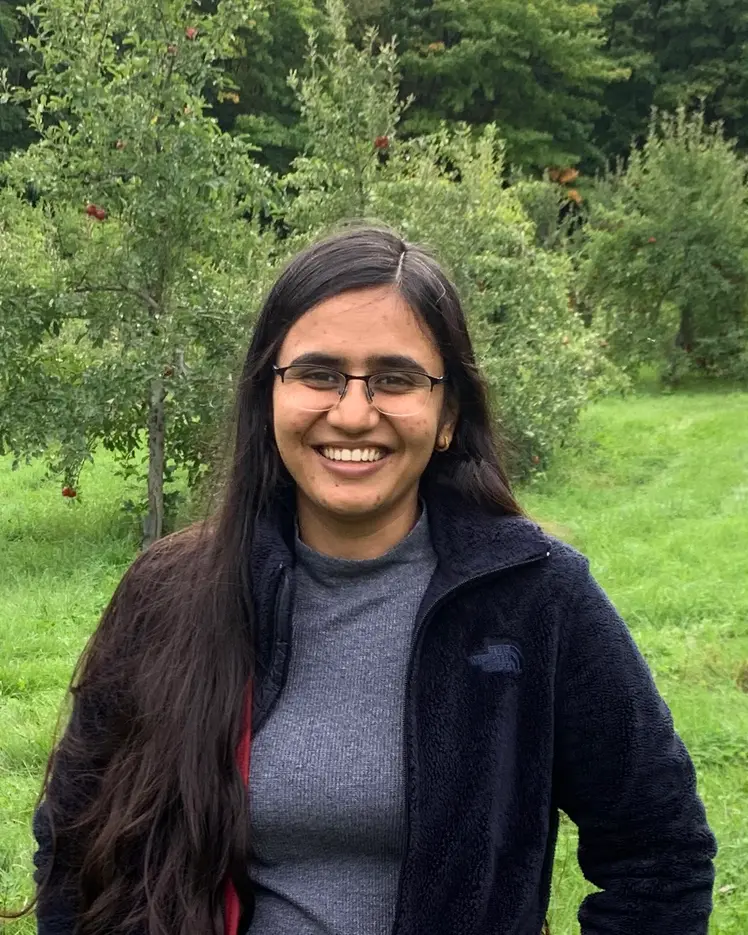
Portrait of Mansi Rankawat

Mansi Rankawat

PhD - Université de Montréal
Research Topics
Machine Learning Theory
Optimization

Publications

From Lyapunov Analysis to Algorithm Design in two-sided PL Minimax Optimization
We derive algorithms for smooth nonconvex nonconcave minimax optimization and establish linear convergence rates for problems that satisfy t… (see more)he two-sided Polyak-Lojasiewicz (PL) inequality. At the core of our approach is the observation that Lyapunov functions can be used not only to certify convergence a posteriori, but also to design algorithms. By replacing an idealized, intractable Lyapunov function with a computable surrogate based on gradient information, we derive TALDA (Tri-Action Lyapunov Descent Ascent), a single-loop algorithm that enforces Lyapunov descent by construction. TALDA guarantees linear convergence under the two-sided PL condition, with a rate that depends explicitly on the cross-smoothness constant. This recovers existing worst-case guarantees while yielding sharper convergence rates in weakly coupled min–max problems.
Bayesian Structure Learning with Generative Flow Networks
In Bayesian structure learning, we are interested in inferring a distribution over the directed acyclic graph (DAG) structure of Bayesian ne… (see more)tworks, from data. Defining such a distribution is very challenging, due to the combinatorially large sample space, and approximations based on MCMC are often required. Recently, a novel class of probabilistic models, called Generative Flow Networks (GFlowNets), have been introduced as a general framework for generative modeling of discrete and composite objects, such as graphs. In this work, we propose to use a GFlowNet as an alternative to MCMC for approximating the posterior distribution over the structure of Bayesian networks, given a dataset of observations. Generating a sample DAG from this approximate distribution is viewed as a sequential decision problem, where the graph is constructed one edge at a time, based on learned transition probabilities. Through evaluation on both simulated and real data, we show that our approach, called DAG-GFlowNet, provides an accurate approximation of the posterior over DAGs, and it compares favorably against other methods based on MCMC or variational inference.