Portrait de Yoshua Bengio

Yoshua Bengio

Membre académique principal
Chaire en IA Canada-CIFAR
Professeur titulaire, Université de Montréal, Département d'informatique et de recherche opérationnelle
Sujets de recherche
Apprentissage automatique médical
Apprentissage de représentations
Apprentissage par renforcement
Apprentissage profond
Causalité
Modèles génératifs
Modèles probabilistes
Modélisation moléculaire
Neurosciences computationnelles
Raisonnement
Réseaux de neurones en graphes
Réseaux de neurones récurrents
Théorie de l'apprentissage automatique
Traitement du langage naturel

Biographie

*Pour toute demande média, veuillez écrire à medias@mila.quebec.

Pour plus d’information, contactez Cassidy MacNeil, adjointe principale et responsable des opérations cassidy.macneil@mila.quebec.

Reconnu comme une sommité mondiale en intelligence artificielle, Yoshua Bengio s’est surtout distingué par son rôle de pionnier en apprentissage profond, ce qui lui a valu le prix A. M. Turing 2018, le « prix Nobel de l’informatique », avec Geoffrey Hinton et Yann LeCun. Il est professeur titulaire à l’Université de Montréal, fondateur et conseiller scientifique de Mila – Institut québécois d’intelligence artificielle, et codirige en tant que senior fellow le programme Apprentissage automatique, apprentissage biologique de l'Institut canadien de recherches avancées (CIFAR). Il occupe également la fonction de conseiller spécial et directeur scientifique fondateur d’IVADO.

En 2018, il a été l’informaticien qui a recueilli le plus grand nombre de nouvelles citations au monde. En 2019, il s’est vu décerner le prestigieux prix Killam. Depuis 2022, il détient le plus grand facteur d’impact (h-index) en informatique à l’échelle mondiale. Il est fellow de la Royal Society de Londres et de la Société royale du Canada, et officier de l’Ordre du Canada.

Soucieux des répercussions sociales de l’IA et de l’objectif que l’IA bénéficie à tous, il a contribué activement à la Déclaration de Montréal pour un développement responsable de l’intelligence artificielle.

Étudiants actuels

Collaborateur·rice de recherche - Cambridge University
Superviseur⋅e principal⋅e :
Collaborateur·rice de recherche - N/A
Superviseur⋅e principal⋅e :
Collaborateur·rice de recherche - KAIST
Collaborateur·rice alumni - UdeM
Postdoctorat - UdeM
Superviseur⋅e principal⋅e :
Collaborateur·rice de recherche - UdeM
Stagiaire de recherche - KOREA ADVANCED INSTITUTE OF SCIENCE AND TECHNOLOGY
Collaborateur·rice de recherche - s.o.
Doctorat - UdeM
Superviseur⋅e principal⋅e :
Visiteur de recherche indépendant - UdeM
Collaborateur·rice de recherche - Ying Wu Coll of Computing
Collaborateur·rice de recherche - University of Waterloo
Superviseur⋅e principal⋅e :
Doctorat - UdeM
Superviseur⋅e principal⋅e :
Collaborateur·rice alumni - UdeM
Co-superviseur⋅e :
Collaborateur·rice de recherche - University of Cambridge
Collaborateur·rice alumni - UdeM
Co-superviseur⋅e :
Collaborateur·rice de recherche - UdeM
Doctorat - McGill
Superviseur⋅e principal⋅e :

Publications

In Which Areas of Technical AI Safety Could Geopolitical Rivals Cooperate?
BEN BUCKNALL
Saad Siddiqui
Robert Trager
LARA THURNHERR
CONOR MCGURK
BEN HARACK
International cooperation is common in AI research, including between geopolitical rivals. While many experts advocate for greater internati… (voir plus)onal cooperation on AI safety to address shared global risks, some view cooperation on AI with suspicion, arguing that it can pose unacceptable risks to national security. However, the extent to which cooperation on AI safety poses such risks, as well as provides benefits, depends on the specific area of cooperation. In this paper, we consider technical factors that impact the risks of international cooperation on AI safety research, focusing on the degree to which such cooperation can advance dangerous capabilities, result in the sharing of sensitive information, or provide opportunities for harm. We begin by why nations historically cooperate on strategic technologies and analyse current US-China cooperation in AI as a case study. We further argue that existing frameworks for managing associated risks can be supplemented with consideration of key risks specific to cooperation on technical AI safety research. Through our analysis, we find that research into AI verification mechanisms and shared protocols may be suitable areas for such cooperation. Through this analysis we aim to help researchers and governments identify and mitigate the risks of international cooperation on AI safety research, so that the benefits of cooperation can be fully realised.
In Which Areas of Technical AI Safety Could Geopolitical Rivals Cooperate?
BEN BUCKNALL
Saad Siddiqui
LARA THURNHERR
CONOR MCGURK
BEN HARACK
Anka Reuel
PATRICIA PASKOV
CASEY MAHONEY
Scott Singer
VINAY HIREMATH
Charbel-Raphael Segerie
OSCAR DELANEY
Alessandro Abate
Fazl Barez
Michael K. Cohen
Philip Torr
FERENC HUSZÁR
ANISOARA CALINESCU
GABRIEL DAVIS JONES … (voir 2 de plus)
Robert Trager
International cooperation is common in AI research, including between geopolitical rivals. While many experts advocate for greater internati… (voir plus)onal cooperation on AI safety to address shared global risks, some view cooperation on AI with suspicion, arguing that it can pose unacceptable risks to national security. However, the extent to which cooperation on AI safety poses such risks, as well as provides benefits, depends on the specific area of cooperation. In this paper, we consider technical factors that impact the risks of international cooperation on AI safety research, focusing on the degree to which such cooperation can advance dangerous capabilities, result in the sharing of sensitive information, or provide opportunities for harm. We begin by why nations historically cooperate on strategic technologies and analyse current US-China cooperation in AI as a case study. We further argue that existing frameworks for managing associated risks can be supplemented with consideration of key risks specific to cooperation on technical AI safety research. Through our analysis, we find that research into AI verification mechanisms and shared protocols may be suitable areas for such cooperation. Through this analysis we aim to help researchers and governments identify and mitigate the risks of international cooperation on AI safety research, so that the benefits of cooperation can be fully realised.
RL, but don't do anything I wouldn't do
Michael K. Cohen
Marcus Hutter
Stuart Russell
In reinforcement learning (RL), if the agent's reward differs from the designers' true utility, even only rarely, the state distribution res… (voir plus)ulting from the agent's policy can be very bad, in theory and in practice. When RL policies would devolve into undesired behavior, a common countermeasure is KL regularization to a trusted policy ("Don't do anything I wouldn't do"). All current cutting-edge language models are RL agents that are KL-regularized to a "base policy" that is purely predictive. Unfortunately, we demonstrate that when this base policy is a Bayesian predictive model of a trusted policy, the KL constraint is no longer reliable for controlling the behavior of an advanced RL agent. We demonstrate this theoretically using algorithmic information theory, and while systems today are too weak to exhibit this theorized failure precisely, we RL-finetune a language model and find evidence that our formal results are plausibly relevant in practice. We also propose a theoretical alternative that avoids this problem by replacing the "Don't do anything I wouldn't do" principle with "Don't do anything I mightn't do".
Discrete Feynman-Kac Correctors
Viktor Ohanesian
Artem Gazizov
Alán Aspuru-Guzik
Roberto Bondesan
Kirill Neklyudov
Discrete diffusion models have recently emerged as a promising alternative to the autoregressive approach for generating discrete sequences.… (voir plus) Sample generation via gradual denoising or demasking processes allows them to capture hierarchical non-sequential interdependencies in the data. These custom processes, however, do not assume a flexible control over the distribution of generated samples. We propose Discrete Feynman-Kac Correctors, a framework that allows for controlling the generated distribution of discrete masked diffusion models at inference time. We derive Sequential Monte Carlo (SMC) algorithms that, given a trained discrete diffusion model, control the temperature of the sampled distribution (i.e. perform annealing), sample from the product of marginals of several diffusion processes (e.g. differently conditioned processes), and sample from the product of the marginal with an external reward function, producing likely samples from the target distribution that also have high reward. Notably, our framework does not require any training of additional models or fine-tuning of the original model. We illustrate the utility of our framework in several applications including: efficient sampling from the annealed Boltzmann distribution of the Ising model, improving the performance of language models for code generation and amortized learning, as well as reward-tilted protein sequence generation.
HVAC-GRACE: Transferable Building Control via Heterogeneous Graph Neural Network Policies
Buildings consume 40% of global energy, with HVAC systems responsible for up to half of that demand. As energy use grows, optimizing HVAC ef… (voir plus)ficiency is critical to meeting climate goals. While reinforcement learning (RL) offers a promising alternative to rule-based control, real-world adoption is limited by poor sample efficiency and generalisation. We introduce HVAC-GRACE, a graph-based RL framework that models buildings as heterogeneous graphs and integrates spatial message passing directly into temporal GRU gates. This enables each zone to learn control actions informed by both its own history and its structural context. Our architecture supports zero-shot transfer by learning topology-agnostic functions—but initial experiments reveal that this benefit depends on sufficient conditioned zone connectivity to maintain gradient flow. These findings highlight both the promise and the architectural requirements of scalable, transferable RL for building control
Efficient Regression-Based Training of Normalizing Flows for Boltzmann Generators
Oscar Davis
Michael Bronstein
Avishek Joey Bose
Simulation-free training frameworks have been at the forefront of the generative modelling revolution in continuous spaces, leading to large… (voir plus)-scale diffusion and flow matching models. However, such modern generative models suffer from expensive inference, inhibiting their use in numerous scientific applications like Boltzmann Generators (BGs) for molecular conformations that require fast likelihood evaluation. In this paper, we revisit classical normalizing flows in the context of BGs that offer efficient sampling and likelihoods, but whose training via maximum likelihood is often unstable and computationally challenging. We propose Regression Training of Normalizing Flows (RegFlow), a novel and scalable regression-based training objective that bypasses the numerical instability and computational challenge of conventional maximum likelihood training in favour of a simple
Fast Monte Carlo Tree Diffusion: 100x Speedup via Parallel Sparse Planning
Jaesik Yoon
Hyeonseo Cho
Diffusion models have recently emerged as a powerful approach for trajectory planning. However, their inherently non-sequential nature limit… (voir plus)s their effectiveness in long-horizon reasoning tasks at test time. The recently proposed Monte Carlo Tree Diffusion (MCTD) offers a promising solution by combining diffusion with tree-based search, achieving state-of-the-art performance on complex planning problems. Despite its strengths, our analysis shows that MCTD incurs substantial computational overhead due to the sequential nature of tree search and the cost of iterative denoising. To address this, we propose Fast-MCTD, a more efficient variant that preserves the strengths of MCTD while significantly improving its speed and scalability. Fast-MCTD integrates two techniques: Parallel MCTD, which enables parallel rollouts via delayed tree updates and redundancy-aware selection; and Sparse MCTD, which reduces rollout length through trajectory coarsening. Experiments show that Fast-MCTD achieves up to 100x speedup over standard MCTD while maintaining or improving planning performance. Remarkably, it even outperforms Diffuser in inference speed on some tasks, despite Diffuser requiring no search and yielding weaker solutions. These results position Fast-MCTD as a practical and scalable solution for diffusion-based inference-time reasoning.
Torsional-GFN: a conditional conformation generator for small molecules
Structure-Aligned Protein Language Model
Can Chen
David Heurtel-Depeiges
Robert M. Vernon
Christopher J. Langmead
Self-Evolving Curriculum for LLM Reasoning
Can a Bayesian Oracle Prevent Harm from an Agent?
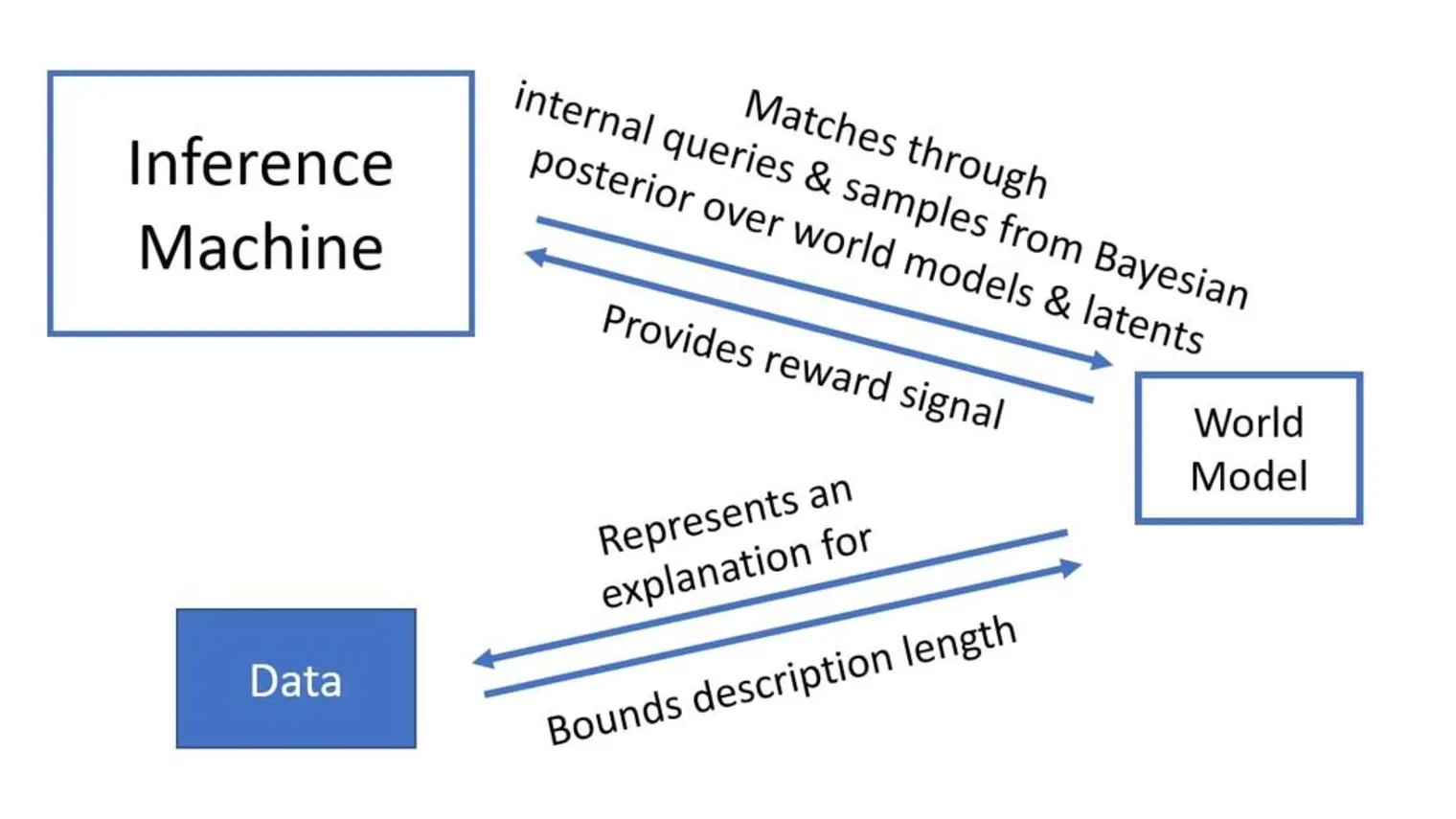
Is there a way to design powerful AI systems based on machine learning methods that would satisfy probabilistic safety guarantees? With the … (voir plus)long-term goal of obtaining a probabilistic guarantee that would apply in every context, we consider estimating a context-dependent bound on the probability of violating a given safety specification. Such a risk evaluation would need to be performed at run-time to provide a guardrail against dangerous actions of an AI. Noting that different plausible hypotheses about the world could produce very different outcomes, and because we do not know which one is right, we derive bounds on the safety violation probability predicted under the true but unknown hypothesis. Such bounds could be used to reject potentially dangerous actions. Our main results involve searching for cautious but plausible hypotheses, obtained by a maximization that involves Bayesian posteriors over hypotheses. We consider two forms of this result, in the iid case and in the non-iid case, and conclude with open problems towards turning such theoretical results into practical AI guardrails.
Ant Colony Sampling with GFlowNets for Combinatorial Optimization
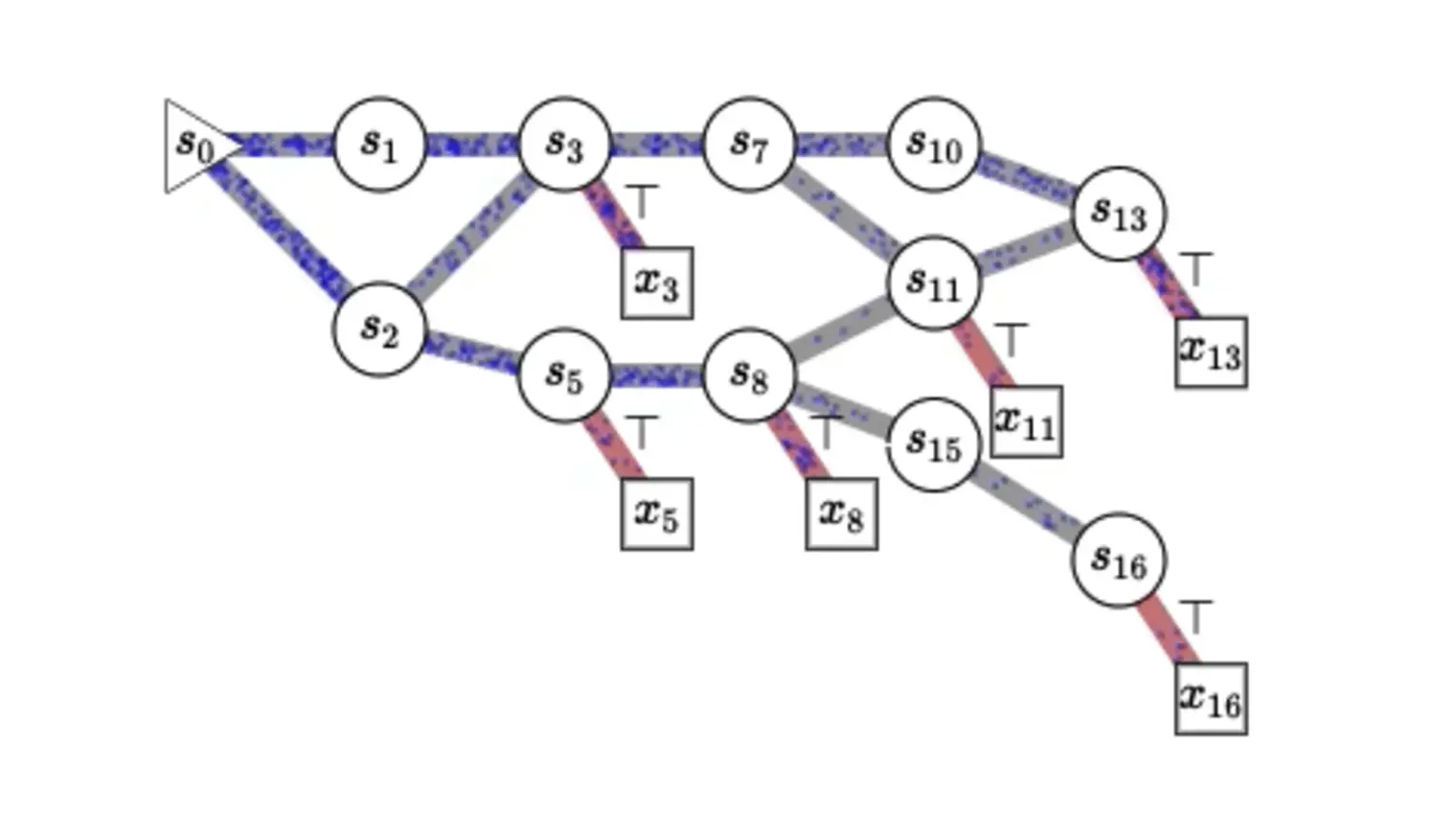
We present the Generative Flow Ant Colony Sampler (GFACS), a novel meta-heuristic method that hierarchically combines amortized inference an… (voir plus)d parallel stochastic search. Our method first leverages Generative Flow Networks (GFlowNets) to amortize a \emph{multi-modal} prior distribution over combinatorial solution space that encompasses both high-reward and diversified solutions. This prior is iteratively updated via parallel stochastic search in the spirit of Ant Colony Optimization (ACO), leading to the posterior distribution that generates near-optimal solutions. Extensive experiments across seven combinatorial optimization problems demonstrate GFACS's promising performances.