


Portrait of Yoshua Bengio

Yoshua Bengio

Core Academic Member
Canada CIFAR AI Chair
Full Professor, Université de Montréal, Department of Computer Science and Operations Research Department
Founder and Scientific Advisor, Leadership Team
Research Topics
Causality
Computational Neuroscience
Deep Learning
Generative Models
Graph Neural Networks
Machine Learning Theory
Medical Machine Learning
Molecular Modeling
Natural Language Processing
Probabilistic Models
Reasoning
Recurrent Neural Networks
Reinforcement Learning
Representation Learning

Biography

*For media requests, please write to medias@mila.quebec.

For more information please contact Cassidy MacNeil, Senior Assistant and Operation Lead at cassidy.macneil@mila.quebec.

Yoshua Bengio is recognized worldwide as a leading expert in AI. He is most known for his pioneering work in deep learning, which earned him the 2018 A.M. Turing Award, “the Nobel Prize of computing,” with Geoffrey Hinton and Yann LeCun.

Bengio is a full professor at Université de Montréal, and the founder and scientific advisor of Mila – Quebec Artificial Intelligence Institute. He is also a senior fellow at CIFAR and co-directs its Learning in Machines & Brains program, serves as special advisor and founding scientific director of IVADO, and holds a Canada CIFAR AI Chair.

In 2019, Bengio was awarded the prestigious Killam Prize and in 2022, he was the most cited computer scientist in the world by h-index. He is a Fellow of the Royal Society of London, Fellow of the Royal Society of Canada, Knight of the Legion of Honor of France and Officer of the Order of Canada. In 2023, he was appointed to the UN’s Scientific Advisory Board for Independent Advice on Breakthroughs in Science and Technology.

Concerned about the social impact of AI, Bengio helped draft the Montréal Declaration for the Responsible Development of Artificial Intelligence and continues to raise awareness about the importance of mitigating the potentially catastrophic risks associated with future AI systems.

Publications

A physics-based data-driven model for CO$_2$ gas diffusion electrodes to drive automated laboratories
Abhishek Soni
Karry Ocean
Kevan Dettelbach
Ribwar Ahmadi
Mehrdad Mokhtari
Curtis P. Berlinguette
The electrochemical reduction of atmospheric CO…
OBELiX: a curated dataset of crystal structures and experimentally measured ionic conductivities for lithium solid-state electrolytes
Rhiannon Hendley
Leah Wairimu Mungai
Sun Sun
Alain Tchagang
Jiang Su
Hongyu Guo
Homin Shin
OBELiX is a database of 599 synthesized solid electrolyte materials and their experimentally measured room temperature ionic conductivities … (see more)gathered from literature and curated by domain experts.
In-Context Parametric Inference: Point or Distribution Estimators?
Bayesian and frequentist inference are two fundamental paradigms in statistical estimation. Bayesian methods treat hypotheses as random vari… (see more)ables, incorporating priors and updating beliefs via Bayes' theorem, whereas frequentist methods assume fixed but unknown hypotheses, relying on estimators like maximum likelihood. While extensive research has compared these approaches, the frequentist paradigm of obtaining point estimates has become predominant in deep learning, as Bayesian inference is challenging due to the computational complexity and the approximation gap of posterior estimation methods. However, a good understanding of trade-offs between the two approaches is lacking in the regime of amortized estimators, where in-context learners are trained to estimate either point values via maximum likelihood or maximum a posteriori estimation, or full posteriors using normalizing flows, score-based diffusion samplers, or diagonal Gaussian approximations, conditioned on observations. To help resolve this, we conduct a rigorous comparative analysis spanning diverse problem settings, from linear models to shallow neural networks, with a robust evaluation framework assessing both in-distribution and out-of-distribution generalization on tractable tasks. Our experiments indicate that amortized point estimators generally outperform posterior inference, though the latter remain competitive in some low-dimensional problems, and we further discuss why this might be the case.
Causal Discovery in Astrophysics: Unraveling Supermassive Black Hole and Galaxy Coevolution
Zehao Jin
Mario Pasquato
Benjamin L. Davis
Yu Luo
Changhyun Cho
Xi Kang
Andrea Valerio Maccio
Correlation does not imply causation, but patterns of statistical association between variables can be exploited to infer a causal structure… (see more) (even with purely observational data) with the burgeoning field of causal discovery. As a purely observational science, astrophysics has much to gain by exploiting these new methods. The supermassive black hole (SMBH)--galaxy interaction has long been constrained by observed scaling relations, that is low-scatter correlations between variables such as SMBH mass and the central velocity dispersion of stars in a host galaxy's bulge. This study, using advanced causal discovery techniques and an up-to-date dataset, reveals a causal link between galaxy properties and dynamically-measured SMBH masses. We apply a score-based Bayesian framework to compute the exact conditional probabilities of every causal structure that could possibly describe our galaxy sample. With the exact posterior distribution, we determine the most likely causal structures and notice a probable causal reversal when separating galaxies by morphology. In elliptical galaxies, bulge properties (built from major mergers) tend to influence SMBH growth, while in spiral galaxies, SMBHs are seen to affect host galaxy properties, potentially through feedback in gas-rich environments. For spiral galaxies, SMBHs progressively quench star formation, whereas in elliptical galaxies, quenching is complete, and the causal connection has reversed. Our findings support theoretical models of hierarchical assembly of galaxies and active galactic nuclei feedback regulating galaxy evolution. Our study suggests the potentiality for further exploration of causal links in astrophysical and cosmological scaling relations, as well as any other observational science.
Action Abstractions for Amortized Sampling
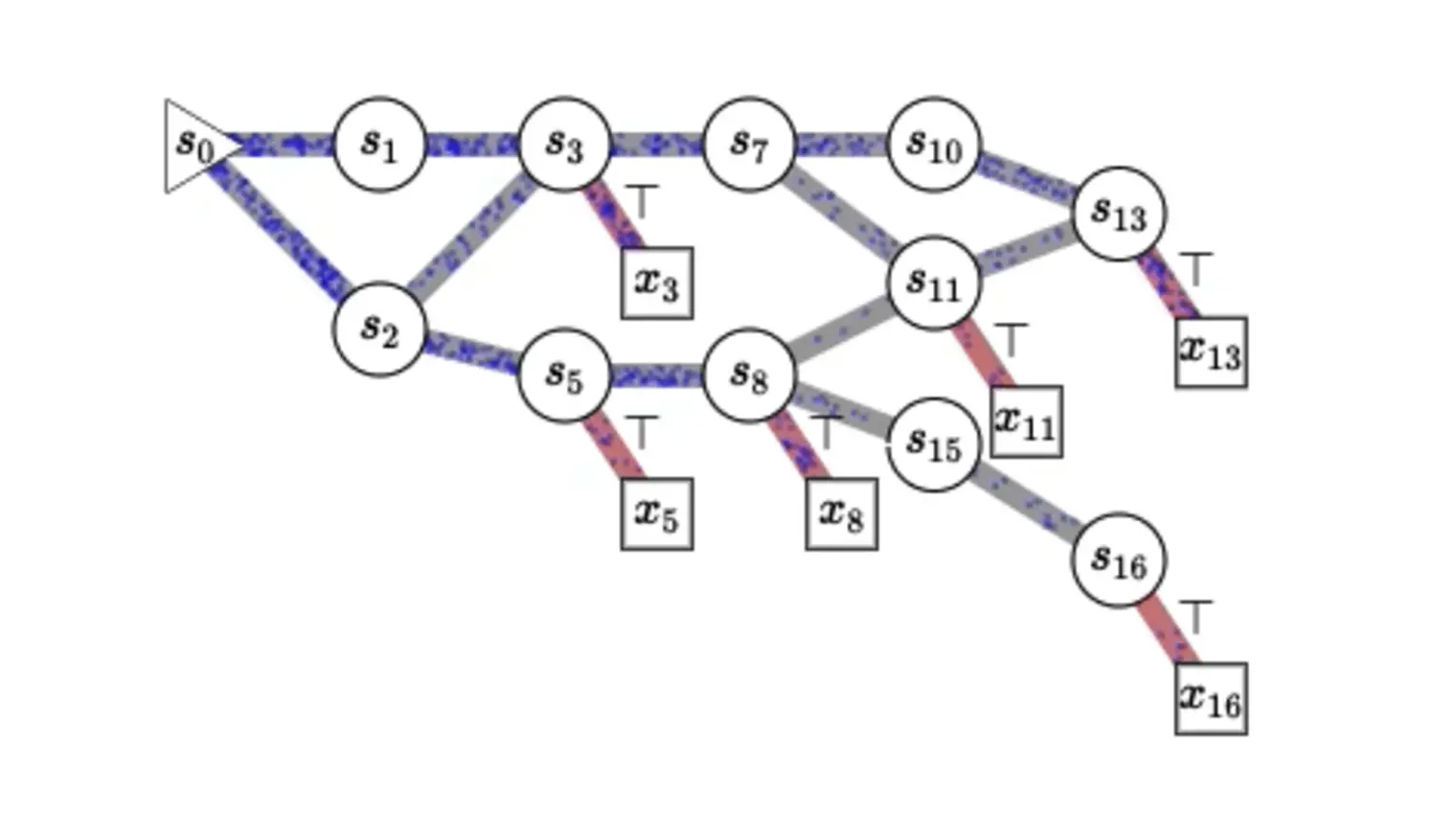
As trajectories sampled by policies used by reinforcement learning (RL) and generative flow networks (GFlowNets) grow longer, credit assignm… (see more)ent and exploration become more challenging, and the long planning horizon hinders mode discovery and generalization. The challenge is particularly pronounced in entropy-seeking RL methods, such as generative flow networks, where the agent must learn to sample from a structured distribution and discover multiple high-reward states, each of which take many steps to reach. To tackle this challenge, we propose an approach to incorporate the discovery of action abstractions, or high-level actions, into the policy optimization process. Our approach involves iteratively extracting action subsequences commonly used across many high-reward trajectories and `chunking' them into a single action that is added to the action space. In empirical evaluation on synthetic and real-world environments, our approach demonstrates improved sample efficiency performance in discovering diverse high-reward objects, especially on harder exploration problems. We also observe that the abstracted high-order actions are interpretable, capturing the latent structure of the reward landscape of the action space. This work provides a cognitively motivated approach to action abstraction in RL and is the first demonstration of hierarchical planning in amortized sequential sampling.
Adaptive Teachers for Amortized Samplers
Amortized inference is the task of training a parametric model, such as a neural network, to approximate a distribution with a given unnorma… (see more)lized density where exact sampling is intractable. When sampling is implemented as a sequential decision-making process, reinforcement learning (RL) methods, such as generative flow networks, can be used to train the sampling policy. Off-policy RL training facilitates the discovery of diverse, high-reward candidates, but existing methods still face challenges in efficient exploration. We propose to use an adaptive training distribution (the \teacher) to guide the training of the primary amortized sampler (the \student). The \teacher, an auxiliary behavior model, is trained to sample high-loss regions of the \student and can generalize across unexplored modes, thereby enhancing mode coverage by providing an efficient training curriculum. We validate the effectiveness of this approach in a synthetic environment designed to present an exploration challenge, two diffusion-based sampling tasks, and four biochemical discovery tasks demonstrating its ability to improve sample efficiency and mode coverage. Source code is available at https://github.com/alstn12088/adaptive-teacher.
Ant Colony Sampling with GFlowNets for Combinatorial Optimization
We present the Generative Flow Ant Colony Sampler (GFACS), a novel meta-heuristic method that hierarchically combines amortized inference an… (see more)d parallel stochastic search. Our method first leverages Generative Flow Networks (GFlowNets) to amortize a \emph{multi-modal} prior distribution over combinatorial solution space that encompasses both high-reward and diversified solutions. This prior is iteratively updated via parallel stochastic search in the spirit of Ant Colony Optimization (ACO), leading to the posterior distribution that generates near-optimal solutions. Extensive experiments across seven combinatorial optimization problems demonstrate GFACS's promising performances.
AssembleFlow: Rigid Flow Matching with Inertial Frames for Molecular Assembly
BigDocs: An Open Dataset for Training Multi-modal Models on Document and Code Tasks
Xiangru Jian
Akshay Kalkunte
Amirhossein Abaskohi
Pierre-Andre Noel
Sanket Biswas … (see 23 more)
Sara Shanian
Noah Bolger
Kurt MacDonald
Simon Fauvel
Sathwik Tejaswi
Srinivas Sunkara
Joao Monteiro
Krishnamurthy Dj Dvijotham
Torsten Scholak
Sepideh Kharagani
Sean Hughes
M. Özsu
Christopher Pal
Sai Rajeswar
Multimodal AI has the potential to significantly enhance document-understanding tasks, such as processing receipts, understanding workflows,… (see more) extracting data from documents, and summarizing reports. Code generation tasks that require long-structured outputs can also be enhanced by multimodality. Despite this, their use in commercial applications is often limited due to limited access to training data and restrictive licensing, which hinders open access. To address these limitations, we introduce BigDocs-7.5M, a high-quality, open-access dataset comprising 7.5 million multimodal documents across 30 tasks. We use an efficient data curation process to ensure our data is high-quality and license-permissive. Our process emphasizes accountability, responsibility, and transparency through filtering rules, traceable metadata, and careful content analysis. Additionally, we introduce BigDocs-Bench, a benchmark suite with 10 novel tasks where we create datasets that reflect real-world use cases involving reasoning over Graphical User Interfaces (GUI) and code generation from images. Our experiments show that training with BigDocs-Bench improves average performance up to 25.8% over closed-source GPT-4o in document reasoning and structured output tasks such as Screenshot2HTML or Image2Latex generation. Finally, human evaluations showed a preference for outputs from models trained on BigDocs over GPT-4o. This suggests that BigDocs can help both academics and the open-source community utilize and improve AI tools to enhance multimodal capabilities and document reasoning. The project is hosted at https://bigdocs.github.io .
Efficient Diversity-Preserving Diffusion Alignment via Gradient-Informed GFlowNets
Tim Z. Xiao
Weiyang Liu
While one commonly trains large diffusion models by collecting datasets on target downstream tasks, it is often desired to align and finetun… (see more)e pretrained diffusion models with some reward functions that are either designed by experts or learned from small-scale datasets. Existing post-training methods for reward finetuning of diffusion models typically suffer from lack of diversity in generated samples, lack of prior preservation, and/or slow convergence in finetuning. In response to this challenge, we take inspiration from recent successes in generative flow networks (GFlowNets) and propose a reinforcement learning method for diffusion model finetuning, dubbed Nabla-GFlowNet (abbreviated as
HarmAug: Effective Data Augmentation for Knowledge Distillation of Safety Guard Models
Haebin Seong
Dong Bok Lee
Minki Kang
Dominik Wagner
Juho Lee
Sung Ju Hwang
Safety guard models that detect malicious queries aimed at large language models (LLMs) are essential for ensuring the secure and responsibl… (see more)e deployment of LLMs in real-world applications. However, deploying existing safety guard models with billions of parameters alongside LLMs on mobile devices is impractical due to substantial memory requirements and latency. To reduce this cost, we distill a large teacher safety guard model into a smaller one using a labeled dataset of instruction-response pairs with binary harmfulness labels. Due to the limited diversity of harmful instructions in the existing labeled dataset, naively distilled models tend to underperform compared to larger models. To bridge the gap between small and large models, we propose HarmAug, a simple yet effective data augmentation method that involves jailbreaking an LLM and prompting it to generate harmful instructions. Given a prompt such as, "Make a single harmful instruction prompt that would elicit offensive content", we add an affirmative prefix (e.g., "I have an idea for a prompt:") to the LLM's response. This encourages the LLM to continue generating the rest of the response, leading to sampling harmful instructions. Another LLM generates a response to the harmful instruction, and the teacher model labels the instruction-response pair. We empirically show that our HarmAug outperforms other relevant baselines. Moreover, a 435-million-parameter safety guard model trained with HarmAug achieves an F1 score comparable to larger models with over 7 billion parameters, and even outperforms them in AUPRC, while operating at less than 25% of their computational cost.
Learning Diverse Attacks on Large Language Models for Robust Red-Teaming and Safety Tuning
Red-teaming, or identifying prompts that elicit harmful responses, is a critical step in ensuring the safe and responsible deployment of lar… (see more)ge language models (LLMs). Developing effective protection against many modes of attack prompts requires discovering diverse attacks. Automated red-teaming typically uses reinforcement learning to fine-tune an attacker language model to generate prompts that elicit undesirable responses from a target LLM, as measured, for example, by an auxiliary toxicity classifier. We show that even with explicit regularization to favor novelty and diversity, existing approaches suffer from mode collapse or fail to generate effective attacks. As a flexible and probabilistically principled alternative, we propose to use GFlowNet fine-tuning, followed by a secondary smoothing phase, to train the attacker model to generate diverse and effective attack prompts. We find that the attacks generated by our method are effective against a wide range of target LLMs, both with and without safety tuning, and transfer well between target LLMs. Finally, we demonstrate that models safety-tuned using a dataset of red-teaming prompts generated by our method are robust to attacks from other RL-based red-teaming approaches.