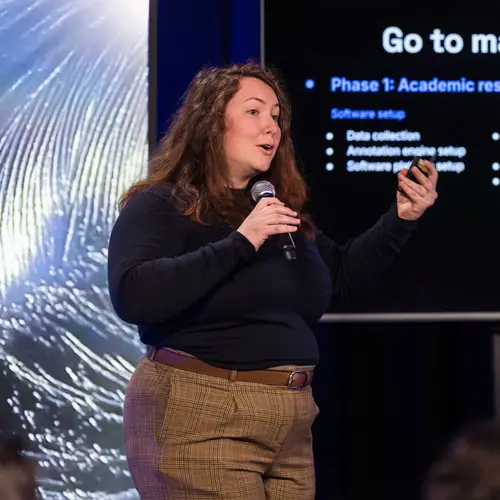
Join us on June 10 for the "After Mila" event, a series of community meetups pairing AI researchers with field experts to discuss the tangible impact of AI on our daily lives.
The Mila AI Policy Fellowship translates deep AI expertise into rigorous, public-interest policy. Read the newest publication Bridging the Expertise Gap: Knowledge Transfer Mechanisms for AI Regulation by Moritz von Knebel
We use cookies to analyze the browsing and usage of our website and to personalize your experience. You can disable these technologies at any time, but this may limit certain functionalities of the site. Read our Privacy Policy for more information.
Setting cookies
You can enable and disable the types of cookies you wish to accept. However certain choices you make could affect the services offered on our sites (e.g. suggestions, personalised ads, etc.).
Essential cookies
These cookies are necessary for the operation of the site and cannot be deactivated. (Still active)
Analytics cookies
Do you accept the use of cookies to measure the audience of our sites?
Multimedia Player
Do you accept the use of cookies to display and allow you to watch the video content hosted by our partners (YouTube, etc.)?
We present a generic algorithm for learning and approximate inference with an intuitive epistemic interpretation: iteratively focus on a sub… (see more)set of the model and resolve inconsistencies using the parameters under control. This framework, which we call Local Inconsistency Resolution (LIR) is built upon Probabilistic Dependency Graphs (PDGs), which provide a flexible representational foundation capable of capturing inconsistent beliefs. We show how LIR unifies and generalizes a wide variety of important algorithms in the literature, including the Expectation-Maximization (EM) algorithm, belief propagation, adversarial training, GANs, and GFlowNets. Each of these methods can be recovered as a specific instance of LIR by choosing a procedure to direct focus (attention and control). We implement this algorithm for discrete PDGs and study its properties on synthetically generated PDGs, comparing its behavior to the global optimization semantics of the full PDG.
2026-02-02
International Conference on Artificial Intelligence and Statistics (spotlight)