Portrait of Chenghao Liu is unavailable

Chenghao Liu

Collaborating Alumni
Supervisor
Research Topics
Generative Models
Molecular Modeling

Publications

General Multimodal Protein Design Enables DNA-Encoding of Chemistry
Théophile Lambert
Daniel Roth
Yueming Long
Zi-Qi Li
Xi Zhang
Miruna Cretu
Francesca-Zhoufan Li
Tanvi Ganapathy
Emily Jin
Avishek Joey Bose
Jason Yang
Kirill Neklyudov
Frances H. Arnold
Cheng-Hao Liu
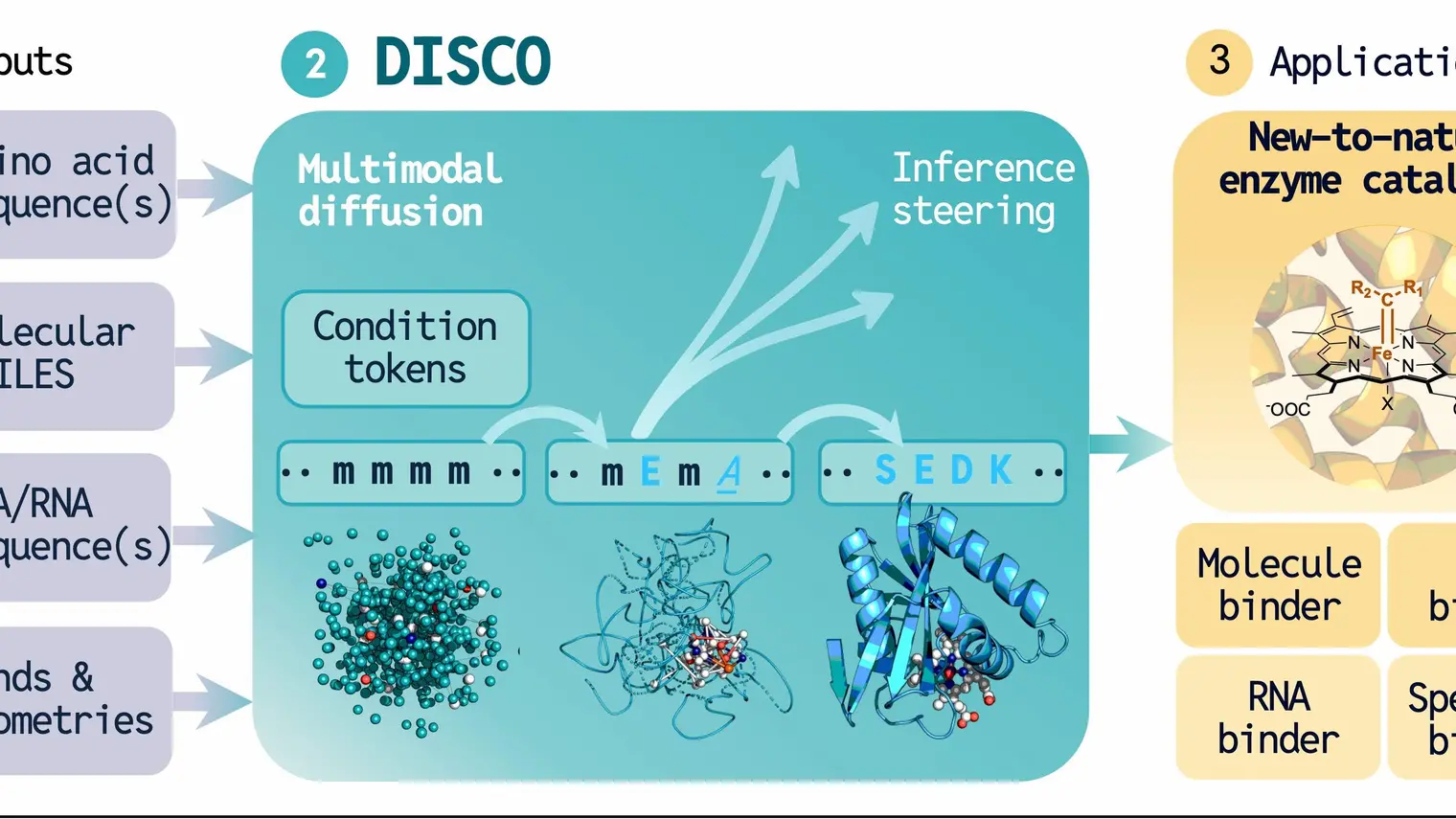
Evolution is an extraordinary engine for enzymatic diversity, yet the chemistry it has explored remains a narrow slice of what DNA can encod… (see more)e. Deep generative models can design new proteins that bind ligands, but none have created enzymes without pre-specifying catalytic residues. We introduce DISCO (DIffusion for Sequence-structure CO-design), a multimodal model that co-designs protein sequence and 3D structure around arbitrary biomolecules, as well as inference-time scaling methods that optimize objectives across both modalities. Conditioned solely on reactive intermediates, DISCO designs diverse heme enzymes with novel active-site geometries. These enzymes catalyze new-to-nature carbene-transfer reactions, including alkene cyclopropanation, spirocyclopropanation, B-H, and C(sp
Navigating ternary doping in Li-ion cathodes with closed-loop multi-objective Bayesian optimization
Nooshin Zeinali Galabi
Cheng-Hao Liu
Marc Kamel
Shipeng Jia
Eric McCalla
To further improve secondary battery materials, we are increasingly exploring highly complex composition spaces in attempts to optimize mult… (see more)iple properties simultaneously. While our past work has done this in systematic manners using high-throughput experimentation, the exponential increase in the search space with triple doping makes grid search prohibitively expensive. Here, we demonstrate a closed-loop, multi-objective machine learning approach to guide the high-throughput workflow to efficiently navigate a space with approximately 14 million unique combinations. The test system is LiCoPO4 which we have previously explored using systematic codoping that was effective in optimizing one property only: energy density. To learn multiple electrochemical metrics, we first pretrain a set transformer on the public Materials Project database as a feature extractor, then attach a multi-task Gaussian process head and finetune the entire model on our high-throughput data. Through 3 rounds of active learning, we demonstrate that with a very small number of samples (as few as 125 random compositions and 63 predicted) we are able to simultaneously optimize four key electrochemical properties. Relative to the undoped system, the best composition raises our composite figure of merit by up to five times. This establishes an end-to-end workflow for accelerated battery materials design to be used in the rapidly growing field of autonomous materials discovery.
Integrating Generative and Experimental Platforms for Biomolecular Design
Soojung Yang
Sidney Lisanza
Jacob Gershon
Lauren Hong
Pranam Chatterjee
Biomolecular design, through artificial engineering of proteins, ligands, nucleic acids, and cells, holds immense promise in addressing pres… (see more)sing medical, industrial, and environmental challenges. While generative machine learning has shown significant potential in this area, a disconnect exists with experimental biology: many ML research efforts prioritize static benchmark performance, potentially sidelining impactful biological applications. This workshop seeks to bridge this gap by bringing computationalists and experimentalists together, catalyzing a deeper interdisciplinary discourse. Together, we will explore the strengths and challenges of generative ML in biology, experimental integration of generative ML, and biological problems ready for ML. To attract high-quality and diverse research, we partnered with Nature Biotechnology for a special collection, and we created dedicated tracks for in-silico ML research and hybrid ML-experimental biology research. Our lineup features emerging leaders as speakers and renowned scientists as panelists, encapsulating a spectrum from high-throughput experimentation and computational biology to generative ML. To catalyze new collaborations, we will host a seed-grant competition for pairs of experimentalists and computationalists proposing fresh joint projects. To connect dry and wet lab practice, a wet-lab challenge sponsored by Adaptyv Bio will empirically evaluate protein design models. With a diverse organizing team and backed by industry sponsors, we dedicate the workshop to pushing the boundaries of ML's role in biology. This will be the third edition of this workshop following the previous versions of it we organized at ICLR 2024 and 2025.


OXtal: An All-Atom Diffusion Model for Organic Crystal Structure Prediction
Emily Jin
Kin Long Kelvin Lee
Santiago Miret
Frances H. Arnold
Michael M. Bronstein
Avishek Bose
Cheng-Hao Liu
Steering Masked Discrete Diffusion Models via Discrete Denoising Posterior Prediction
Zhangzhi Peng
Zachary Quinn
Michael Bronstein
Pranam Chatterjee
Avishek Joey Bose
Generative modeling of discrete data underlies important applications spanning text-based agents like ChatGPT to the design of the very buil… (see more)ding blocks of life in protein sequences. However, application domains need to exert control over the generated data by steering the generative process - typically via RLHF - to satisfy a specified property, reward, or affinity metric. In this paper, we study the problem of steering Masked Diffusion Models (MDMs), a recent class of discrete diffusion models that offer a compelling alternative to traditional autoregressive models. We introduce Discrete Denoising Posterior Prediction (DDPP), a novel framework that casts the task of steering pre-trained MDMs as a problem of probabilistic inference by learning to sample from a target Bayesian posterior. Our DDPP framework leads to a family of three novel objectives that are all simulation-free, and thus scalable while applying to general non-differentiable reward functions. Empirically, we instantiate DDPP by steering MDMs to perform class-conditional pixel-level image modeling, RLHF-based alignment of MDMs using text-based rewards, and finetuning protein language models to generate more diverse secondary structures and shorter proteins. We substantiate our designs via wet-lab validation, where we observe transient expression of reward-optimized protein sequences.
Integrating Generative and Experimental Platforms for Biomolecular Design
Cheng-Hao Liu
Soojung Yang
Sidney L Lisanza
Francesca-Zhoufan Li
Hannes Stärk
Jacob Gershon
Lauren Hong
Pranam Chatterjee
Tommi Jaakkola
Regina Barzilay
David Baker
Frances H. Arnold
Biomolecular design, through artificial engineering of proteins, ligands, and nucleic acids, holds immense promise in addressing pressing me… (see more)dical, industrial, and environmental challenges. While generative machine learning has shown significant potential in this area, a palpable disconnect exists with experimental biology: many ML research efforts prioritize static benchmark performance, potentially sidelining impactful biological applications. This workshop seeks to bridge this gap by bringing computationalists and experimentalists together, catalyzing a deeper interdisciplinary discourse. Together, we will explore the strengths and challenges of generative ML in biology, experimental integration of generative ML, and biological problems ready for ML. To attract high-quality and diverse research, we partnered with Nature Biotechnology for a special collection, and we created dedicated tracks for in-silico ML research and hybrid ML-experimental biology research. Our lineup features emerging leaders as speakers and renowned scientists as panelists, encapsulating a spectrum from high-throughput experimentation and computational biology to generative ML. With a diverse organizing team and backed by industry sponsors, we dedicate the workshop to pushing the boundaries of ML's role in biology.
RGFN: Synthesizable Molecular Generation Using GFlowNets
Andrei Rekesh
Dmytro Shevchuk
Cheng-Hao Liu
Mike Tyers
Robert A. Batey
Generative models hold great promise for small molecule discovery, significantly increasing the size of search space compared to traditional… (see more) in silico screening libraries. However, most existing machine learning methods for small molecule generation suffer from poor synthesizability of candidate compounds, making experimental validation difficult. In this paper we propose Reaction-GFlowNet (RGFN), an extension of the GFlowNet framework that operates directly in the space of chemical reactions, thereby allowing out-of-the-box synthesizability while maintaining comparable quality of generated candidates. We demonstrate that with the proposed set of reactions and building blocks, it is possible to obtain a search space of molecules orders of magnitude larger than existing screening libraries coupled with low cost of synthesis. We also show that the approach scales to very large fragment libraries, further increasing the number of potential molecules. We demonstrate the effectiveness of the proposed approach across a range of oracle models, including pretrained proxy models and GPU-accelerated docking.
Multi-Fidelity Active Learning with GFlowNets
In the last decades, the capacity to generate large amounts of data in science and engineering applications has been growing steadily. Meanw… (see more)hile, the progress in machine learning has turned it into a suitable tool to process and utilise the available data. Nonetheless, many relevant scientific and engineering problems present challenges where current machine learning methods cannot yet efficiently leverage the available data and resources. For example, in scientific discovery, we are often faced with the problem of exploring very large, high-dimensional spaces, where querying a high fidelity, black-box objective function is very expensive. Progress in machine learning methods that can efficiently tackle such problems would help accelerate currently crucial areas such as drug and materials discovery. In this paper, we propose the use of GFlowNets for multi-fidelity active learning, where multiple approximations of the black-box function are available at lower fidelity and cost. GFlowNets are recently proposed methods for amortised probabilistic inference that have proven efficient for exploring large, high-dimensional spaces and can hence be practical in the multi-fidelity setting too. Here, we describe our algorithm for multi-fidelity active learning with GFlowNets and evaluate its performance in both well-studied synthetic tasks and practically relevant applications of molecular discovery. Our results show that multi-fidelity active learning with GFlowNets can efficiently leverage the availability of multiple oracles with different costs and fidelities to accelerate scientific discovery and engineering design.
Iterated Denoising Energy Matching for Sampling from Boltzmann Densities
Efficiently generating statistically independent samples from an unnormalized probability distribution, such as equilibrium samples of many-… (see more)body systems, is a foundational problem in science. In this paper, we propose Iterated Denoising Energy Matching (iDEM), an iterative algorithm that uses a novel stochastic score matching objective leveraging solely the energy function and its gradient -- and no data samples -- to train a diffusion-based sampler. Specifically, iDEM alternates between (I) sampling regions of high model density from a diffusion-based sampler and (II) using these samples in our stochastic matching objective to further improve the sampler. iDEM is scalable to high dimensions as the inner matching objective, is simulation-free, and requires no MCMC samples. Moreover, by leveraging the fast mode mixing behavior of diffusion, iDEM smooths out the energy landscape enabling efficient exploration and learning of an amortized sampler. We evaluate iDEM on a suite of tasks ranging from standard synthetic energy functions to invariant
Integrating Generative and Experimental Platforms or Biomolecular Design
Cheng-Hao Liu
Jason Yim
Soojung Yang
Sidney Lisanza
Francesca-Zhoufan Li
Pranam Chatterjee
Tommi Jaakkola
Regina Barzilay
David Baker
Frances H. Arnold
Diffusion Generative Flow Samplers: Improving Learning Signals Through Partial Trajectory Optimization
Ricky T. Q. Chen
Cheng-Hao Liu
We tackle the problem of sampling from intractable high-dimensional density functions, a fundamental task that often appears in machine lear… (see more)ning and statistics. We extend recent sampling-based approaches that leverage controlled stochastic processes to model approximate samples from these target densities. The main drawback of these approaches is that the training objective requires full trajectories to compute, resulting in sluggish credit assignment issues due to use of entire trajectories and a learning signal present only at the terminal time. In this work, we present Diffusion Generative Flow Samplers (DGFS), a sampling-based framework where the learning process can be tractably broken down into short partial trajectory segments, via parameterizing an additional "flow function". Our method takes inspiration from the theory developed for generative flow networks (GFlowNets), allowing us to make use of intermediate learning signals. Through various challenging experiments, we demonstrate that DGFS achieves more accurate estimates of the normalization constant than closely-related prior methods.
Generative Active Learning for the Search of Small-Molecule Protein Binders
Cheng-Hao Liu
Éric Jolicoeur
Edward Ruediger
Andrei Nica
Daniel St-Cyr
Doris Alexandra Schuetz
Victor Ion Butoi
Saikrishna Gottipati
Prateek Gupta
Sasikanth Avancha
William Hamilton
Brooks Paige
Sanchit Misra
Bharat Kaul
José Miguel Hernández-Lobato
Marwin Segler
Michael Bronstein
Anne Marinier
Mike Tyers
Despite substantial progress in machine learning for scientific discovery in recent years, truly de novo design of small molecules which exh… (see more)ibit a property of interest remains a significant challenge. We introduce LambdaZero, a generative active learning approach to search for synthesizable molecules. Powered by deep reinforcement learning, LambdaZero learns to search over the vast space of molecules to discover candidates with a desired property. We apply LambdaZero with molecular docking to design novel small molecules that inhibit the enzyme soluble Epoxide Hydrolase 2 (sEH), while enforcing constraints on synthesizability and drug-likeliness. LambdaZero provides an exponential speedup in terms of the number of calls to the expensive molecular docking oracle, and LambdaZero de novo designed molecules reach docking scores that would otherwise require the virtual screening of a hundred billion molecules. Importantly, LambdaZero discovers novel scaffolds of synthesizable, drug-like inhibitors for sEH. In in vitro experimental validation, a series of ligands from a generated quinazoline-based scaffold were synthesized, and the lead inhibitor N-(4,6-di(pyrrolidin-1-yl)quinazolin-2-yl)-N-methylbenzamide (UM0152893) displayed sub-micromolar enzyme inhibition of sEH.