Portrait de Danilo Bzdok

Danilo Bzdok

Membre académique principal
Chaire en IA Canada-CIFAR
Professeur agrégé, McGill University, Département de génie biomédicale
Sujets de recherche
Apprentissage profond
Biologie computationnelle
Grands modèles de langage (LLM)
Traitement du langage naturel

Biographie

Danilo Bzdok est informaticien et médecin de formation. Il possède une double formation unique en neurosciences systémiques et en algorithmes d'apprentissage automatique. Après une formation à l'Université d'Aix-la-Chapelle (RWTH) (Allemagne), à l'Université de Lausanne (Suisse) et à la Harvard Medical School (États-Unis), il a obtenu un doctorat en neurosciences du Centre de recherche de Jülich (Allemagne) et un doctorat en informatique dans le domaine des statistiques d'apprentissage automatique à l'INRIA Saclay et à NeuroSpin (Paris, France). Il est actuellement professeur agrégé à la Faculté de médecine de l'Université McGill et titulaire d’une chaire en IA Canada-CIFAR à Mila – Institut québécois d'intelligence artificielle. Son activité de recherche interdisciplinaire est centrée sur la réduction des lacunes dans la connaissance des bases cérébrales des types de pensée qui définissent l'être humain, afin de découvrir les principes clés de conception computationnelle qui sous-tendent l'intelligence humaine.
Étudiants actuels

Doctorat - McGill
Doctorat - McGill
Doctorat - McGill
Collaborateur·rice de recherche - CentraleSupélec
Doctorat - McGill
Collaborateur·rice de recherche - École Polytechnique Paris
Doctorat - McGill
Postdoctorat - McGill
Maîtrise recherche - McGill
Visiteur de recherche indépendant - McGill
Doctorat - McGill
Doctorat - McGill
Collaborateur·rice de recherche - Aix-Marseille Université
Doctorat - McGill
Doctorat - McGill

Publications

The default network of the human brain is associated with perceived social isolation
R. Nathan Spreng
Laetitia Mwilambwe-Tshilobo
Alain Dagher
Philipp Koellinger
Gideon Nave
Anthony Ong
Julius M. Kernbach
Thomas V. Wiecki
Tian Ge
Avram J. Holmes
B. T. Thomas Yeo
Gary R. Turner
Robin I. M. Dunbar
Humans survive and thrive through social exchange. Yet, social dependency also comes at a cost. Perceived social isolation, or loneliness, a… (voir plus)ffects physical and mental health, cognitive performance, overall life expectancy, and increases vulnerability to Alzheimer’s disease-related dementias. Despite severe consequences on behavior and health, the neural basis of loneliness remains elusive. Using the UK Biobank population imaging-genetics cohort (n = ~40,000, aged 40–69 years when recruited, mean age = 54.9), we test for signatures of loneliness in grey matter morphology, intrinsic functional coupling, and fiber tract microstructure. The loneliness-linked neurobiological profiles converge on a collection of brain regions known as the ‘default network’. This higher associative network shows more consistent loneliness associations in grey matter volume than other cortical brain networks. Lonely individuals display stronger functional communication in the default network, and greater microstructural integrity of its fornix pathway. The findings fit with the possibility that the up-regulation of these neural circuits supports mentalizing, reminiscence and imagination to fill the social void.
Inference and Prediction Diverge in Biomedicine
Denis Engemann
Bertrand Thirion
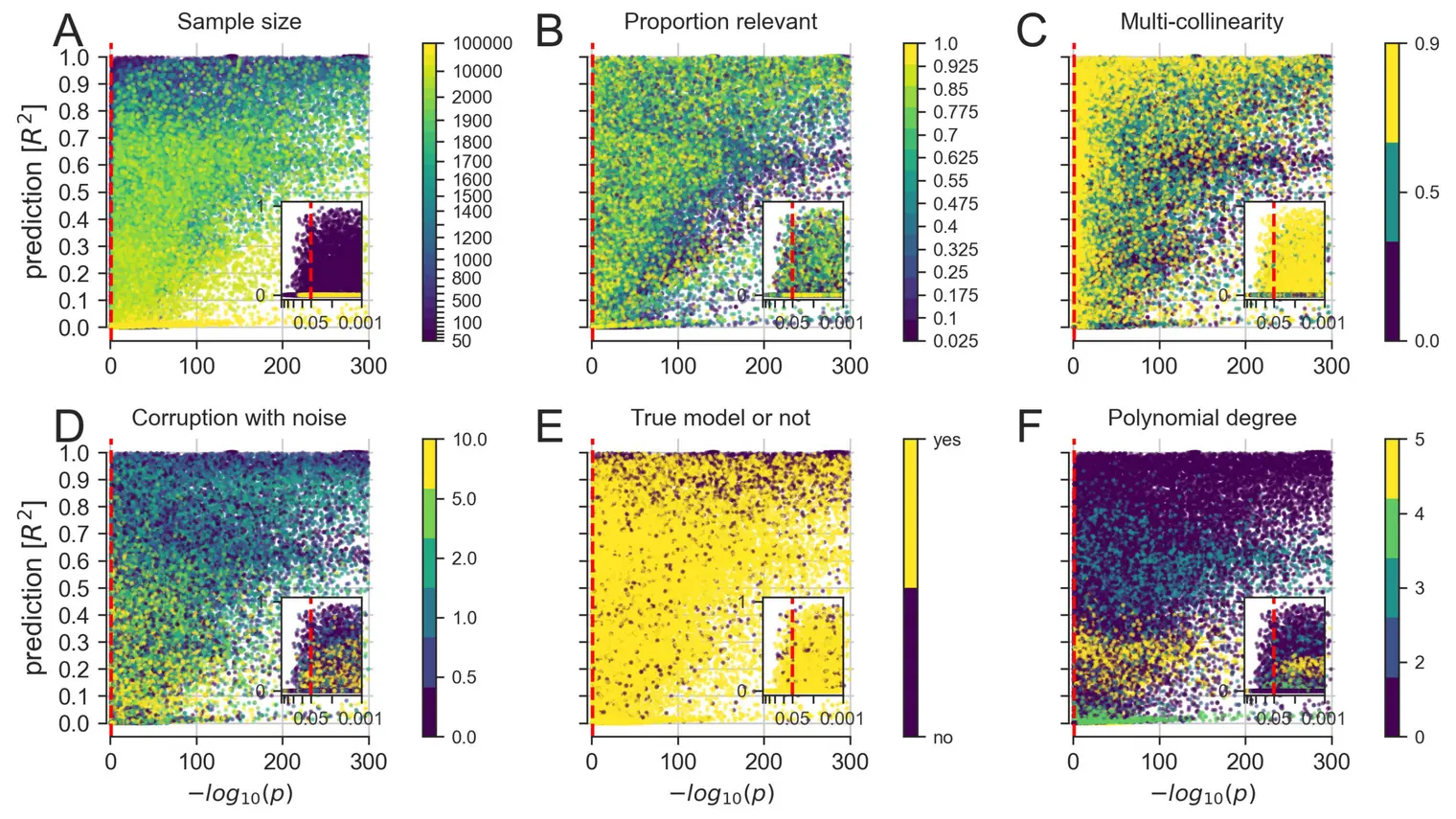
In the 20th century, many advances in biological knowledge and evidence-based medicine were supported by p values and accompanying methods. … (voir plus)In the early 21st century, ambitions toward precision medicine place a premium on detailed predictions for single individuals. The shift causes tension between traditional regression methods used to infer statistically significant group differences and burgeoning predictive analysis tools suited to forecast an individual's future. Our comparison applies linear models for identifying significant contributing variables and for finding the most predictive variable sets. In systematic data simulations and common medical datasets, we explored how variables identified as significantly relevant and variables identified as predictively relevant can agree or diverge. Across analysis scenarios, even small predictive performances typically coincided with finding underlying significant statistical relationships, but not vice versa. More complete understanding of different ways to define “important” associations is a prerequisite for reproducible research and advances toward personalizing medical care.
Neuroimaging: into the Multiverse
Jessica Dafflon
Pedro F. da Costa
František Váša
Ricardo Pio Monti
Peter J. Hellyer
Federico Turkheimer
Jonathan Smallwood
Emily J. H. Jones
Robert Leech
For most neuroimaging questions the huge range of possible analytic choices leads to the possibility that conclusions from any single analyt… (voir plus)ic approach may be misleading. Examples of possible choices include the motion regression approach used and smoothing and threshold factors applied during the processing pipeline. Although it is possible to perform a multiverse analysis that evaluates all possible analytic choices, this can be computationally challenging and repeated sequential analyses on the same data can compromise inferential and predictive power. Here, we establish how active learning on a low-dimensional space that captures the inter-relationships between analysis approaches can be used to efficiently approximate the whole multiverse of analyses. This approach balances the benefits of a multiverse analysis without the accompanying cost to statistical power, computational power and the integrity of inferences. We illustrate this approach with a functional MRI dataset of functional connectivity across adolescence, demonstrating how a multiverse of graph theoretic and simple pre-processing steps can be efficiently navigated using active learning. Our study shows how this approach can identify the subset of analysis techniques (i.e., pipelines) which are best able to predict participants’ ages, as well as allowing the performance of different approaches to be quantified.
Different scaling of linear models and deep learning in UKBiobank brain images versus machine-learning datasets
Marc-Andre Schulz
B. T. Thomas Yeo
Joshua T. Vogelstein
Janaina Mourao-Miranada
Jakob N. Kather
Konrad Kording
Recently, deep learning has unlocked unprecedented success in various domains, especially using images, text, and speech. However, deep lear… (voir plus)ning is only beneficial if the data have nonlinear relationships and if they are exploitable at available sample sizes. We systematically profiled the performance of deep, kernel, and linear models as a function of sample size on UKBiobank brain images against established machine learning references. On MNIST and Zalando Fashion, prediction accuracy consistently improves when escalating from linear models to shallow-nonlinear models, and further improves with deep-nonlinear models. In contrast, using structural or functional brain scans, simple linear models perform on par with more complex, highly parameterized models in age/sex prediction across increasing sample sizes. In sum, linear models keep improving as the sample size approaches ~10,000 subjects. Yet, nonlinearities for predicting common phenotypes from typical brain scans remain largely inaccessible to the examined kernel and deep learning methods.
Prediction, Not Association, Paves the Road to Precision Medicine
Ewout W. Steyerberg
Meta-matching: a simple framework to translate phenotypic predictive models from big to small data
Tong He
Lijun An
Jiashi Feng
Avram J Holmes
Simon B. Eickhoff
B.T. Thomas Yeo
There is significant interest in using brain imaging data to predict non-brain-imaging phenotypes in individual participants. However, most … (voir plus)prediction studies are underpowered, relying on less than a few hundred participants, leading to low reliability and inflated prediction performance. Yet, small sample sizes are unavoidable when studying clinical populations or addressing focused neuroscience questions. Here, we propose a simple framework – “meta-matching” – to translate predictive models from large-scale datasets to new unseen non-brain-imaging phenotypes in boutique studies. The key observation is that many large-scale datasets collect a wide range inter-correlated phenotypic measures. Therefore, a unique phenotype from a boutique study likely correlates with (but is not the same as) some phenotypes in some large-scale datasets. Meta-matching exploits these correlations to boost prediction in the boutique study. We applied meta-matching to the problem of predicting non-brain-imaging phenotypes using resting-state functional connectivity (RSFC). Using the UK Biobank (N = 36,848), we demonstrated that meta-matching can boost the prediction of new phenotypes in small independent datasets by 100% to 400% in many scenarios. When considering relative prediction performance, meta-matching significantly improved phenotypic prediction even in samples with 10 participants. When considering absolute prediction performance, meta-matching significantly improved phenotypic prediction when there were least 50 participants. With a growing number of large-scale population-level datasets collecting an increasing number of phenotypic measures, our results represent a lower bound on the potential of meta-matching to elevate small-scale boutique studies.
Hidden population modes in social brain morphology: Its parts are more than its sum
Hannah Kiesow
R. Nathan Spreng
Avram J. Holmes
M. Mallar Chakravarty
Andre F. Marquand
B.T. Thomas Yeo
The complexity of social interactions is a defining property of the human species. Many social neuroscience experiments have sought to map … (voir plus)perspective taking’, ‘empathy’, and other canonical psychological constructs to distinguishable brain circuits. This predominant research paradigm was seldom complemented by bottom-up studies of the unknown sources of variation that add up to measures of social brain structure; perhaps due to a lack of large population datasets. We aimed at a systematic de-construction of social brain morphology into its elementary building blocks in the UK Biobank cohort (n=~10,000). Coherent patterns of structural co-variation were explored within a recent atlas of social brain locations, enabled through translating autoencoder algorithms from deep learning. The artificial neural networks learned rich subnetwork representations that became apparent from social brain variation at population scale. The learned subnetworks carried essential information about the co-dependence configurations between social brain regions, with the nucleus accumbens, medial prefrontal cortex, and temporoparietal junction embedded at the core. Some of the uncovered subnetworks contributed to predicting examined social traits in general, while other subnetworks helped predict specific facets of social functioning, such as feelings of loneliness. Our population-level evidence indicates that hidden subsystems of the social brain underpin interindividual variation in dissociable aspects of social lifestyle.
Inferring disease subtypes from clusters in explanation space
Marc-Andre Schulz
Matt Chapman-Rounds
Manisha Verma
Konstantinos Georgatzis
Identification of disease subtypes and corresponding biomarkers can substantially improve clinical diagnosis and treatment selection. Discov… (voir plus)ering these subtypes in noisy, high dimensional biomedical data is often impossible for humans and challenging for machines. We introduce a new approach to facilitate the discovery of disease subtypes: Instead of analyzing the original data, we train a diagnostic classifier (healthy vs. diseased) and extract instance-wise explanations for the classifier’s decisions. The distribution of instances in the explanation space of our diagnostic classifier amplifies the different reasons for belonging to the same class–resulting in a representation that is uniquely useful for discovering latent subtypes. We compare our ability to recover subtypes via cluster analysis on model explanations to classical cluster analysis on the original data. In multiple datasets with known ground-truth subclasses, particularly on UK Biobank brain imaging data and transcriptome data from the Cancer Genome Atlas, we show that cluster analysis on model explanations substantially outperforms the classical approach. While we believe clustering in explanation space to be particularly valuable for inferring disease subtypes, the method is more general and applicable to any kind of sub-type identification.
Molecular signatures of cognition and affect
Justine Y. Hansen
Ross D. Markello
Jacob W. Vogel
Jakob Seidlitz
Bratislav Misic
Regulation of gene expression drives protein interactions that govern synaptic wiring and neuronal activity. The resulting coordinated activ… (voir plus)ity among neuronal populations supports complex psychological processes, yet how gene expression shapes cognition and emotion remains unknown. Here we directly bridge the microscale and macroscale by mapping gene expression patterns to functional activation patterns across the cortical sheet. Applying unsupervised learning to the Allen Human Brain Atlas and Neurosynth databases, we identify a ventromedial-dorsolateral gradient of gene assemblies that separate affective and cognitive domains. This topographic molecular-psychological signature reflects the hierarchical organization of the neocortex, including systematic variations in cell type, myeloarchitecture, laminar differentiation, and intrinsic network affiliation. In addition, this molecular-psychological signature is related to individual differences in cognitive performance, strengthens over neurodevelopment, and can be replicated in two independent repositories. Collectively, our results reveal spatially covarying transcriptomic and cognitive architectures, highlighting the influence that molecular mechanisms exert on psychological processes.
Shared and unique brain network features predict cognition, personality and mental health in childhood
Jianzhong Chen
Angela Tam
Valeria Kebets
Csaba Orbán
Leon Qi Rong Ooi
Scott Marek
Nico U.F. Dosenbach
Simon B. Eickhoff
Avram J. Holmes
B.T. Thomas Yeo
The manner through which individual differences in brain network organization track population-level behavioral variability is a fundamental… (voir plus) question in systems neuroscience. Recent work suggests that resting-state and task-state functional connectivity can predict specific traits at the individual level. However, the focus of most studies on single behavioral traits has come at the expense of capturing broader relationships across behaviors. Here, we utilized a large-scale dataset of 1858 typically developing children to estimate whole-brain functional network organization that is predictive of individual differences in cognition, impulsivity-related personality, and mental health during rest and task states. Predictive network features were distinct across the broad behavioral domains: cognition, personality and mental health. On the other hand, traits within each behavioral domain were predicted by highly similar network features. This is surprising given decades of research emphasizing that distinct brain networks support different mental processes. Although tasks are known to modulate the functional connectome, we found that predictive network features were similar between resting and task states. Overall, our findings reveal shared brain network features that account for individual variation within broad domains of behavior in childhood, yet are unique to different behavioral domains.
Dark control: The default mode network as a reinforcement learning agent
Elvis Dohmatob
The default mode network (DMN) is believed to subserve the baseline mental activity in humans. Its higher energy consumption compared to oth… (voir plus)er brain networks and its intimate coupling with conscious awareness are both pointing to an unknown overarching function. Many research streams speak in favor of an evolutionarily adaptive role in envisioning experience to anticipate the future. In the present work, we propose a process model that tries to explain how the DMN may implement continuous evaluation and prediction of the environment to guide behavior. The main purpose of DMN activity, we argue, may be described by Markov decision processes that optimize action policies via value estimates through vicarious trial and error. Our formal perspective on DMN function naturally accommodates as special cases previous interpretations based on (a) predictive coding, (b) semantic associations, and (c) a sentinel role. Moreover, this process model for the neural optimization of complex behavior in the DMN offers parsimonious explanations for recent experimental findings in animals and humans.
The Neurobiology of Social Distance
Robin I. M. Dunbar