


Portrait of Yoshua Bengio

Yoshua Bengio

Core Academic Member
Canada CIFAR AI Chair
Full Professor, Université de Montréal, Department of Computer Science and Operations Research Department
Founder and Scientific Advisor, Leadership Team
Research Topics
Causality
Computational Neuroscience
Deep Learning
Generative Models
Graph Neural Networks
Machine Learning Theory
Medical Machine Learning
Molecular Modeling
Natural Language Processing
Probabilistic Models
Reasoning
Recurrent Neural Networks
Reinforcement Learning
Representation Learning

Biography

*For media requests, please write to medias@mila.quebec.

For more information please contact Cassidy MacNeil, Senior Assistant and Operation Lead at cassidy.macneil@mila.quebec.

Yoshua Bengio is recognized worldwide as a leading expert in AI. He is most known for his pioneering work in deep learning, which earned him the 2018 A.M. Turing Award, “the Nobel Prize of computing,” with Geoffrey Hinton and Yann LeCun.

Bengio is a full professor at Université de Montréal, and the founder and scientific advisor of Mila – Quebec Artificial Intelligence Institute. He is also a senior fellow at CIFAR and co-directs its Learning in Machines & Brains program, serves as special advisor and founding scientific director of IVADO, and holds a Canada CIFAR AI Chair.

In 2019, Bengio was awarded the prestigious Killam Prize and in 2022, he was the most cited computer scientist in the world by h-index. He is a Fellow of the Royal Society of London, Fellow of the Royal Society of Canada, Knight of the Legion of Honor of France and Officer of the Order of Canada. In 2023, he was appointed to the UN’s Scientific Advisory Board for Independent Advice on Breakthroughs in Science and Technology.

Concerned about the social impact of AI, Bengio helped draft the Montréal Declaration for the Responsible Development of Artificial Intelligence and continues to raise awareness about the importance of mitigating the potentially catastrophic risks associated with future AI systems.

Current Students

Collaborating Alumni - McGill University
Collaborating researcher - Cambridge University
Principal supervisor :
PhD - Université de Montréal
Independent visiting researcher
Co-supervisor :
Collaborating researcher - N/A
Principal supervisor :
PhD - Université de Montréal
Collaborating researcher - KAIST
PhD - Université de Montréal
Collaborating Alumni - Université de Montréal
Co-supervisor :
Independent visiting researcher
Principal supervisor :
PhD - Université de Montréal
Co-supervisor :
PhD - Université de Montréal
Principal supervisor :
Collaborating Alumni - Université de Montréal
Postdoctorate - Université de Montréal
Principal supervisor :
Postdoctorate - Université de Montréal
Principal supervisor :
Collaborating Alumni
Collaborating Alumni - Université de Montréal
PhD - Université de Montréal
Co-supervisor :
PhD - Université de Montréal
Principal supervisor :
Independent visiting researcher - Université de Montréal
PhD - Université de Montréal
Principal supervisor :
Collaborating researcher - Ying Wu Coll of Computing
Collaborating researcher - University of Waterloo
Principal supervisor :
Collaborating Alumni - Max-Planck-Institute for Intelligent Systems
Collaborating researcher - Université de Montréal
Co-supervisor :
PhD - Université de Montréal
Postdoctorate - Université de Montréal
PhD - Université de Montréal
Principal supervisor :
Collaborating Alumni - Université de Montréal
Postdoctorate
Co-supervisor :
Collaborating Alumni - Polytechnique Montréal
Co-supervisor :
PhD - Université de Montréal
Co-supervisor :
Collaborating researcher
Principal supervisor :
Collaborating Alumni - Université de Montréal
Co-supervisor :
PhD - Université de Montréal
Principal supervisor :
Collaborating researcher
Collaborating researcher - Université de Montréal
PhD - Université de Montréal
PhD - McGill University
Principal supervisor :
PhD - Université de Montréal
Principal supervisor :
Collaborating Alumni - McGill University
Principal supervisor :

Publications

Parameterizing Branch-and-Bound Search Trees to Learn Branching Policies
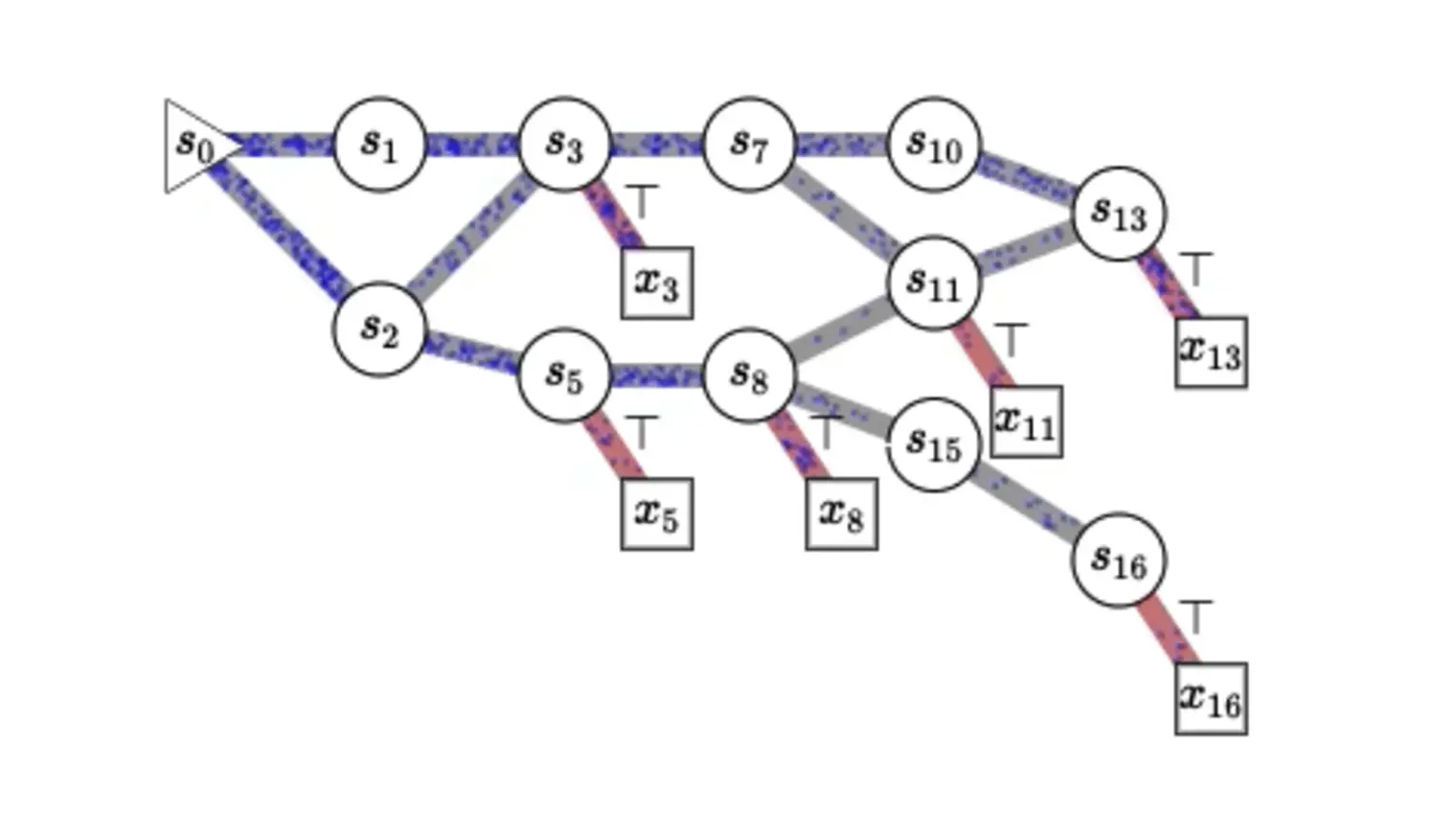
Branch and Bound (B&B) is the exact tree search method typically used to solve Mixed-Integer Linear Programming problems (MILPs). Learni… (see more)ng branching policies for MILP has become an active research area, with most works proposing to imitate the strong branching rule and specialize it to distinct classes of problems. We aim instead at learning a policy that generalizes across heterogeneous MILPs: our main hypothesis is that parameterizing the state of the B&B search tree can aid this type of generalization. We propose a novel imitation learning framework, and introduce new input features and architectures to represent branching. Experiments on MILP benchmark instances clearly show the advantages of incorporating an explicit parameterization of the state of the search tree to modulate the branching decisions, in terms of both higher accuracy and smaller B&B trees. The resulting policies significantly outperform the current state-of-the-art method for "learning to branch" by effectively allowing generalization to generic unseen instances.
Visual Concept Reasoning Networks
Sungwoong Kim
How does hemispheric specialization contribute to human-defining cognition?
Gesa Hartwigsen
hBERT + BiasCorp - Fighting Racism on the Web
Olawale Moses Onabola
Zhuang Ma
Xie Yang
Benjamin Akera
Jia Xue
Dianbo Liu
Subtle and overt racism is still present both in physical and online communities today and has impacted many lives in different segments of … (see more)the society. In this short piece of work, we present how we’re tackling this societal issue with Natural Language Processing. We are releasing BiasCorp, a dataset containing 139,090 comments and news segment from three specific sources - Fox News, BreitbartNews and YouTube. The first batch (45,000 manually annotated) is ready for publication. We are currently in the final phase of manually labeling the remaining dataset using Amazon Mechanical Turk. BERT has been used widely in several downstream tasks. In this work, we present hBERT, where we modify certain layers of the pretrained BERT model with the new Hopfield Layer. hBert generalizes well across different distributions with the added advantage of a reduced model complexity. We are also releasing a JavaScript library 3 and a Chrome Extension Application, to help developers make use of our trained model in web applications (say chat application) and for users to identify and report racially biased contents on the web respectively
Neural Function Modules with Sparse Arguments: A Dynamic Approach to Integrating Information across Layers
Agnieszka Słowik
Michael Mozer
Philippe Beaudoin
Feed-forward neural networks consist of a sequence of layers, in which each layer performs some processing on the information from the previ… (see more)ous layer. A downside to this approach is that each layer (or module, as multiple modules can operate in parallel) is tasked with processing the entire hidden state, rather than a particular part of the state which is most relevant for that module. Methods which only operate on a small number of input variables are an essential part of most programming languages, and they allow for improved modularity and code re-usability. Our proposed method, Neural Function Modules (NFM), aims to introduce the same structural capability into deep learning. Most of the work in the context of feed-forward networks combining top-down and bottom-up feedback is limited to classification problems. The key contribution of our work is to combine attention, sparsity, top-down and bottom-up feedback, in a flexible algorithm which, as we show, improves the results in standard classification, out-of-domain generalization, generative modeling, and learning representations in the context of reinforcement learning.
A Two-Stream Continual Learning System With Variational Domain-Agnostic Feature Replay
Learning in nonstationary environments is one of the biggest challenges in machine learning. Nonstationarity can be caused by either task dr… (see more)ift, i.e., the drift in the conditional distribution of labels given the input data, or the domain drift, i.e., the drift in the marginal distribution of the input data. This article aims to tackle this challenge with a modularized two-stream continual learning (CL) system, where the model is required to learn new tasks from a support stream and adapted to new domains in the query stream while maintaining previously learned knowledge. To deal with both drifts within and across the two streams, we propose a variational domain-agnostic feature replay-based approach that decouples the system into three modules: an inference module that filters the input data from the two streams into domain-agnostic representations, a generative module that facilitates the high-level knowledge transfer, and a solver module that applies the filtered and transferable knowledge to solve the queries. We demonstrate the effectiveness of our proposed approach in addressing the two fundamental scenarios and complex scenarios in two-stream CL.
Transformers with Competitive Ensembles of Independent Mechanisms
Di He
Guolin Ke
Chien-Feng Liao
An important development in deep learning from the earliest MLPs has been a move towards architectures with structural inductive biases whic… (see more)h enable the model to keep distinct sources of information and routes of processing well-separated. This structure is linked to the notion of independent mechanisms from the causality literature, in which a mechanism is able to retain the same processing as irrelevant aspects of the world are changed. For example, convnets enable separation over positions, while attention-based architectures (especially Transformers) learn which combination of positions to process dynamically. In this work we explore a way in which the Transformer architecture is deficient: it represents each position with a large monolithic hidden representation and a single set of parameters which are applied over the entire hidden representation. This potentially throws unrelated sources of information together, and limits the Transformer's ability to capture independent mechanisms. To address this, we propose Transformers with Independent Mechanisms (TIM), a new Transformer layer which divides the hidden representation and parameters into multiple mechanisms, which only exchange information through attention. Additionally, we propose a competition mechanism which encourages these mechanisms to specialize over time steps, and thus be more independent. We study TIM on a large-scale BERT model, on the Image Transformer, and on speech enhancement and find evidence for semantically meaningful specialization as well as improved performance.
Towards Causal Representation Learning
Bernhard Schölkopf
Francesco Locatello
Nan Rosemary Ke
Nal Kalchbrenner
The two fields of machine learning and graphical causality arose and developed separately. However, there is now cross-pollination and incre… (see more)asing interest in both fields to benefit from the advances of the other. In the present paper, we review fundamental concepts of causal inference and relate them to crucial open problems of machine learning, including transfer and generalization, thereby assaying how causality can contribute to modern machine learning research. This also applies in the opposite direction: we note that most work in causality starts from the premise that the causal variables are given. A central problem for AI and causality is, thus, causal representation learning, the discovery of high-level causal variables from low-level observations. Finally, we delineate some implications of causality for machine learning and propose key research areas at the intersection of both communities.
Scaling Equilibrium Propagation to Deep ConvNets by Drastically Reducing Its Gradient Estimator Bias
Axel Laborieux
Julie Grollier
Damien Querlioz
Structured Sparsity Inducing Adaptive Optimizers for Deep Learning
The parameters of a neural network are naturally organized in groups, some of which might not contribute to its overall performance. To prun… (see more)e out unimportant groups of parameters, we can include some non-differentiable penalty to the objective function, and minimize it using proximal gradient methods. In this paper, we derive the weighted proximal operator, which is a necessary component of these proximal methods, of two structured sparsity inducing penalties. Moreover, they can be approximated efficiently with a numerical solver, and despite this approximation, we prove that existing convergence guarantees are preserved when these operators are integrated as part of a generic adaptive proximal method. Finally, we show that this adaptive method, together with the weighted proximal operators derived here, is indeed capable of finding solutions with structure in their sparsity patterns, on representative examples from computer vision and natural language processing.
Training neural networks to recognize speech increased their correspondence to the human auditory pathway but did not yield a shared hierarchy of acoustic features
Jessica A.F. Thompson
Elia Formisano
Marc Schönwiesner
Trained CNNs more similar to auditory fMRI activity than untrainedNo evidence of a shared representational hierarchy for acoustic featuresAl… (see more)l ROIs were most similar to the first fully-connected layerCNN performance on speech recognition task positively associated with fmri similarity
CausalWorld: A Robotic Manipulation Benchmark for Causal Structure and Transfer Learning
Despite recent successes of reinforcement learning (RL), it remains a challenge for agents to transfer learned skills to related environment… (see more)s. To facilitate research addressing this problem, we propose CausalWorld, a benchmark for causal structure and transfer learning in a robotic manipulation environment. The environment is a simulation of an open-source robotic platform, hence offering the possibility of sim-to-real transfer. Tasks consist of constructing 3D shapes from a given set of blocks - inspired by how children learn to build complex structures. The key strength of CausalWorld is that it provides a combinatorial family of such tasks with common causal structure and underlying factors (including, e.g., robot and object masses, colors, sizes). The user (or the agent) may intervene on all causal variables, which allows for fine-grained control over how similar different tasks (or task distributions) are. One can thus easily define training and evaluation distributions of a desired difficulty level, targeting a specific form of generalization (e.g., only changes in appearance or object mass). Further, this common parametrization facilitates defining curricula by interpolating between an initial and a target task. While users may define their own task distributions, we present eight meaningful distributions as concrete benchmarks, ranging from simple to very challenging, all of which require long-horizon planning as well as precise low-level motor control. Finally, we provide baseline results for a subset of these tasks on distinct training curricula and corresponding evaluation protocols, verifying the feasibility of the tasks in this benchmark.