Portrait of Yoshua Bengio

Yoshua Bengio

Core Academic Member
Canada CIFAR AI Chair
Full Professor, Université de Montréal, Department of Computer Science and Operations Research Department
Research Topics
Causality
Computational Neuroscience
Deep Learning
Generative Models
Graph Neural Networks
Machine Learning Theory
Medical Machine Learning
Molecular Modeling
Natural Language Processing
Probabilistic Models
Reasoning
Recurrent Neural Networks
Reinforcement Learning
Representation Learning

Biography

*For media requests, please write to medias@mila.quebec.

For more information please contact Cassidy MacNeil, Senior Assistant and Operation Lead at cassidy.macneil@mila.quebec.

Yoshua Bengio is recognized worldwide as a leading expert in AI. He is most known for his pioneering work in deep learning, which earned him the 2018 A.M. Turing Award, “the Nobel Prize of computing,” with Geoffrey Hinton and Yann LeCun.

Bengio is a full professor at Université de Montréal, and the founder and scientific advisor of Mila – Quebec Artificial Intelligence Institute. He is also a senior fellow at CIFAR and co-directs its Learning in Machines & Brains program, serves as special advisor and founding scientific director of IVADO, and holds a Canada CIFAR AI Chair.

In 2019, Bengio was awarded the prestigious Killam Prize and in 2022, he was the most cited computer scientist in the world by h-index. He is a Fellow of the Royal Society of London, Fellow of the Royal Society of Canada, Knight of the Legion of Honor of France and Officer of the Order of Canada. In 2023, he was appointed to the UN’s Scientific Advisory Board for Independent Advice on Breakthroughs in Science and Technology.

Concerned about the social impact of AI, Bengio helped draft the Montréal Declaration for the Responsible Development of Artificial Intelligence and continues to raise awareness about the importance of mitigating the potentially catastrophic risks associated with future AI systems.

Current Students

Collaborating Alumni - McGill University
Collaborating researcher - Cambridge University
Principal supervisor :
PhD - Université de Montréal
Collaborating researcher - N/A
Principal supervisor :
PhD - Université de Montréal
Collaborating Alumni - Université de Montréal
Postdoctorate - Université de Montréal
Principal supervisor :
Collaborating researcher - Université de Montréal
Research Intern - KOREA ADVANCED INSTITUTE OF SCIENCE AND TECHNOLOGY
Collaborating researcher - s.o.
PhD - Université de Montréal
Co-supervisor :
PhD - Université de Montréal
Principal supervisor :
Independent visiting researcher - Université de Montréal
Collaborating researcher - Ying Wu Coll of Computing
Collaborating researcher - University of Waterloo
Principal supervisor :
Postdoctorate - Université de Montréal
PhD - Université de Montréal
Principal supervisor :
Postdoctorate - Université de Montréal
Co-supervisor :
Collaborating Alumni - Université de Montréal
Co-supervisor :
Collaborating Alumni - Université de Montréal
Collaborating researcher - University of Cambridge
Collaborating Alumni - Université de Montréal
Co-supervisor :
PhD - Université de Montréal
Principal supervisor :
Collaborating researcher - Université de Montréal
PhD - McGill University
Principal supervisor :

Publications

Posterior samples of source galaxies in strong gravitational lenses with score-based priors
Inferring accurate posteriors for high-dimensional representations of the brightness of gravitationally-lensed sources is a major challenge,… (see more) in part due to the difficulties of accurately quantifying the priors. Here, we report the use of a score-based model to encode the prior for the inference of undistorted images of background galaxies. This model is trained on a set of high-resolution images of undistorted galaxies. By adding the likelihood score to the prior score and using a reverse-time stochastic differential equation solver, we obtain samples from the posterior. Our method produces independent posterior samples and models the data almost down to the noise level. We show how the balance between the likelihood and the prior meet our expectations in an experiment with out-of-distribution data.
Bayesian learning of Causal Structure and Mechanisms with GFlowNets and Variational Bayes
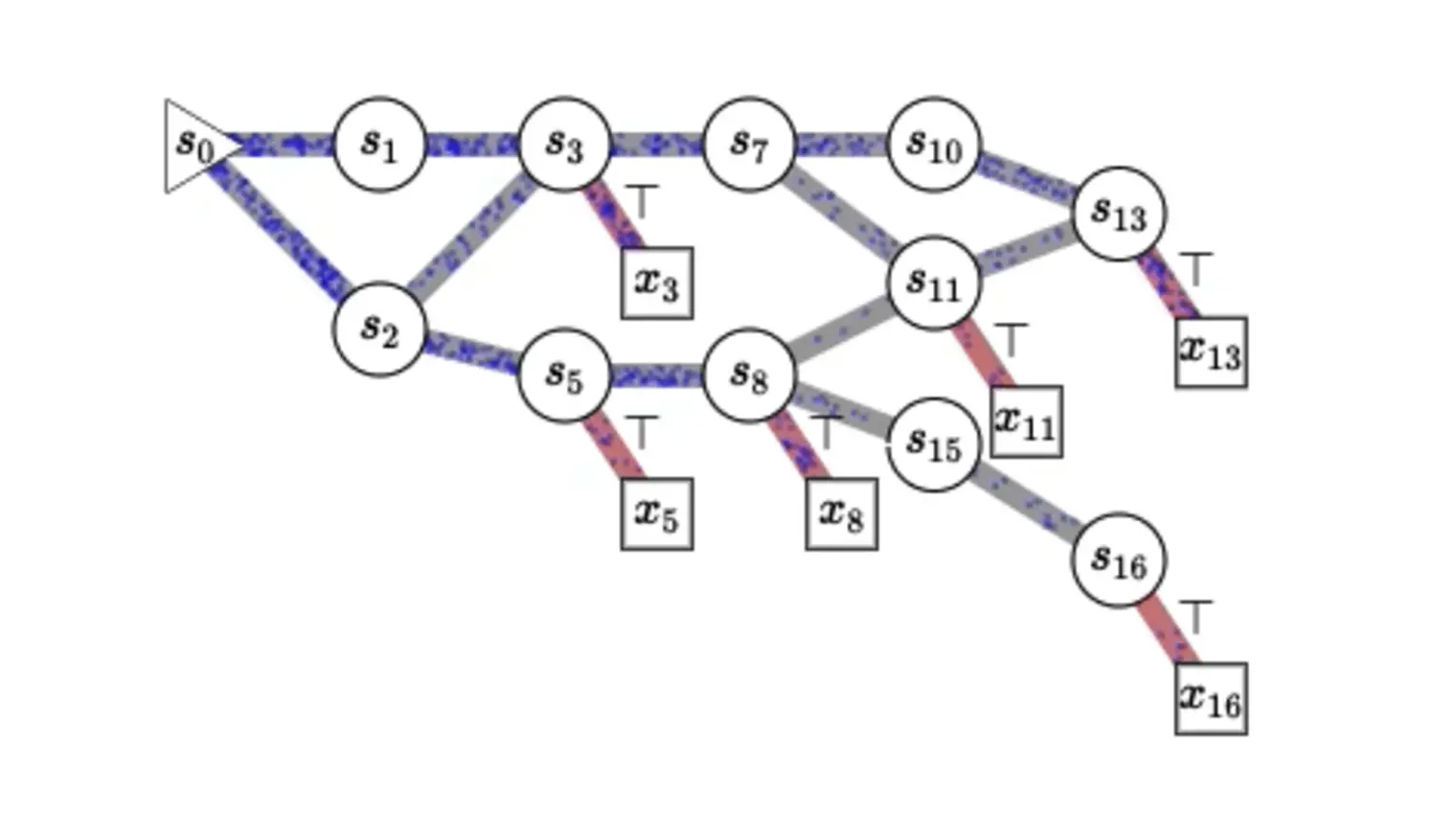
Bayesian causal structure learning aims to learn a posterior distribution over directed acyclic graphs (DAGs), and the mechanisms that defin… (see more)e the relationship between parent and child variables. By taking a Bayesian approach, it is possible to reason about the uncertainty of the causal model. The notion of modelling the uncertainty over models is particularly crucial for causal structure learning since the model could be unidentifiable when given only a finite amount of observational data. In this paper, we introduce a novel method to jointly learn the structure and mechanisms of the causal model using Variational Bayes, which we call Variational Bayes-DAG-GFlowNet (VBG). We extend the method of Bayesian causal structure learning using GFlowNets to learn not only the posterior distribution over the structure, but also the parameters of a linear-Gaussian model. Our results on simulated data suggest that VBG is competitive against several baselines in modelling the posterior over DAGs and mechanisms, while offering several advantages over existing methods, including the guarantee to sample acyclic graphs, and the flexibility to generalize to non-linear causal mechanisms.
A General-Purpose Neural Architecture for Geospatial Systems
Nasim Rahaman
Francesco Locatello
Alexandre Lacoste
Li Erran Li
Bernhard Schölkopf
Consistent Training via Energy-Based GFlowNets for Modeling Discrete Joint Distributions
Moksh J. Jain
Payel Das
Generative Flow Networks (GFlowNets) have demonstrated significant performance improvements for generating diverse discrete objects …
Discrete Factorial Representations as an Abstraction for Goal Conditioned Reinforcement Learning
Hongyu Zang
Xin Li
Romain Laroche
Remi Tachet des Combes
Efficient Queries Transformer Neural Processes
Hossein Hajimirsadeghi
Mohamed Osama Ahmed
FL Games: A federated learning framework for distribution shifts
Federated learning aims to train predictive models for data that is distributed across clients, under the orchestration of a server. However… (see more), participating clients typically each hold data from a different distribution, whereby predictive models with strong in-distribution generalization can fail catastrophically on unseen domains. In this work, we argue that in order to generalize better across non-i.i.d. clients, it is imperative to only learn correlations that are stable and invariant across domains. We propose FL Games, a game-theoretic framework for federated learning for learning causal features that are invariant across clients. While training to achieve the Nash equilibrium, the traditional best response strategy suffers from high-frequency oscillations. We demonstrate that FL Games effectively resolves this challenge and exhibits smooth performance curves. Further, FL Games scales well in the number of clients, requires significantly fewer communication rounds, and is agnostic to device heterogeneity. Through empirical evaluation, we demonstrate that FL Games achieves high out-of-distribution performance on various benchmarks.
Inductive biases for deep learning of higher-level cognition
Lookback for Learning to Branch
Prateek Gupta
Elias B. Khalil
Didier Chételat
Maxime Gasse
Andrea Lodi
M. Pawan Kumar
The expressive and computationally inexpensive bipartite Graph Neural Networks (GNN) have been shown to be an important component of deep le… (see more)arning based Mixed-Integer Linear Program (MILP) solvers. Recent works have demonstrated the effectiveness of such GNNs in replacing the branching (variable selection) heuristic in branch-and-bound (B&B) solvers. These GNNs are trained, offline and on a collection of MILPs, to imitate a very good but computationally expensive branching heuristic, strong branching. Given that B&B results in a tree of sub-MILPs, we ask (a) whether there are strong dependencies exhibited by the target heuristic among the neighboring nodes of the B&B tree, and (b) if so, whether we can incorporate them in our training procedure. Specifically, we find that with the strong branching heuristic, a child node's best choice was often the parent's second-best choice. We call this the "lookback" phenomenon. Surprisingly, the typical branching GNN of Gasse et al. (2019) often misses this simple "answer". To imitate the target behavior more closely by incorporating the lookback phenomenon in GNNs, we propose two methods: (a) target smoothing for the standard cross-entropy loss function, and (b) adding a Parent-as-Target (PAT) Lookback regularizer term. Finally, we propose a model selection framework to incorporate harder-to-formulate objectives such as solving time in the final models. Through extensive experimentation on standard benchmark instances, we show that our proposal results in up to 22% decrease in the size of the B&B tree and up to 15% improvement in the solving times.
Interpolated Adversarial Training: Achieving Robust Neural Networks Without Sacrificing Too Much Accuracy
Adversarial robustness has become a central goal in deep learning, both in theory and in practice. However, successful methods to improve th… (see more)e adversarial robustness (such as adversarial training) greatly hurt generalization performance on the unperturbed data. This could have a major impact on how achieving adversarial robustness affects real world systems (i.e. many may opt to forego robustness if it can improve accuracy on the unperturbed data). We propose Interpolated Adversarial Training, which employs recently proposed interpolation based training methods in the framework of adversarial training. On CIFAR-10, adversarial training increases the standard test error (when there is no adversary) from 4.43% to 12.32%, whereas with our Interpolated adversarial training we retain adversarial robustness while achieving a standard test error of only 6.45%. With our technique, the relative increase in the standard error for the robust model is reduced from 178.1% to just 45.5%.
Designing Biological Sequences via Meta-Reinforcement Learning and Bayesian Optimization
The ability to accelerate the design of biological sequences can have a substantial impact on the progress of the medical field. The problem… (see more) can be framed as a global optimization problem where the objective is an expensive black-box function such that we can query large batches restricted with a limitation of a low number of rounds. Bayesian Optimization is a principled method for tackling this problem. However, the astronomically large state space of biological sequences renders brute-force iterating over all possible sequences infeasible. In this paper, we propose MetaRLBO where we train an autoregressive generative model via Meta-Reinforcement Learning to propose promising sequences for selection via Bayesian Optimization. We pose this problem as that of finding an optimal policy over a distribution of MDPs induced by sampling subsets of the data acquired in the previous rounds. Our in-silico experiments show that meta-learning over such ensembles provides robustness against reward misspecification and achieves competitive results compared to existing strong baselines.
Unifying Generative Models with GFlowNets
Ricky T. Q. Chen
Nikolay Malkin
There are many frameworks for deep generative modeling, each often presented with their own specific training algorithms and inference metho… (see more)ds. Here, we demonstrate the connections between existing deep generative models and the recently introduced GFlowNet framework, a probabilistic inference machine which treats sampling as a decision-making process. This analysis sheds light on their overlapping traits and provides a unifying viewpoint through the lens of learning with Markovian trajectories. Our framework provides a means for unifying training and inference algorithms, and provides a route to shine a unifying light over many generative models. Beyond this, we provide a practical and experimentally verified recipe for improving generative modeling with insights from the GFlowNet perspective.