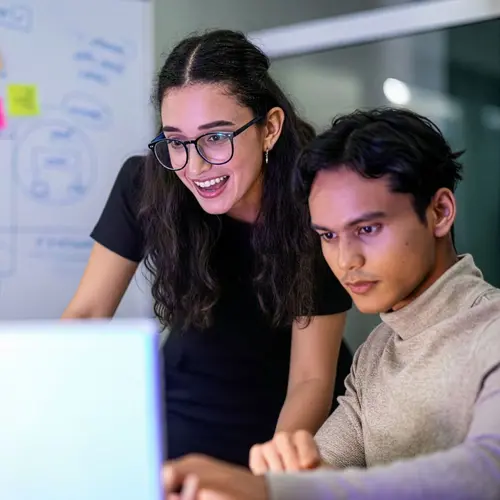
Hackathon | Créer une IA plus sécuritaire pour la santé mentale des jeunes
Du 16 au 23 mars 2026, rejoignez une communauté dynamique dédiée à exploiter la puissance de l'IA pour créer des solutions favorisant le bien-être mental des jeunes.
La prochaine rencontre, qui aura lieu le 12 février à Mila, permettra de renforcer la compréhension des enjeux qui entourent la sécurité en IA et de partager les meilleures pratiques entre chercheur·euse·s académiques et chercheur·euse·s de l’industrie.
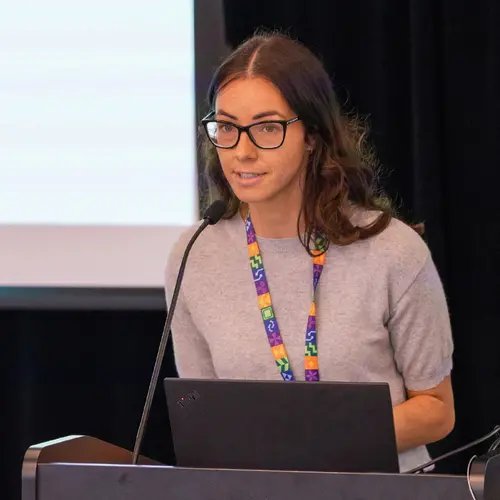
Apprenez à tirer parti de l’IA générative pour soutenir et améliorer votre productivité au travail. La prochaine cohorte se déroulera en ligne les 24 et 26 février 2026, en anglais.
Nous utilisons des témoins pour analyser le trafic et l’utilisation de notre site web, afin de personnaliser votre expérience. Vous pouvez désactiver ces technologies à tout moment, mais cela peut restreindre certaines fonctionnalités du site. Consultez notre Politique de protection de la vie privée pour en savoir plus.
Paramètre des cookies
Vous pouvez activer et désactiver les types de cookies que vous souhaitez accepter. Cependant certains choix que vous ferez pourraient affecter les services proposés sur nos sites (ex : suggestions, annonces personnalisées, etc.).
Cookies essentiels
Ces cookies sont nécessaires au fonctionnement du site et ne peuvent être désactivés. (Toujours actif)
Cookies analyse
Acceptez-vous l'utilisation de cookies pour mesurer l'audience de nos sites ?
Lecteur Multimédia
Acceptez-vous l'utilisation de cookies pour afficher et vous permettre de regarder les contenus vidéo hébergés par nos partenaires (YouTube, etc.) ?
State space models (SSMs) have shown impressive results on tasks that require modeling long-range dependencies and efficiently scale to long… (voir plus) sequences owing to their subquadratic runtime complexity. Originally designed for continuous signals, SSMs have shown superior performance on a plethora of tasks, in vision and audio; however, SSMs still lag Transformer performance in Language Modeling tasks. In this work, we propose a hybrid layer named Block-State Transformer (BST), that internally combines an SSM sublayer for long-range contextualization, and a Block Transformer sublayer for short-term representation of sequences. We study three different, and completely parallelizable, variants that integrate SSMs and block-wise attention. We show that our model outperforms similar Transformer-based architectures on language modeling perplexity and generalizes to longer sequences. In addition, the Block-State Transformer demonstrates more than tenfold increase in speed at the layer level compared to the Block-Recurrent Transformer when model parallelization is employed.
Theano is a Python library that allows to define, optimize, and evaluate mathematical expressions involving multi-dimensional arrays efficie… (voir plus)ntly. Since its introduction, it has been one of the most used CPU and GPU mathematical compilers - especially in the machine learning community - and has shown steady performance improvements. Theano is being actively and continuously developed since 2008, multiple frameworks have been built on top of it and it has been used to produce many state-of-the-art machine learning models.
The present article is structured as follows. Section I provides an overview of the Theano software and its community. Section II presents the principal features of Theano and how to use them, and compares them with other similar projects. Section III focuses on recently-introduced functionalities and improvements. Section IV compares the performance of Theano against Torch7 and TensorFlow on several machine learning models. Section V discusses current limitations of Theano and potential ways of improving it.
Theano is a Python library that allows to define, optimize, and evaluate mathematical expressions involving multi-dimensional arrays efficie… (voir plus)ntly. Since its introduction, it has been one of the most used CPU and GPU mathematical compilers - especially in the machine learning community - and has shown steady performance improvements. Theano is being actively and continuously developed since 2008, multiple frameworks have been built on top of it and it has been used to produce many state-of-the-art machine learning models.
The present article is structured as follows. Section I provides an overview of the Theano software and its community. Section II presents the principal features of Theano and how to use them, and compares them with other similar projects. Section III focuses on recently-introduced functionalities and improvements. Section IV compares the performance of Theano against Torch7 and TensorFlow on several machine learning models. Section V discusses current limitations of Theano and potential ways of improving it.