

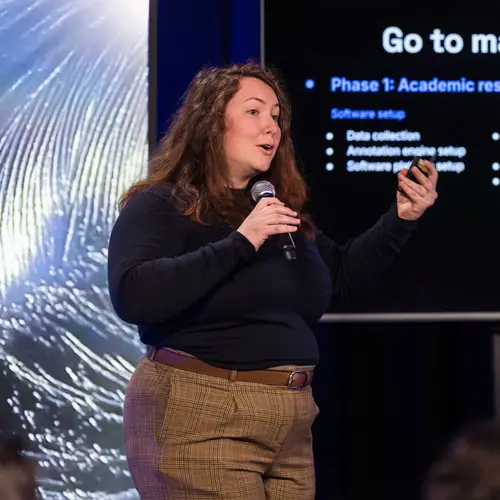

Portrait of Ross Goroshin

Ross Goroshin

Core Industry Member
Adjunct professor, Université de Montréal, Department of Computer Science and Operations Research
Google DeepMind
Research Topics
Applied AI
Computer Vision
Deep Learning
Dynamical Systems
Representation Learning

Biography

Ross Goroshin is a Research Scientist at Google DeepMind, Montreal and Core Industry Member at Mila - Quebec Artificial Intelligence Institute. He holds a PhD in Computer Science from NYU, where he was advised by Yann LeCun. He also earned a B.Eng. in Electrical Engineering from Concordia University and an M.S. in Electrical Engineering from Georgia Tech. His research focuses on computer vision, self-supervised learning, and optimal control.

In addition to his roles at Google DeepMind and Mila, Ross serves as an adjunct professor in the Department of Computer Science and Operations Research (DIRO) at Université de Montréal.

Current Students

Master's Research - Université de Montréal
Principal supervisor :

Publications

TRecViT: A Recurrent Video Transformer
Viorica Patraucean
Joseph Heyward
Chuhan Zhang
Mehdi S. M. Sajjadi
George-Cristian Muraru
Mahdi Karami
Yutian Chen 0001
Simon Kayode Osindero
João Carreira
We propose a novel block for video modelling. It relies on a time-space-channel factorisation with dedicated blocks for each dimension: gate… (see more)d linear recurrent units (LRUs) perform information mixing over time, self-attention layers perform mixing over space, and MLPs over channels. The resulting architecture TRecViT performs well on sparse and dense tasks, trained in supervised or self-supervised regimes. Notably, our model is causal and outperforms or is on par with a pure attention model ViViT-L on large scale video datasets (SSv2, Kinetics400), while having
TAPNext: Tracking Any Point (TAP) as Next Token Prediction
Carl Doersch
Yi Yang
Skanda Koppula
Viorica Patraucean
Ignacio Rocco
Mehdi S. M. Sajjadi
A. Chandar
BootsTAP: Bootstrapped Training for Tracking-Any-Point
Carl Doersch
Yi Yang
Dilara Gokay
Pauline Luc
Skanda Koppula
Ankush Gupta
Joseph Heyward
Ignacio Rocco
João Carreira
Andrew Zisserman
To endow models with greater understanding of physics and motion, it is useful to enable them to perceive how solid surfaces move and deform… (see more) in real scenes. This can be formalized as Tracking-Any-Point (TAP), which requires the algorithm to track any point on solid surfaces in a video, potentially densely in space and time. Large-scale groundtruth training data for TAP is only available in simulation, which currently has a limited variety of objects and motion. In this work, we demonstrate how large-scale, unlabeled, uncurated real-world data can improve a TAP model with minimal architectural changes, using a selfsupervised student-teacher setup. We demonstrate state-of-the-art performance on the TAP-Vid benchmark surpassing previous results by a wide margin: for example, TAP-Vid-DAVIS performance improves from 61.3% to 67.4%, and TAP-Vid-Kinetics from 57.2% to 62.5%. For visualizations, see our project webpage at https://bootstap.github.io/
Satellite Sunroof: High-res Digital Surface Models and Roof Segmentation for Global Solar Mapping
Vishal Batchu
A. Wilson
Betty Peng
Carl D. Elkin
Umangi Jain
Christopher Van Arsdale
Varun Gulshan
The transition to renewable energy, particularly solar, is key to mitigating climate change. Google's Solar API aids this transition by esti… (see more)mating solar potential from aerial imagery, but its impact is constrained by geographical coverage. This paper proposes expanding the API's reach using satellite imagery, enabling global solar potential assessment. We tackle challenges involved in building a Digital Surface Model (DSM) and roof instance segmentation from lower resolution and single oblique views using deep learning models. Our models, trained on aligned satellite and aerial datasets, produce 25cm DSMs and roof segments. With ~1m DSM MAE on buildings, ~5deg roof pitch error and ~56% IOU on roof segmentation, they significantly enhance the Solar API's potential to promote solar adoption.
Course Correcting Koopman Representations
Koopman representations aim to learn features of nonlinear dynamical systems (NLDS) which lead to linear dynamics in the latent space. Theor… (see more)etically, such features can be used to simplify many problems in modeling and control of NLDS. In this work we study autoencoder formulations of this problem, and different ways they can be used to model dynamics, specifically for future state prediction over long horizons. We discover several limitations of predicting future states in the latent space and propose an inference-time mechanism, which we refer to as Periodic Reencoding, for faithfully capturing long term dynamics. We justify this method both analytically and empirically via experiments in low and high dimensional NLDS.
Proto-Value Networks: Scaling Representation Learning with Auxiliary Tasks
Auxiliary tasks improve the representations learned by deep reinforcement learning agents. Analytically, their effect is reasonably well und… (see more)erstood; in practice, however, their primary use remains in support of a main learning objective, rather than as a method for learning representations. This is perhaps surprising given that many auxiliary tasks are defined procedurally, and hence can be treated as an essentially infinite source of information about the environment. Based on this observation, we study the effectiveness of auxiliary tasks for learning rich representations, focusing on the setting where the number of tasks and the size of the agent's network are simultaneously increased. For this purpose, we derive a new family of auxiliary tasks based on the successor measure. These tasks are easy to implement and have appealing theoretical properties. Combined with a suitable off-policy learning rule, the result is a representation learning algorithm that can be understood as extending Mahadevan & Maggioni (2007)'s proto-value functions to deep reinforcement learning -- accordingly, we call the resulting object proto-value networks. Through a series of experiments on the Arcade Learning Environment, we demonstrate that proto-value networks produce rich features that may be used to obtain performance comparable to established algorithms, using only linear approximation and a small number (~4M) of interactions with the environment's reward function.
Block-State Transformers
State space models (SSMs) have shown impressive results on tasks that require modeling long-range dependencies and efficiently scale to long… (see more) sequences owing to their subquadratic runtime complexity. Originally designed for continuous signals, SSMs have shown superior performance on a plethora of tasks, in vision and audio; however, SSMs still lag Transformer performance in Language Modeling tasks. In this work, we propose a hybrid layer named Block-State Transformer (BST), that internally combines an SSM sublayer for long-range contextualization, and a Block Transformer sublayer for short-term representation of sequences. We study three different, and completely parallelizable, variants that integrate SSMs and block-wise attention. We show that our model outperforms similar Transformer-based architectures on language modeling perplexity and generalizes to longer sequences. In addition, the Block-State Transformer demonstrates more than tenfold increase in speed at the layer level compared to the Block-Recurrent Transformer when model parallelization is employed.
Learned Image Compression for Machine Perception
Recent work has shown that learned image compression strategies can outperform standard hand-crafted compression algorithms that have been d… (see more)eveloped over decades of intensive research on the rate-distortion trade-off. With growing applications of computer vision, high quality image reconstruction from a compressible representation is often a secondary objective. Compression that ensures high accuracy on computer vision tasks such as image segmentation, classification, and detection therefore has the potential for significant impact across a wide variety of settings. In this work, we develop a framework that produces a compression format suitable for both human perception and machine perception. We show that representations can be learned that simultaneously optimize for compression and performance on core vision tasks. Our approach allows models to be trained directly from compressed representations, and this approach yields increased performance on new tasks and in low-shot learning settings. We present results that improve upon segmentation and detection performance compared to standard high quality JPGs, but with representations that are four to ten times smaller in terms of bits per pixel. Further, unlike naive compression methods, at a level ten times smaller than standard JEPGs, segmentation and detection models trained from our format suffer only minor degradation in performance.
Impact of Aliasing on Generalization in Deep Convolutional Networks
Cristina Vasconcelos
Rob Romijnders
Nicolas Roux
We investigate the impact of aliasing on generalization in Deep Convolutional Networks and show that data augmentation schemes alone are una… (see more)ble to prevent it due to structural limitations in widely used architectures. Drawing insights from frequency analysis theory, we take a closer look at ResNet and EfficientNet architectures and review the trade-off between aliasing and information loss in each of their major components. We show how to mitigate aliasing by inserting non-trainable low-pass filters at key locations, particularly where networks lack the capacity to learn them. These simple architectural changes lead to substantial improvements in generalization on i.i.d. and even more on out-of-distribution conditions, such as image classification under natural corruptions on ImageNet-C [11] and few-shot learning on Meta-Dataset [26]. State-of-the art results are achieved on both datasets without introducing additional trainable parameters and using the default hyper-parameters of open source codebases.
Comparing Transfer and Meta Learning Approaches on a Unified Few-Shot Classification Benchmark
Neil Houlsby
Utku Evci
Xiaohua Zhai
Sylvain Gelly
Meta and transfer learning are two successful families of approaches to few-shot learning. Despite highly related goals, state-of-the-art ad… (see more)vances in each family are measured largely in isolation of each other. As a result of diverging evaluation norms, a direct or thorough comparison of different approaches is challenging. To bridge this gap, we perform a cross-family study of the best transfer and meta learners on both a large-scale meta-learning benchmark (Meta-Dataset, MD), and a transfer learning benchmark (Visual Task Adaptation Benchmark, VTAB). We find that, on average, large-scale transfer methods (Big Transfer, BiT) outperform competing approaches on MD, even when trained only on ImageNet. In contrast, meta-learning approaches struggle to compete on VTAB when trained and validated on MD. However, BiT is not without limitations, and pushing for scale does not improve performance on highly out-of-distribution MD tasks. In performing this study, we reveal a number of discrepancies in evaluation norms and study some of these in light of the performance gap. We hope that this work facilitates sharing of insights from each community, and accelerates progress on few-shot learning.
A Unified Few-Shot Classification Benchmark to Compare Transfer and Meta Learning Approaches
Neil Houlsby
Utku Evci
Xiaohua Zhai
Sylvain Gelly
Meta and transfer learning are two successful families of approaches to few-shot 1 learning. Despite highly related goals, state-of-the-art … (see more)advances in each family are 2 measured largely in isolation of each other. As a result of diverging evaluation 3 norms, a direct or thorough comparison of different approaches is challenging. 4 To bridge this gap, we introduce a few-shot classification evaluation protocol 5 named VTAB+MD with the explicit goal of facilitating sharing of insights from 6 each community. We demonstrate its accessibility in practice by performing a 7 cross-family study of the best transfer and meta learners which report on both a 8 large-scale meta-learning benchmark (Meta-Dataset, MD), and a transfer learning 9 benchmark (Visual Task Adaptation Benchmark, VTAB). We find that, on average, 10 large-scale transfer methods (Big Transfer, BiT) outperform competing approaches 11 on MD, even when trained only on ImageNet. In contrast, meta-learning approaches 12 struggle to compete on VTAB when trained and validated on MD. However, BiT 13 is not without limitations, and pushing for scale does not improve performance 14 on highly out-of-distribution MD tasks. We hope that this work contributes to 15 accelerating progress on few-shot learning research. 16
An Effective Anti-Aliasing Approach for Residual Networks
Cristina Vasconcelos
Nicolas Roux
Image pre-processing in the frequency domain has traditionally played a vital role in computer vision and was even part of the standard pipe… (see more)line in the early days of deep learning. However, with the advent of large datasets, many practitioners concluded that this was unnecessary due to the belief that these priors can be learned from the data itself. Frequency aliasing is a phenomenon that may occur when sub-sampling any signal, such as an image or feature map, causing distortion in the sub-sampled output. We show that we can mitigate this effect by placing non-trainable blur filters and using smooth activation functions at key locations, particularly where networks lack the capacity to learn them. These simple architectural changes lead to substantial improvements in out-of-distribution generalization on both image classification under natural corruptions on ImageNet-C [10] and few-shot learning on Meta-Dataset [17], without introducing additional trainable parameters and using the default hyper-parameters of open source codebases.