
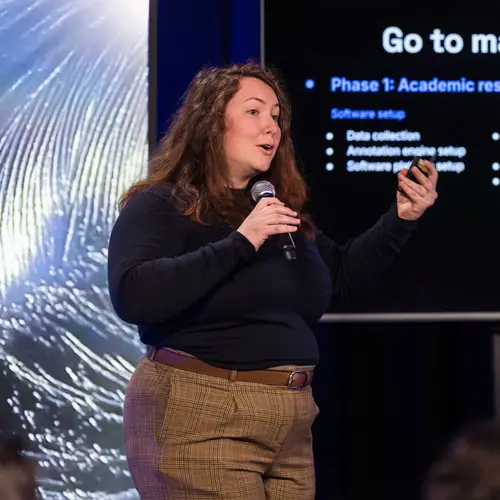
The upcoming meeting, taking place on November 10 at Mila, will explore how we can collectively develop, govern, and deploy high-performing, reliable, and secure agentic systems by connecting academic researchers, industry experts, and practitioners.
We use cookies to analyze the browsing and usage of our website and to personalize your experience. You can disable these technologies at any time, but this may limit certain functionalities of the site. Read our Privacy Policy for more information.
Setting cookies
You can enable and disable the types of cookies you wish to accept. However certain choices you make could affect the services offered on our sites (e.g. suggestions, personalised ads, etc.).
Essential cookies
These cookies are necessary for the operation of the site and cannot be deactivated. (Still active)
Analytics cookies
Do you accept the use of cookies to measure the audience of our sites?
Multimedia Player
Do you accept the use of cookies to display and allow you to watch the video content hosted by our partners (YouTube, etc.)?
Koopman autoencoders (KAEs) seek a higher-dimensional latent representation in which nonlinear dynamics evolve linearly. However, many inter… (see more)esting systems have multiple basins of attraction, and both theoretical and empirical work has shown these multibasin systems cannot generally admit a single finite-dimensional global Koopman embedding under standard assumptions. We posit that encoders with a sparsity-inducing objective encouraging few active latent coefficients will provide latent supports as an inspectable basin-modeling principle for Koopman autoencoders. We use these encoders producing sparse latents in training Sparse Koopman Autoencoders (SKAEs) without basin labels or other regime annotations, and treat the learned latent supports as model-produced regime variables after training. Across a range of procedurally generated multibasin systems and chaotic flows, we show that SKAEs have superior forecasting performance compared to dense-latent KAEs. We also perform a mechanistic study that shows latent supports produced by SKAEs are both essential for the quality of the representation and useful for identifying basins on held-out basin interior states, whereas dense-latent KAEs collapse to an uninformative single family. These results identify sparse latents and their corresponding supports as label-free, interpretable regime variables for Koopman learning in nonlinear systems with multiple local dynamical laws.
Reinforcement learning (RL) has become a predominant technique to align language models (LMs) with human preferences or promote outputs whic… (see more)h are deemed to be desirable by a given reward function. Standard RL approaches optimize average reward, while methods explicitly focused on reducing the probability of undesired outputs typically come at a cost to average-case performance. To improve this tradeoff, we introduce RePULSe, a new training method that augments the standard RL loss with an additional loss that uses learned proposals to guide sampling low-reward outputs, and then reduces those outputs’ probability. We run experiments demonstrating that RePULSe produces a better tradeoff of expected reward versus the probability of undesired outputs and is more adversarially robust, compared to standard RL alignment approaches and alternatives.
2025-12-02
Neural Information Processing Systems (Accept (poster))