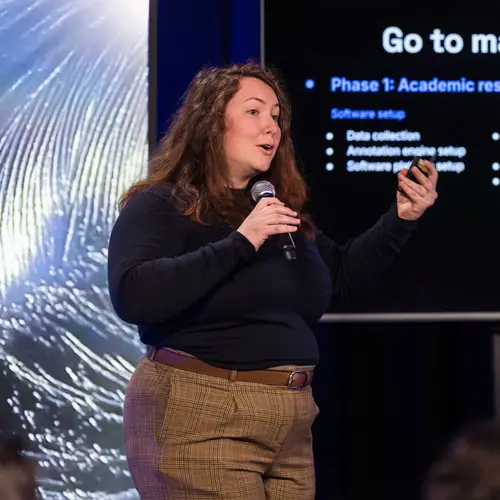
La prochaine rencontre, qui aura lieu le 10 novembre à Mila, permettra d'explorer comment pouvons-nous collectivement développer, encadrer et déployer des systèmes agentiques performants, fiables et sécuritaires en connectant chercheur·euse·s académiques, expert·e·s industriel·le·s et praticien·ne·s.
Ce programme à temps partiel offre aux scientifiques l'opportunité de tester leur intérêt pour l'entrepreneuriat. Vous avez jusqu'au 5 octobre pour postuler.
Avantage IA : productivité dans la fonction publique
Apprenez à tirer parti de l’IA générative pour soutenir et améliorer votre productivité au travail. La prochaine cohorte se déroulera en ligne les 6 et 8 octobre 2026, en anglais.
Nous utilisons des témoins pour analyser le trafic et l’utilisation de notre site web, afin de personnaliser votre expérience. Vous pouvez désactiver ces technologies à tout moment, mais cela peut restreindre certaines fonctionnalités du site. Consultez notre Politique de protection de la vie privée pour en savoir plus.
Paramètre des cookies
Vous pouvez activer et désactiver les types de cookies que vous souhaitez accepter. Cependant certains choix que vous ferez pourraient affecter les services proposés sur nos sites (ex : suggestions, annonces personnalisées, etc.).
Cookies essentiels
Ces cookies sont nécessaires au fonctionnement du site et ne peuvent être désactivés. (Toujours actif)
Cookies analyse
Acceptez-vous l'utilisation de cookies pour mesurer l'audience de nos sites ?
Lecteur Multimédia
Acceptez-vous l'utilisation de cookies pour afficher et vous permettre de regarder les contenus vidéo hébergés par nos partenaires (YouTube, etc.) ?
Koopman autoencoders (KAEs) seek a higher-dimensional latent representation in which nonlinear dynamics evolve linearly. However, many inter… (voir plus)esting systems have multiple basins of attraction, and both theoretical and empirical work has shown these multibasin systems cannot generally admit a single finite-dimensional global Koopman embedding under standard assumptions. We posit that encoders with a sparsity-inducing objective encouraging few active latent coefficients will provide latent supports as an inspectable basin-modeling principle for Koopman autoencoders. We use these encoders producing sparse latents in training Sparse Koopman Autoencoders (SKAEs) without basin labels or other regime annotations, and treat the learned latent supports as model-produced regime variables after training. Across a range of procedurally generated multibasin systems and chaotic flows, we show that SKAEs have superior forecasting performance compared to dense-latent KAEs. We also perform a mechanistic study that shows latent supports produced by SKAEs are both essential for the quality of the representation and useful for identifying basins on held-out basin interior states, whereas dense-latent KAEs collapse to an uninformative single family. These results identify sparse latents and their corresponding supports as label-free, interpretable regime variables for Koopman learning in nonlinear systems with multiple local dynamical laws.
Reinforcement learning (RL) has become a predominant technique to align language models (LMs) with human preferences or promote outputs whic… (voir plus)h are deemed to be desirable by a given reward function. Standard RL approaches optimize average reward, while methods explicitly focused on reducing the probability of undesired outputs typically come at a cost to average-case performance. To improve this tradeoff, we introduce RePULSe, a new training method that augments the standard RL loss with an additional loss that uses learned proposals to guide sampling low-reward outputs, and then reduces those outputs’ probability. We run experiments demonstrating that RePULSe produces a better tradeoff of expected reward versus the probability of undesired outputs and is more adversarially robust, compared to standard RL alignment approaches and alternatives.
2025-12-02
Neural Information Processing Systems (Accept (poster))