


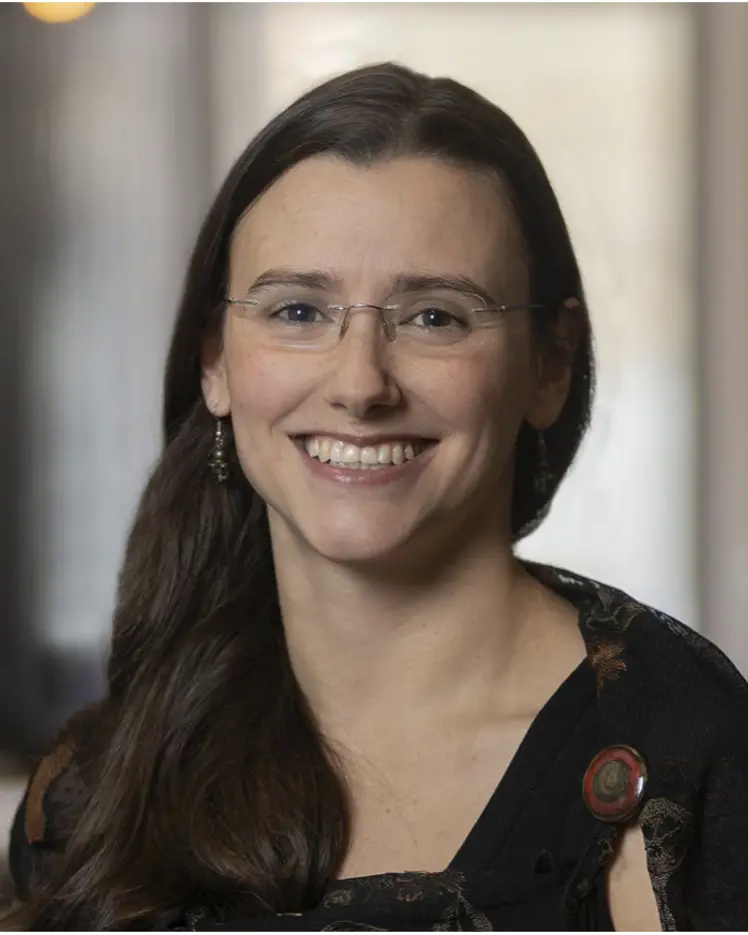
Portrait de Laurence Perreault-Levasseur n'est pas disponible

Laurence Perreault-Levasseur

Membre académique associé
Professeure adjointe, Université de Montréal, Département de physique
Sujets de recherche
Apprentissage profond
Modèles génératifs
Modèles probabilistes
Réseaux de neurones en graphes
Systèmes dynamiques
Vision par ordinateur

Biographie

Laurence Perreault-Levasseur est titulaire de la Chaire de recherche du Canada en cosmologie computationnelle et en intelligence artificielle. Elle est professeure adjointe à l'Université de Montréal et membre associée de Mila – Institut québécois d’intelligence artificielle, où elle mène des recherches sur le développement et l'application de méthodes d'apprentissage automatique à la cosmologie. Elle est également chercheuse invitée au Flatiron Institute, à New York. Auparavant, elle a été chargée de recherche au Center for Computational Astrophysics du Flatiron Institute et boursière postdoctorale du KIPAC à l'Université de Stanford. Laurence Perreault-Levasseur a obtenu un doctorat de l'Université de Cambridge, où elle a travaillé sur les applications des méthodes de la théorie des champs effectifs ouverts au formalisme de l'inflation. Elle est titulaire d'une licence et d'une maîtrise en sciences de l'Université McGill.

Étudiants actuels

Doctorat - McGill
Superviseur⋅e principal⋅e :
Doctorat - UdeM
Co-superviseur⋅e :
Doctorat - UdeM
Superviseur⋅e principal⋅e :
Stagiaire de recherche - UdeM
Co-superviseur⋅e :
Doctorat - UdeM
Co-superviseur⋅e :
Doctorat - UdeM
Superviseur⋅e principal⋅e :
Postdoctorat - UdeM
Co-superviseur⋅e :
Doctorat - UdeM
Maîtrise recherche - UdeM
Superviseur⋅e principal⋅e :
Doctorat - UdeM
Co-superviseur⋅e :
Doctorat - UdeM
Maîtrise recherche - UdeM
Postdoctorat - UdeM
Superviseur⋅e principal⋅e :
Postdoctorat - McGill
Co-superviseur⋅e :
Postdoctorat - UdeM
Co-superviseur⋅e :

Publications

Multi-phase black-hole feedback and a bright [CII] halo in a Lo-BAL quasar at $z\sim6.6$
Manuela Bischetti
Hyunseop 현섭 Choi 최
Fabrizio Fiore
Chiara Feruglio
Stefano Carniani
Valentina D'Odorico
Eduardo Banados
Huanqing Chen
Roberto Decarli
Simona Gallerani
J. Hlavacek-Larrondo
Samuel Lai
Karen M. Leighly
Chiara Mazzucchelli
Roberta Tripodi
Fabian Walter
Feige Wang
Jinyi Yang
Maria Vittoria Zanchettin … (voir 1 de plus)
Yongda Zhu
PQMass: Probabilistic Assessment of the Quality of Generative Models using Probability Mass Estimation
We propose a comprehensive sample-based method for assessing the quality of generative models. The proposed approach enables the estimation … (voir plus)of the probability that two sets of samples are drawn from the same distribution, providing a statistically rigorous method for assessing the performance of a single generative model or the comparison of multiple competing models trained on the same dataset. This comparison can be conducted by dividing the space into non-overlapping regions and comparing the number of data samples in each region. The method only requires samples from the generative model and the test data. It is capable of functioning directly on high-dimensional data, obviating the need for dimensionality reduction. Significantly, the proposed method does not depend on assumptions regarding the density of the true distribution, and it does not rely on training or fitting any auxiliary models. Instead, it focuses on approximating the integral of the density (probability mass) across various sub-regions within the data space.
Caustics: A Python Package for Accelerated Strong Gravitational Lensing Simulations
M. J. Yantovski-Barth
Landung Setiawan
Cordero Core
Charles Wilson
Gabriel Missael Barco
Improving Gradient-guided Nested Sampling for Posterior Inference
We present a performant, general-purpose gradient-guided nested sampling algorithm, …
Active learning meets fractal decision boundaries: a cautionary tale from the Sitnikov three-body problem
Mario Pasquato
Alessandro A. Trani
Chaotic systems such as the gravitational N-body problem are ubiquitous in astronomy. Machine learning (ML) is increasingly deployed to pred… (voir plus)ict the evolution of such systems, e.g. with the goal of speeding up simulations. Strategies such as active Learning (AL) are a natural choice to optimize ML training. Here we showcase an AL failure when predicting the stability of the Sitnikov three-body problem, the simplest case of N-body problem displaying chaotic behavior. We link this failure to the fractal nature of our classification problem's decision boundary. This is a potential pitfall in optimizing large sets of N-body simulations via AL in the context of star cluster physics, galactic dynamics, or cosmology.
Bayesian Imaging for Radio Interferometry with Score-Based Priors
No'e Dia
M. J. Yantovski-Barth
Micah Bowles
A. Scaife
U. Montŕeal
Ciela Institute
Flatiron Institute
Learning an Effective Evolution Equation for Particle-Mesh Simulations Across Cosmologies
Unraveling the Mysteries of Galaxy Clusters: Recurrent Inference Deconvolution of X-ray Spectra
C. L. Rhea
J. Hlavacek-Larrondo
Ralph P. Kraft
Ákos Bogdán
The search for the lost attractor
Mario Pasquato
Syphax Haddad
Pierfrancesco Di Cintio
No'e Dia
Mircea Petrache
Ugo Niccolo Di Carlo
Alessandro A. Trani
Score-Based Likelihood Characterization for Inverse Problems in the Presence of Non-Gaussian Noise
Likelihood analysis is typically limited to normally distributed noise due to the difficulty of determining the probability density function… (voir plus) of complex, high-dimensional, non-Gaussian, and anisotropic noise. This work presents Score-based LIkelihood Characterization (SLIC), a framework that resolves this issue by building a data-driven noise model using a set of noise realizations from observations. We show that the approach produces unbiased and precise likelihoods even in the presence of highly non-Gaussian correlated and spatially varying noise. We use diffusion generative models to estimate the gradient of the probability density of noise with respect to data elements. In combination with the Jacobian of the physical model of the signal, we use Langevin sampling to produce independent samples from the unbiased likelihood. We demonstrate the effectiveness of the method using real data from the Hubble Space Telescope and James Webb Space Telescope.
Posterior Sampling of the Initial Conditions of the Universe from Non-linear Large Scale Structures using Score-Based Generative Models
Matthew Ho
Shirley Ho
Benjamin Wandelt
Time Delay Cosmography with a Neural Ratio Estimator
We explore the use of a Neural Ratio Estimator (NRE) to determine the Hubble constant (…