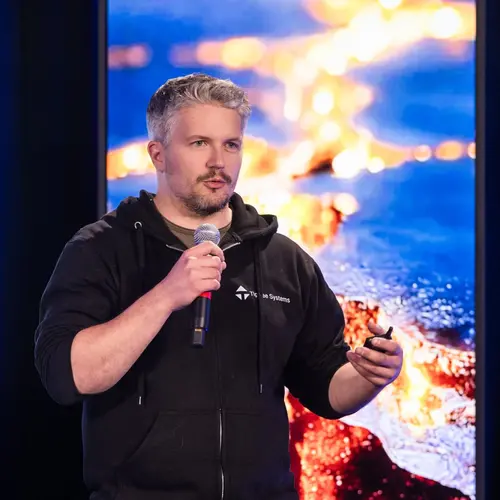

Portrait of Yoshua Bengio

Yoshua Bengio

Core Academic Member
Canada CIFAR AI Chair
Full Professor, Université de Montréal, Department of Computer Science and Operations Research Department
Research Topics
Causality
Computational Neuroscience
Deep Learning
Generative Models
Graph Neural Networks
Machine Learning Theory
Medical Machine Learning
Molecular Modeling
Natural Language Processing
Probabilistic Models
Reasoning
Recurrent Neural Networks
Reinforcement Learning
Representation Learning

Biography

*For media requests, please write to medias@mila.quebec.

For more information please contact Cassidy MacNeil, Senior Assistant and Operation Lead at cassidy.macneil@mila.quebec.

Yoshua Bengio is recognized worldwide as a leading expert in AI. He is most known for his pioneering work in deep learning, which earned him the 2018 A.M. Turing Award, “the Nobel Prize of computing,” with Geoffrey Hinton and Yann LeCun.

Bengio is a full professor at Université de Montréal, and the founder and scientific advisor of Mila – Quebec Artificial Intelligence Institute. He is also a senior fellow at CIFAR and co-directs its Learning in Machines & Brains program, serves as special advisor and founding scientific director of IVADO, and holds a Canada CIFAR AI Chair.

In 2019, Bengio was awarded the prestigious Killam Prize and in 2022, he was the most cited computer scientist in the world by h-index. He is a Fellow of the Royal Society of London, Fellow of the Royal Society of Canada, Knight of the Legion of Honor of France and Officer of the Order of Canada. In 2023, he was appointed to the UN’s Scientific Advisory Board for Independent Advice on Breakthroughs in Science and Technology.

Concerned about the social impact of AI, Bengio helped draft the Montréal Declaration for the Responsible Development of Artificial Intelligence and continues to raise awareness about the importance of mitigating the potentially catastrophic risks associated with future AI systems.

Current Students

Collaborating Alumni - McGill University
Collaborating researcher - Cambridge University
Principal supervisor :
PhD - Université de Montréal
Collaborating researcher - N/A
Principal supervisor :
PhD - Université de Montréal
Collaborating researcher - KAIST
PhD - Université de Montréal
Independent visiting researcher
Principal supervisor :
PhD - Université de Montréal
Co-supervisor :
PhD - Université de Montréal
Principal supervisor :
Collaborating Alumni - Université de Montréal
Collaborating researcher - Université de Montréal
Postdoctorate - Université de Montréal
Principal supervisor :
Postdoctorate - Université de Montréal
Principal supervisor :
Collaborating researcher - s.o.
Collaborating Alumni
PhD - Université de Montréal
Co-supervisor :
PhD - Université de Montréal
Principal supervisor :
Independent visiting researcher - Université de Montréal
PhD - Université de Montréal
Principal supervisor :
Collaborating researcher - Ying Wu Coll of Computing
Collaborating researcher - University of Waterloo
Principal supervisor :
PhD - Université de Montréal
Postdoctorate - Université de Montréal
PhD - Université de Montréal
Principal supervisor :
Postdoctorate
Co-supervisor :
Collaborating Alumni - Université de Montréal
Co-supervisor :
Collaborating researcher
Principal supervisor :
Collaborating Alumni - Université de Montréal
Co-supervisor :
PhD - Université de Montréal
Principal supervisor :
Collaborating researcher - Université de Montréal
Collaborating researcher
Collaborating researcher - Université de Montréal
PhD - Université de Montréal
PhD - McGill University
Principal supervisor :
Collaborating Alumni - McGill University
Principal supervisor :

Publications

GraphMix: Improved Training of GNNs for Semi-Supervised Learning
We present GraphMix, a regularization method for Graph Neural Network based semi-supervised object classification, whereby we propose to tra… (see more)in a fully-connected network jointly with the graph neural network via parameter sharing and interpolation-based regularization. Further, we provide a theoretical analysis of how GraphMix improves the generalization bounds of the underlying graph neural network, without making any assumptions about the "aggregation" layer or the depth of the graph neural networks. We experimentally validate this analysis by applying GraphMix to various architectures such as Graph Convolutional Networks, Graph Attention Networks and Graph-U-Net. Despite its simplicity, we demonstrate that GraphMix can consistently improve or closely match state-of-the-art performance using even simpler architectures such as Graph Convolutional Networks, across three established graph benchmarks: Cora, Citeseer and Pubmed citation network datasets, as well as three newly proposed datasets: Cora-Full, Co-author-CS and Co-author-Physics.
Meta-learning framework with applications to zero-shot time-series forecasting
Boris Oreshkin
Dmitri Carpov
Can meta-learning discover generic ways of processing time series (TS) from a diverse dataset so as to greatly improve generalization on new… (see more) TS coming from different datasets? This work provides positive evidence to this using a broad meta-learning framework which we show subsumes many existing meta-learning algorithms. Our theoretical analysis suggests that residual connections act as a meta-learning adaptation mechanism, generating a subset of task-specific parameters based on a given TS input, thus gradually expanding the expressive power of the architecture on-the-fly. The same mechanism is shown via linearization analysis to have the interpretation of a sequential update of the final linear layer. Our empirical results on a wide range of data emphasize the importance of the identified meta-learning mechanisms for successful zero-shot univariate forecasting, suggesting that it is viable to train a neural network on a source TS dataset and deploy it on a different target TS dataset without retraining, resulting in performance that is at least as good as that of state-of-practice univariate forecasting models.
Object-Centric Image Generation from Layouts
Pengchuan Zhang
R Devon Hjelm
Shikhar Sharma
Parameterizing Branch-and-Bound Search Trees to Learn Branching Policies
Branch and Bound (B&B) is the exact tree search method typically used to solve Mixed-Integer Linear Programming problems (MILPs). Learni… (see more)ng branching policies for MILP has become an active research area, with most works proposing to imitate the strong branching rule and specialize it to distinct classes of problems. We aim instead at learning a policy that generalizes across heterogeneous MILPs: our main hypothesis is that parameterizing the state of the B&B search tree can aid this type of generalization. We propose a novel imitation learning framework, and introduce new input features and architectures to represent branching. Experiments on MILP benchmark instances clearly show the advantages of incorporating an explicit parameterization of the state of the search tree to modulate the branching decisions, in terms of both higher accuracy and smaller B&B trees. The resulting policies significantly outperform the current state-of-the-art method for "learning to branch" by effectively allowing generalization to generic unseen instances.
Visual Concept Reasoning Networks
Sungwoong Kim
How does hemispheric specialization contribute to human-defining cognition?
Gesa Hartwigsen
Predicting Infectiousness for Proactive Contact Tracing
Prateek Gupta
Nasim Rahaman
Pierre-Luc St-Charles
Hannah Alsdurf
Olexa Bilanuik
Pierre-Luc Carrier
Joumana Ghosn
Bernhard Schölkopf … (see 3 more)
Abhinav Sharma
The COVID-19 pandemic has spread rapidly worldwide, overwhelming manual contact tracing in many countries and resulting in widespread lockdo… (see more)wns for emergency containment. Large-scale digital contact tracing (DCT) has emerged as a potential solution to resume economic and social activity while minimizing spread of the virus. Various DCT methods have been proposed, each making trade-offs between privacy, mobility restrictions, and public health. The most common approach, binary contact tracing (BCT), models infection as a binary event, informed only by an individual's test results, with corresponding binary recommendations that either all or none of the individual's contacts quarantine. BCT ignores the inherent uncertainty in contacts and the infection process, which could be used to tailor messaging to high-risk individuals, and prompt proactive testing or earlier warnings. It also does not make use of observations such as symptoms or pre-existing medical conditions, which could be used to make more accurate infectiousness predictions. In this paper, we use a recently-proposed COVID-19 epidemiological simulator to develop and test methods that can be deployed to a smartphone to locally and proactively predict an individual's infectiousness (risk of infecting others) based on their contact history and other information, while respecting strong privacy constraints. Predictions are used to provide personalized recommendations to the individual via an app, as well as to send anonymized messages to the individual's contacts, who use this information to better predict their own infectiousness, an approach we call proactive contact tracing (PCT). We find a deep-learning based PCT method which improves over BCT for equivalent average mobility, suggesting PCT could help in safe re-opening and second-wave prevention.
Saliency Is a Possible Red Herring When Diagnosing Poor Generalization
Joseph D. Viviano
Becks Simpson
Poor generalization is one symptom of models that learn to predict target variables using spuriously-correlated image features present only … (see more)in the training distribution instead of the true image features that denote a class. It is often thought that this can be diagnosed visually using attribution (aka saliency) maps. We study if this assumption is correct. In some prediction tasks, such as for medical images, one may have some images with masks drawn by a human expert, indicating a region of the image containing relevant information to make the prediction. We study multiple methods that take advantage of such auxiliary labels, by training networks to ignore distracting features which may be found outside of the region of interest. This mask information is only used during training and has an impact on generalization accuracy depending on the severity of the shift between the training and test distributions. Surprisingly, while these methods improve generalization performance in the presence of a covariate shift, there is no strong correspondence between the correction of attribution towards the features a human expert has labelled as important and generalization performance. These results suggest that the root cause of poor generalization may not always be spatially defined, and raise questions about the utility of masks as "attribution priors" as well as saliency maps for explainable predictions.
hBERT + BiasCorp - Fighting Racism on the Web
Olawale Moses Onabola
Zhuang Ma
Xie Yang
Benjamin Akera
Jia Xue
Dianbo Liu
Subtle and overt racism is still present both in physical and online communities today and has impacted many lives in different segments of … (see more)the society. In this short piece of work, we present how we’re tackling this societal issue with Natural Language Processing. We are releasing BiasCorp, a dataset containing 139,090 comments and news segment from three specific sources - Fox News, BreitbartNews and YouTube. The first batch (45,000 manually annotated) is ready for publication. We are currently in the final phase of manually labeling the remaining dataset using Amazon Mechanical Turk. BERT has been used widely in several downstream tasks. In this work, we present hBERT, where we modify certain layers of the pretrained BERT model with the new Hopfield Layer. hBert generalizes well across different distributions with the added advantage of a reduced model complexity. We are also releasing a JavaScript library 3 and a Chrome Extension Application, to help developers make use of our trained model in web applications (say chat application) and for users to identify and report racially biased contents on the web respectively
Neural Function Modules with Sparse Arguments: A Dynamic Approach to Integrating Information across Layers
Agnieszka Słowik
Michael Mozer
Philippe Beaudoin
Feed-forward neural networks consist of a sequence of layers, in which each layer performs some processing on the information from the previ… (see more)ous layer. A downside to this approach is that each layer (or module, as multiple modules can operate in parallel) is tasked with processing the entire hidden state, rather than a particular part of the state which is most relevant for that module. Methods which only operate on a small number of input variables are an essential part of most programming languages, and they allow for improved modularity and code re-usability. Our proposed method, Neural Function Modules (NFM), aims to introduce the same structural capability into deep learning. Most of the work in the context of feed-forward networks combining top-down and bottom-up feedback is limited to classification problems. The key contribution of our work is to combine attention, sparsity, top-down and bottom-up feedback, in a flexible algorithm which, as we show, improves the results in standard classification, out-of-domain generalization, generative modeling, and learning representations in the context of reinforcement learning.
A Two-Stream Continual Learning System With Variational Domain-Agnostic Feature Replay
Learning in nonstationary environments is one of the biggest challenges in machine learning. Nonstationarity can be caused by either task dr… (see more)ift, i.e., the drift in the conditional distribution of labels given the input data, or the domain drift, i.e., the drift in the marginal distribution of the input data. This article aims to tackle this challenge with a modularized two-stream continual learning (CL) system, where the model is required to learn new tasks from a support stream and adapted to new domains in the query stream while maintaining previously learned knowledge. To deal with both drifts within and across the two streams, we propose a variational domain-agnostic feature replay-based approach that decouples the system into three modules: an inference module that filters the input data from the two streams into domain-agnostic representations, a generative module that facilitates the high-level knowledge transfer, and a solver module that applies the filtered and transferable knowledge to solve the queries. We demonstrate the effectiveness of our proposed approach in addressing the two fundamental scenarios and complex scenarios in two-stream CL.
Transformers with Competitive Ensembles of Independent Mechanisms
Di He
Guolin Ke
Chien-Feng Liao
An important development in deep learning from the earliest MLPs has been a move towards architectures with structural inductive biases whic… (see more)h enable the model to keep distinct sources of information and routes of processing well-separated. This structure is linked to the notion of independent mechanisms from the causality literature, in which a mechanism is able to retain the same processing as irrelevant aspects of the world are changed. For example, convnets enable separation over positions, while attention-based architectures (especially Transformers) learn which combination of positions to process dynamically. In this work we explore a way in which the Transformer architecture is deficient: it represents each position with a large monolithic hidden representation and a single set of parameters which are applied over the entire hidden representation. This potentially throws unrelated sources of information together, and limits the Transformer's ability to capture independent mechanisms. To address this, we propose Transformers with Independent Mechanisms (TIM), a new Transformer layer which divides the hidden representation and parameters into multiple mechanisms, which only exchange information through attention. Additionally, we propose a competition mechanism which encourages these mechanisms to specialize over time steps, and thus be more independent. We study TIM on a large-scale BERT model, on the Image Transformer, and on speech enhancement and find evidence for semantically meaningful specialization as well as improved performance.