

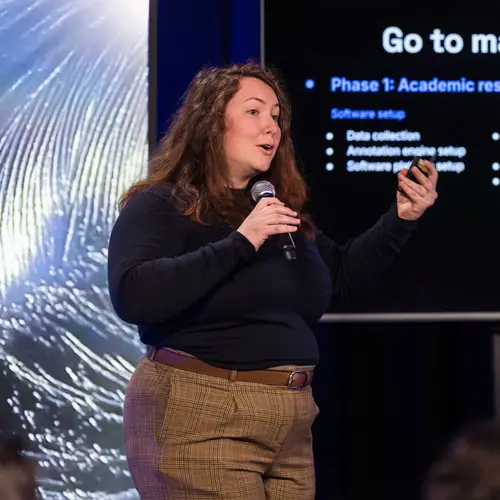


Portrait of Alexandra Volokhova

Alexandra Volokhova

Lab Representative
PhD
Research Topics
Deep Learning
Generative Models
Molecular Modeling
Probabilistic Models

Biography

Sasha is a fifth year PhD student in the group of Prof. Yoshua Bengio. She is passionate about her research on AI for scientific discovery and on the critical approaches to AI research and technology. She has been contributing to the Mila community in various ways during her PhD journey and hopes to continue bringing people together for collective co-creation and co-liberation. Don't hesitate to reach out if you would like to chat!

Publications

The implicated scientist: on the role of AI researchers in the development of weapons systems
Artificial intelligence (AI) technologies are increasingly used in modern weapons systems. Notably, these systems have recently been involve… (see more)d in mass killings and destruction at scale. Furthermore, there is currently a strong interest and competition among powerful players to accelerate the proliferation of weapons with automated or AI-based components, a phenomenon known as AI arms race. This competition poses a risk of causing even more deaths and devastation in the future, as well as increased power and wealth inequality. In this work, we aim to shed light on the role of AI researchers as implicated subjects in the harms caused by weapons enabled by AI technologies. We investigate and discuss the specifics of this implication and explore ways to transfigure this position of implication into one of differentiated, long-distance solidarity with the victims of technologically fortified injustices.
Position: Irresponsible AI: big tech’s influence on AI research and associated impacts
The accelerated development, deployment and adoption of artificial intelligence systems has been fuelled by the increasing presence of big t… (see more)ech in the AI field. This trend has been accompanied by growing ethical concerns and intensified societal and environmental impacts. This position paper argues that irresponsible AI development is strongly driven by big tech's influence and involvement in the field. We develop this argument by laying out the factors through which this influence leads to irresponsible AI. First, we examine the growing and disproportionate influence of big tech in AI research and argue that its drive for scaling and general-purpose systems is fundamentally at odds with the responsible, ethical, and sustainable development of AI. Second, we review key current environmental and societal negative impacts of AI and trace their connections to big tech's influence. Third, we discuss the underlying economic forces driving big tech's actions. Finally, as a call to action, we highlight the need for AI researchers to counter big tech's influence, and review and propose strategies that build on the responsibility of implicated actors and collective action.
Torsional-GFN: a conditional conformation generator for small molecules
Crystal-GFN: sampling materials with desirable properties and constraints
Towards equilibrium molecular conformation generation with GFlowNets
Cheng-Hao Liu
Santiago Miret
Luca Thiede
Alán Aspuru-Guzik
Sampling diverse, thermodynamically feasible molecular conformations plays a crucial role in predicting properties of a molecule. In this pa… (see more)per we propose to use GFlowNet for sampling conformations of small molecules from the Boltzmann distribution, as determined by the molecule's energy. The proposed approach can be used in combination with energy estimation methods of different fidelity and discovers a diverse set of low-energy conformations for highly flexible drug-like molecules. We demonstrate that GFlowNet can reproduce molecular potential energy surfaces by sampling proportionally to the Boltzmann distribution.
Crystal-GFN: sampling crystals with desirable properties and constraints
Accelerating material discovery holds the potential to greatly help mitigate the climate crisis. Discovering new solid-state materials such … (see more)as electrocatalysts, super-ionic conductors or photovoltaic materials can have a crucial impact, for instance, in improving the efficiency of renewable energy production and storage. In this paper, we introduce Crystal-GFN, a generative model of crystal structures that sequentially samples structural properties of crystalline materials, namely the space group, composition and lattice parameters. This domain-inspired approach enables the flexible incorporation of physical and structural hard constraints, as well as the use of any available predictive model of a desired physicochemical property as an objective function. To design stable materials, one must target the candidates with the lowest formation energy. Here, we use as objective the formation energy per atom of a crystal structure predicted by a new proxy machine learning model trained on MatBench. The results demonstrate that Crystal-GFN is able to sample highly diverse crystals with low (median -3.1 eV/atom) predicted formation energy.
A Theory of Continuous Generative Flow Networks
Generative flow networks (GFlowNets) are amortized variational inference algorithms that are trained to sample from unnormalized target dist… (see more)ributions over compositional objects. A key limitation of GFlowNets until this time has been that they are restricted to discrete spaces. We present a theory for generalized GFlowNets, which encompasses both existing discrete GFlowNets and ones with continuous or hybrid state spaces, and perform experiments with two goals in mind. First, we illustrate critical points of the theory and the importance of various assumptions. Second, we empirically demonstrate how observations about discrete GFlowNets transfer to the continuous case and show strong results compared to non-GFlowNet baselines on several previously studied tasks. This work greatly widens the perspectives for the application of GFlowNets in probabilistic inference and various modeling settings.
Generative Flow Networks for Discrete Probabilistic Modeling
We present energy-based generative flow networks (EB-GFN), a novel probabilistic modeling algorithm for high-dimensional discrete data. Buil… (see more)ding upon the theory of generative flow networks (GFlowNets), we model the generation process by a stochastic data construction policy and thus amortize expensive MCMC exploration into a fixed number of actions sampled from a GFlowNet. We show how GFlowNets can approximately perform large-block Gibbs sampling to mix between modes. We propose a framework to jointly train a GFlowNet with an energy function, so that the GFlowNet learns to sample from the energy distribution, while the energy learns with an approximate MLE objective with negative samples from the GFlowNet. We demonstrate EB-GFN's effectiveness on various probabilistic modeling tasks. Code is publicly available at https://github.com/zdhNarsil/EB_GFN.