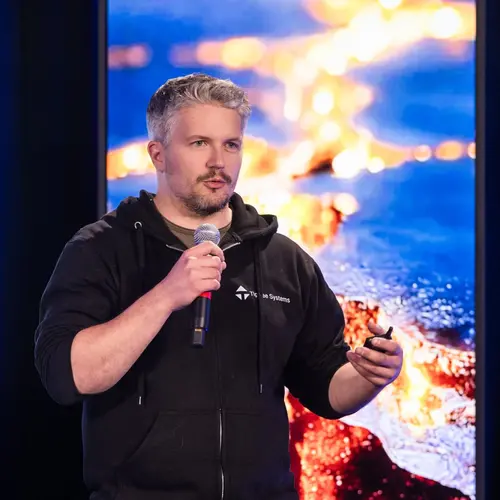

Portrait of Yoshua Bengio

Yoshua Bengio

Core Academic Member
Canada CIFAR AI Chair
Full Professor, Université de Montréal, Department of Computer Science and Operations Research Department
Founder and Scientific Advisor, Leadership Team
Research Topics
Causality
Computational Neuroscience
Deep Learning
Generative Models
Graph Neural Networks
Machine Learning Theory
Medical Machine Learning
Molecular Modeling
Natural Language Processing
Probabilistic Models
Reasoning
Recurrent Neural Networks
Reinforcement Learning
Representation Learning

Biography

*For media requests, please write to medias@mila.quebec.

For more information please contact Cassidy MacNeil, Senior Assistant and Operation Lead at cassidy.macneil@mila.quebec.

Yoshua Bengio is recognized worldwide as a leading expert in AI. He is most known for his pioneering work in deep learning, which earned him the 2018 A.M. Turing Award, “the Nobel Prize of computing,” with Geoffrey Hinton and Yann LeCun.

Bengio is a full professor at Université de Montréal, and the founder and scientific advisor of Mila – Quebec Artificial Intelligence Institute. He is also a senior fellow at CIFAR and co-directs its Learning in Machines & Brains program, serves as special advisor and founding scientific director of IVADO, and holds a Canada CIFAR AI Chair.

In 2019, Bengio was awarded the prestigious Killam Prize and in 2022, he was the most cited computer scientist in the world by h-index. He is a Fellow of the Royal Society of London, Fellow of the Royal Society of Canada, Knight of the Legion of Honor of France and Officer of the Order of Canada. In 2023, he was appointed to the UN’s Scientific Advisory Board for Independent Advice on Breakthroughs in Science and Technology.

Concerned about the social impact of AI, Bengio helped draft the Montréal Declaration for the Responsible Development of Artificial Intelligence and continues to raise awareness about the importance of mitigating the potentially catastrophic risks associated with future AI systems.

Current Students

Collaborating Alumni - McGill University
Collaborating researcher - Cambridge University
Principal supervisor :
PhD - Université de Montréal
Independent visiting researcher
Co-supervisor :
Collaborating researcher - N/A
Principal supervisor :
PhD - Université de Montréal
Collaborating researcher - KAIST
PhD - Université de Montréal
Collaborating Alumni - Université de Montréal
Co-supervisor :
Independent visiting researcher
Principal supervisor :
PhD - Université de Montréal
Co-supervisor :
PhD - Université de Montréal
Principal supervisor :
Collaborating Alumni - Université de Montréal
Postdoctorate - Université de Montréal
Principal supervisor :
Postdoctorate - Université de Montréal
Principal supervisor :
Collaborating Alumni
Collaborating Alumni - Université de Montréal
PhD - Université de Montréal
Co-supervisor :
PhD - Université de Montréal
Principal supervisor :
Independent visiting researcher - Université de Montréal
PhD - Université de Montréal
Principal supervisor :
Collaborating researcher - Ying Wu Coll of Computing
Collaborating researcher - University of Waterloo
Principal supervisor :
Collaborating Alumni - Max-Planck-Institute for Intelligent Systems
Collaborating researcher - Université de Montréal
Co-supervisor :
PhD - Université de Montréal
Postdoctorate - Université de Montréal
PhD - Université de Montréal
Principal supervisor :
Collaborating Alumni - Université de Montréal
Postdoctorate
Co-supervisor :
Collaborating Alumni - Polytechnique Montréal
Co-supervisor :
PhD - Université de Montréal
Co-supervisor :
Collaborating researcher
Principal supervisor :
Collaborating Alumni - Université de Montréal
Co-supervisor :
PhD - Université de Montréal
Principal supervisor :
Collaborating researcher
Collaborating researcher - Université de Montréal
PhD - Université de Montréal
PhD - McGill University
Principal supervisor :
PhD - Université de Montréal
Principal supervisor :
Collaborating Alumni - McGill University
Principal supervisor :

Publications

Deep Learning for Patient-Specific Kidney Graft Survival Analysis
Margaux Luck
Heloise Cardinal
Andrea Lodi
An accurate model of patient-specific kidney graft survival distributions can help to improve shared-decision making in the treatment and ca… (see more)re of patients. In this paper, we propose a deep learning method that directly models the survival function instead of estimating the hazard function to predict survival times for graft patients based on the principle of multi-task learning. By learning to jointly predict the time of the event, and its rank in the cox partial log likelihood framework, our deep learning approach outperforms, in terms of survival time prediction quality and concordance index, other common methods for survival analysis, including the Cox Proportional Hazards model and a network trained on the cox partial log-likelihood.
Char2Wav: End-to-End Speech Synthesis
A Hierarchical Latent Variable Encoder-Decoder Model for Generating Dialogues
Sequential data often possesses a hierarchical structure with complex dependencies between subsequences, such as found between the utterance… (see more)s in a dialogue. In an effort to model this kind of generative process, we propose a neural network-based generative architecture, with latent stochastic variables that span a variable number of time steps. We apply the proposed model to the task of dialogue response generation and compare it with recent neural network architectures. We evaluate the model performance through automatic evaluation metrics and by carrying out a human evaluation. The experiments demonstrate that our model improves upon recently proposed models and that the latent variables facilitate the generation of long outputs and maintain the context.
Multiresolution Recurrent Neural Networks: An Application to Dialogue Response Generation
Iulian V. Serban
Tim Klinger
Gerald Tesauro
Kartik Talamadupula
Bowen Zhou
We introduce a new class of models called multiresolution recurrent neural networks, which explicitly model natural language generation at m… (see more)ultiple levels of abstraction. The models extend the sequence-to-sequence framework to generate two parallel stochastic processes: a sequence of high-level coarse tokens, and a sequence of natural language words (e.g. sentences). The coarse sequences follow a latent stochastic process with a factorial representation, which helps the models generalize to new examples. The coarse sequences can also incorporate task-specific knowledge, when available. In our experiments, the coarse sequences are extracted using automatic procedures, which are designed to capture compositional structure and semantics. These procedures enable training the multiresolution recurrent neural networks by maximizing the exact joint log-likelihood over both sequences. We apply the models to dialogue response generation in the technical support domain and compare them with several competing models. The multiresolution recurrent neural networks outperform competing models by a substantial margin, achieving state-of-the-art results according to both a human evaluation study and automatic evaluation metrics. Furthermore, experiments show the proposed models generate more fluent, relevant and goal-oriented responses.
An Actor-Critic Algorithm for Sequence Prediction
We present an approach to training neural networks to generate sequences using actor-critic methods from reinforcement learning (RL). Curren… (see more)t log-likelihood training methods are limited by the discrepancy between their training and testing modes, as models must generate tokens conditioned on their previous guesses rather than the ground-truth tokens. We address this problem by introducing a \textit{critic} network that is trained to predict the value of an output token, given the policy of an \textit{actor} network. This results in a training procedure that is much closer to the test phase, and allows us to directly optimize for a task-specific score such as BLEU. Crucially, since we leverage these techniques in the supervised learning setting rather than the traditional RL setting, we condition the critic network on the ground-truth output. We show that our method leads to improved performance on both a synthetic task, and for German-English machine translation. Our analysis paves the way for such methods to be applied in natural language generation tasks, such as machine translation, caption generation, and dialogue modelling.
Diet Networks: Thin Parameters for Fat Genomics
Learning tasks such as those involving genomic data often poses a serious challenge: the number of input features can be orders of magnitude… (see more) larger than the number of training examples, making it difficult to avoid overfitting, even when using the known regularization techniques. We focus here on tasks in which the input is a description of the genetic variation specific to a patient, the single nucleotide polymorphisms (SNPs), yielding millions of ternary inputs. Improving the ability of deep learning to handle such datasets could have an important impact in precision medicine, where high-dimensional data regarding a particular patient is used to make predictions of interest. Even though the amount of data for such tasks is increasing, this mismatch between the number of examples and the number of inputs remains a concern. Naive implementations of classifier neural networks involve a huge number of free parameters in their first layer: each input feature is associated with as many parameters as there are hidden units. We propose a novel neural network parametrization which considerably reduces the number of free parameters. It is based on the idea that we can first learn or provide a distributed representation for each input feature (e.g. for each position in the genome where variations are observed), and then learn (with another neural network called the parameter prediction network) how to map a feature's distributed representation to the vector of parameters specific to that feature in the classifier neural network (the weights which link the value of the feature to each of the hidden units). We show experimentally on a population stratification task of interest to medical studies that the proposed approach can significantly reduce both the number of parameters and the error rate of the classifier.
Generalizable Features From Unsupervised Learning
Humans learn a predictive model of the world and use this model to reason about future events and the consequences of actions. In contrast t… (see more)o most machine predictors, we exhibit an impressive ability to generalize to unseen scenarios and reason intelligently in these settings. One important aspect of this ability is physical intuition(Lake et al., 2016). In this work, we explore the potential of unsupervised learning to find features that promote better generalization to settings outside the supervised training distribution. Our task is predicting the stability of towers of square blocks. We demonstrate that an unsupervised model, trained to predict future frames of a video sequence of stable and unstable block configurations, can yield features that support extrapolating stability prediction to blocks configurations outside the training set distribution
GibbsNet: Iterative Adversarial Inference for Deep Graphical Models
Directed latent variable models that formulate the joint distribution as …
Independently Controllable Factors
Valentin Thomas
Philippe Beaudoin
Marie-Jean Meurs
It has been postulated that a good representation is one that disentangles the underlying explanatory factors of variation. However, it rema… (see more)ins an open question what kind of training framework could potentially achieve that. Whereas most previous work focuses on the static setting (e.g., with images), we postulate that some of the causal factors could be discovered if the learner is allowed to interact with its environment. The agent can experiment with different actions and observe their effects. More specifically, we hypothesize that some of these factors correspond to aspects of the environment which are independently controllable, i.e., that there exists a policy and a learnable feature for each such aspect of the environment, such that this policy can yield changes in that feature with minimal changes to other features that explain the statistical variations in the observed data. We propose a specific objective function to find such factors and verify experimentally that it can indeed disentangle independently controllable aspects of the environment without any extrinsic reward signal.
SampleRNN: An Unconditional End-to-End Neural Audio Generation Model
In this paper we propose a novel model for unconditional audio generation task that generates one audio sample at a time. We show that our m… (see more)odel which profits from combining memory-less modules, namely autoregressive multilayer perceptron, and stateful recurrent neural networks in a hierarchical structure is de facto powerful to capture the underlying sources of variations in temporal domain for very long time on three datasets of different nature. Human evaluation on the generated samples indicate that our model is preferred over competing models. We also show how each component of the model contributes to the exhibited performance.
Z-Forcing: Training Stochastic Recurrent Networks
Many efforts have been devoted to training generative latent variable models with autoregressive decoders, such as recurrent neural networks… (see more) (RNN). Stochastic recurrent models have been successful in capturing the variability observed in natural sequential data such as speech. We unify successful ideas from recently proposed architectures into a stochastic recurrent model: each step in the sequence is associated with a latent variable that is used to condition the recurrent dynamics for future steps. Training is performed with amortized variational inference where the approximate posterior is augmented with a RNN that runs backward through the sequence. In addition to maximizing the variational lower bound, we ease training of the latent variables by adding an auxiliary cost which forces them to reconstruct the state of the backward recurrent network. This provides the latent variables with a task-independent objective that enhances the performance of the overall model. We found this strategy to perform better than alternative approaches such as KL annealing. Although being conceptually simple, our model achieves state-of-the-art results on standard speech benchmarks such as TIMIT and Blizzard and competitive performance on sequential MNIST. Finally, we apply our model to language modeling on the IMDB dataset where the auxiliary cost helps in learning interpretable latent variables. Source Code: https://github.com/anirudh9119/zforcing_nips17