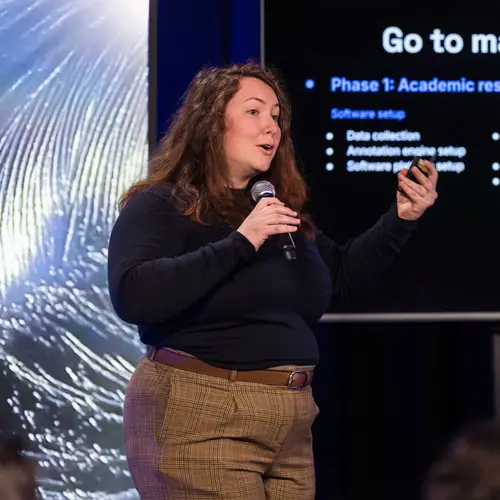
The upcoming meeting at Mila on February 12 will deepen the understanding of the issues surrounding AI safety and foster the exchange of best practices between academic and industry researchers.
Learn how to leverage generative AI to support and improve your productivity at work. The next cohort will take place online on February 24 and 26, 2026.
We use cookies to analyze the browsing and usage of our website and to personalize your experience. You can disable these technologies at any time, but this may limit certain functionalities of the site. Read our Privacy Policy for more information.
Setting cookies
You can enable and disable the types of cookies you wish to accept. However certain choices you make could affect the services offered on our sites (e.g. suggestions, personalised ads, etc.).
Essential cookies
These cookies are necessary for the operation of the site and cannot be deactivated. (Still active)
Analytics cookies
Do you accept the use of cookies to measure the audience of our sites?
Multimedia Player
Do you accept the use of cookies to display and allow you to watch the video content hosted by our partners (YouTube, etc.)?
In this paper we propose a novel model for unconditional audio generation task that generates one audio sample at a time. We show that our m… (see more)odel which profits from combining memory-less modules, namely autoregressive multilayer perceptron, and stateful recurrent neural networks in a hierarchical structure is de facto powerful to capture the underlying sources of variations in temporal domain for very long time on three datasets of different nature. Human evaluation on the generated samples indicate that our model is preferred over competing models. We also show how each component of the model contributes to the exhibited performance.