

Portrait of Yoshua Bengio

Yoshua Bengio

Core Academic Member
Canada CIFAR AI Chair
Full Professor, Université de Montréal
Research Topics
Causality
Computational Neuroscience
Deep Learning
Generative Models
Graph Neural Networks
Machine Learning Theory
Medical Machine Learning
Molecular Modeling
Natural Language Processing
Probabilistic Models
Reasoning
Recurrent Neural Networks
Reinforcement Learning
Representation Learning

Biography

*For media requests, please write to medias@mila.quebec.

For more information please contact Cassidy MacNeil, Senior Assistant and Operation Lead at cassidy.macneil@mila.quebec.

Yoshua Bengio is recognized worldwide as a leading expert in AI. He is most known for his pioneering work in deep learning, which earned him the 2018 A.M. Turing Award, “the Nobel Prize of computing,” with Geoffrey Hinton and Yann LeCun.

Bengio is a full professor at Université de Montréal, and the founder and scientific advisor of Mila – Quebec Artificial Intelligence Institute. He is also a senior fellow at CIFAR and co-directs its Learning in Machines & Brains program, serves as special advisor and founding scientific director of IVADO, and holds a Canada CIFAR AI Chair.

In 2019, Bengio was awarded the prestigious Killam Prize and in 2022, he was the most cited computer scientist in the world by h-index. He is a Fellow of the Royal Society of London, Fellow of the Royal Society of Canada, Knight of the Legion of Honor of France and Officer of the Order of Canada. In 2023, he was appointed to the UN’s Scientific Advisory Board for Independent Advice on Breakthroughs in Science and Technology.

Concerned about the social impact of AI, Bengio helped draft the Montréal Declaration for the Responsible Development of Artificial Intelligence and continues to raise awareness about the importance of mitigating the potentially catastrophic risks associated with future AI systems.

Current Students

Collaborating researcher - Cambridge University
Principal supervisor :
PhD - Université de Montréal
Collaborating Alumni - Université de Montréal
Collaborating researcher - Université de Montréal
Postdoctorate - Université de Montréal
Principal supervisor :
Collaborating researcher - KOREA ADVANCED INSTITUTE OF SCIENCE AND TECHNOLOGY
Collaborating researcher - s.o.
PhD - Université de Montréal
Co-supervisor :
PhD - Université de Montréal
Principal supervisor :
Independent visiting researcher - Université de Montréal
Collaborating researcher - Ying Wu Coll of Computing
Collaborating researcher - University of Waterloo
Principal supervisor :
Postdoctorate - Université de Montréal
PhD - Université de Montréal
Principal supervisor :
Postdoctorate - Université de Montréal
Co-supervisor :
Collaborating Alumni - Université de Montréal
Co-supervisor :
Collaborating Alumni - Université de Montréal
Collaborating researcher - University of Cambridge
Collaborating Alumni - Université de Montréal
Co-supervisor :
PhD - Université de Montréal
Principal supervisor :
Collaborating researcher - Université de Montréal
PhD - McGill University
Principal supervisor :
Collaborating Alumni - McGill University
Principal supervisor :

Publications

Multi-Domain Balanced Sampling Improves Out-of-Generalization of Chest X-ray Pathology Prediction Models
Enoch Amoatey Tetteh
David M. Krueger
Learning models that generalize under different distribution shifts in medical imaging has been a long-standing research challenge. There ha… (see more)ve been several proposals for efficient and robust visual representation learning among vision research practitioners, especially in the sensitive and critical biomedical domain. In this paper, we propose an idea for out-of-distribution generalization of chest X-ray pathologies that uses a simple balanced batch sampling technique. We observed that balanced sampling between the multiple training datasets improves the performance over baseline models trained without balancing. Code for this work is available on Github. 1
Multi-Domain Balanced Sampling Improves Out-of-Distribution Generalization of Chest X-ray Pathology Prediction Models
Learning models that generalize under different distribution shifts in medical imaging has been a long-standing research challenge. There ha… (see more)ve been several proposals for efficient and robust visual representation learning among vision research practitioners, especially in the sensitive and critical biomedical domain. In this paper, we propose an idea for out-of-distribution generalization of chest X-ray pathologies that uses a simple balanced batch sampling technique. We observed that balanced sampling between the multiple training datasets improves the performance over baseline models trained without balancing.
Long-Term Credit Assignment via Model-based Temporal Shortcuts
Effect of diversity in Meta-Learning
Few-shot learning aims to learn representations that can tackle novel tasks given a small number of examples. Recent studies show that task … (see more)distribution plays a vital role in the performance of the model. Conventional wisdom is that task diversity should improve the performance of meta-learning. In this work, we find evidence to the contrary; we study different task distributions on a myriad of models and datasets to evaluate the effect of task diversity on meta-learning algorithms. For this experiment, we train on two datasets - Omniglot and miniImageNet and with three broad classes of meta-learning models - Metric-based (i.e., Protonet, Matching Networks), Optimization-based (i.e., MAML, Reptile, and MetaOptNet), and Bayesian meta-learning models (i.e., CNAPs). Our experiments demonstrate that the effect of task diversity on all these algorithms follows a similar trend, and task diversity does not seem to offer any benefits to the learning of the model. Furthermore, we also demonstrate that even a handful of tasks, repeated over multiple batches, would be sufficient to achieve a performance similar to uniform sampling and draws into question the need for additional tasks to create better models.
A Consciousness-Inspired Planning Agent for Model-Based Reinforcement Learning
We present an end-to-end, model-based deep reinforcement learning agent which dynamically attends to relevant parts of its state during plan… (see more)ning. The agent uses a bottleneck mechanism over a set-based representation to force the number of entities to which the agent attends at each planning step to be small. In experiments, we investigate the bottleneck mechanism with several sets of customized environments featuring different challenges. We consistently observe that the design allows the planning agents to generalize their learned task-solving abilities in compatible unseen environments by attending to the relevant objects, leading to better out-of-distribution generalization performance.
Discrete-Valued Neural Communication in Structured Architectures Enhances Generalization
Dianbo Liu
Chen Sun
Michael C. Mozer
Deep learning has advanced from fully connected architectures to structured models organized into components, e.g., the transformer composed… (see more) of positional elements, modular architectures divided into slots, and graph neural nets made up of nodes. In structured models, an interesting question is how to conduct dynamic and possibly sparse communication among the separate components. Here, we explore the hypothesis that restricting the transmitted information among components to discrete representations is a beneficial bottleneck. The motivating intuition is human language in which communication occurs through discrete symbols. Even though individuals have different understandings of what a "cat" is based on their specific experiences, the shared discrete token makes it possible for communication among individuals to be unimpeded by individual differences in internal representation. To discretize the values of concepts dynamically communicated among specialist components, we extend the quantization mechanism from the Vector-Quantized Variational Autoencoder to multi-headed discretization with shared codebooks and use it for discrete-valued neural communication (DVNC). Our experiments show that DVNC substantially improves systematic generalization in a variety of architectures -- transformers, modular architectures, and graph neural networks. We also show that the DVNC is robust to the choice of hyperparameters, making the method very useful in practice. Moreover, we establish a theoretical justification of our discretization process, proving that it has the ability to increase noise robustness and reduce the underlying dimensionality of the model.
Dynamic Inference with Neural Interpreters
Nasim Rahaman
Muhammad Waleed Gondal
Peter Gehler
Francesco Locatello
Bernhard Schölkopf
Modern neural network architectures can leverage large amounts of data to generalize well within the training distribution. However, they ar… (see more)e less capable of systematic generalization to data drawn from unseen but related distributions, a feat that is hypothesized to require compositional reasoning and reuse of knowledge. In this work, we present Neural Interpreters, an architecture that factorizes inference in a self-attention network as a system of modules, which we call \emph{functions}. Inputs to the model are routed through a sequence of functions in a way that is end-to-end learned. The proposed architecture can flexibly compose computation along width and depth, and lends itself well to capacity extension after training. To demonstrate the versatility of Neural Interpreters, we evaluate it in two distinct settings: image classification and visual abstract reasoning on Raven Progressive Matrices. In the former, we show that Neural Interpreters perform on par with the vision transformer using fewer parameters, while being transferrable to a new task in a sample efficient manner. In the latter, we find that Neural Interpreters are competitive with respect to the state-of-the-art in terms of systematic generalization
Flow Network based Generative Models for Non-Iterative Diverse Candidate Generation
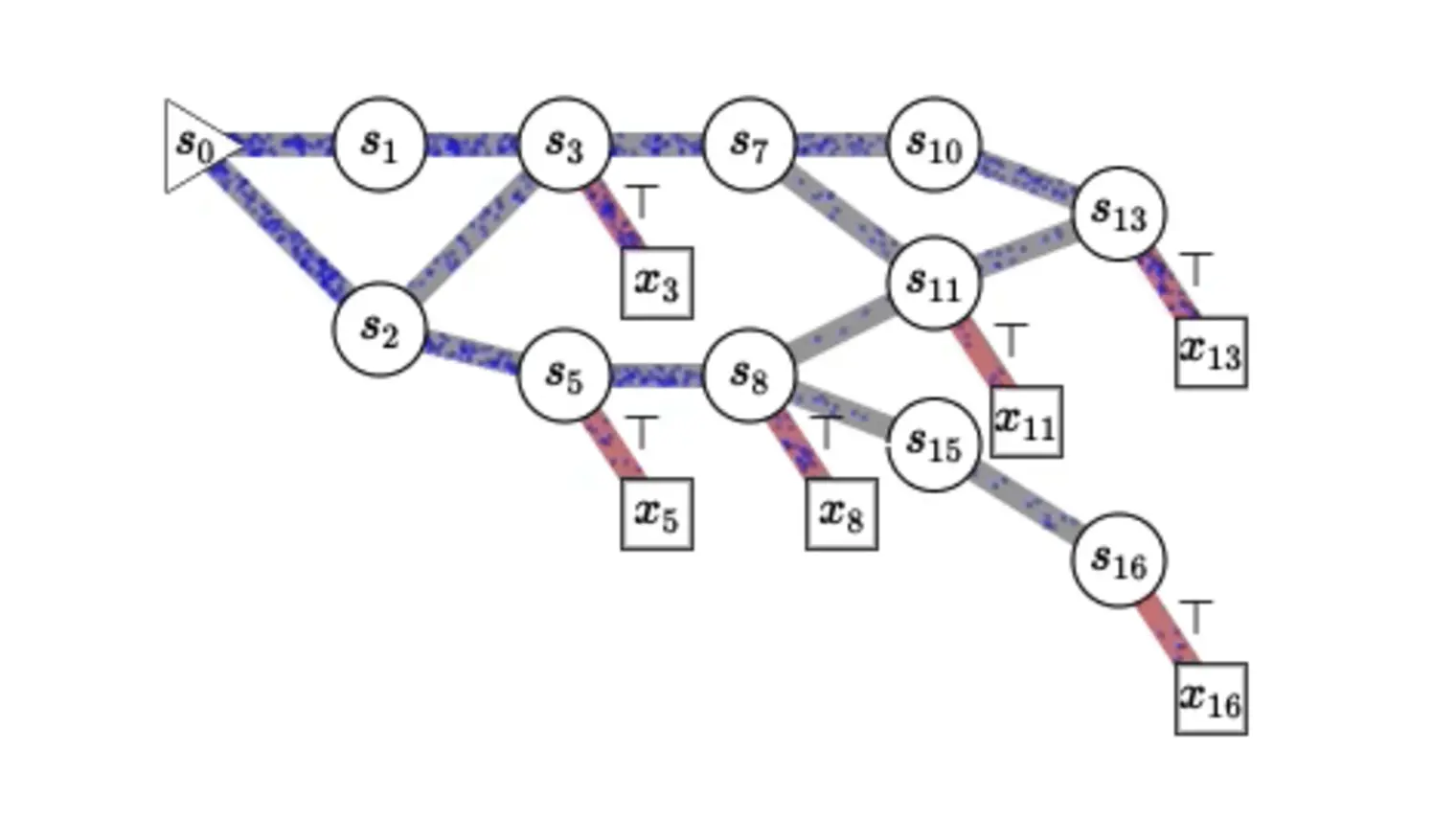
This paper is about the problem of learning a stochastic policy for generating an object (like a molecular graph) from a sequence of actions… (see more), such that the probability of generating an object is proportional to a given positive reward for that object. Whereas standard return maximization tends to converge to a single return-maximizing sequence, there are cases where we would like to sample a diverse set of high-return solutions. These arise, for example, in black-box function optimization when few rounds are possible, each with large batches of queries, where the batches should be diverse, e.g., in the design of new molecules. One can also see this as a problem of approximately converting an energy function to a generative distribution. While MCMC methods can achieve that, they are expensive and generally only perform local exploration. Instead, training a generative policy amortizes the cost of search during training and yields to fast generation. Using insights from Temporal Difference learning, we propose GFlowNet, based on a view of the generative process as a flow network, making it possible to handle the tricky case where different trajectories can yield the same final state, e.g., there are many ways to sequentially add atoms to generate some molecular graph. We cast the set of trajectories as a flow and convert the flow consistency equations into a learning objective, akin to the casting of the Bellman equations into Temporal Difference methods. We prove that any global minimum of the proposed objectives yields a policy which samples from the desired distribution, and demonstrate the improved performance and diversity of GFlowNet on a simple domain where there are many modes to the reward function, and on a molecule synthesis task.
Gradient Starvation: A Learning Proclivity in Neural Networks
We identify and formalize a fundamental gradient descent phenomenon resulting in a learning proclivity in over-parameterized neural networks… (see more). Gradient Starvation arises when cross-entropy loss is minimized by capturing only a subset of features relevant for the task, despite the presence of other predictive features that fail to be discovered. This work provides a theoretical explanation for the emergence of such feature imbalance in neural networks. Using tools from Dynamical Systems theory, we identify simple properties of learning dynamics during gradient descent that lead to this imbalance, and prove that such a situation can be expected given certain statistical structure in training data. Based on our proposed formalism, we develop guarantees for a novel regularization method aimed at decoupling feature learning dynamics, improving accuracy and robustness in cases hindered by gradient starvation. We illustrate our findings with simple and real-world out-of-distribution (OOD) generalization experiments.
Invariance Principle Meets Information Bottleneck for Out-of-Distribution Generalization
The invariance principle from causality is at the heart of notable approaches such as invariant risk minimization (IRM) that seek to address… (see more) out-of-distribution (OOD) generalization failures. Despite the promising theory, invariance principle-based approaches fail in common classification tasks, where invariant (causal) features capture all the information about the label. Are these failures due to the methods failing to capture the invariance? Or is the invariance principle itself insufficient? To answer these questions, we revisit the fundamental assumptions in linear regression tasks, where invariance-based approaches were shown to provably generalize OOD. In contrast to the linear regression tasks, we show that for linear classification tasks we need much stronger restrictions on the distribution shifts, or otherwise OOD generalization is impossible. Furthermore, even with appropriate restrictions on distribution shifts in place, we show that the invariance principle alone is insufficient. We prove that a form of the information bottleneck constraint along with invariance helps address key failures when invariant features capture all the information about the label and also retains the existing success when they do not. We propose an approach that incorporates both of these principles and demonstrate its effectiveness in several experiments.
Neural Production Systems
Nan Rosemary Ke
Charles Blundell
Nicolas Heess
Michael Mozer
Visual environments are structured, consisting of distinct objects or entities. These entities have properties -- both visible and latent --… (see more) that determine the manner in which they interact with one another. To partition images into entities, deep-learning researchers have proposed structural inductive biases such as slot-based architectures. To model interactions among entities, equivariant graph neural nets (GNNs) are used, but these are not particularly well suited to the task for two reasons. First, GNNs do not predispose interactions to be sparse, as relationships among independent entities are likely to be. Second, GNNs do not factorize knowledge about interactions in an entity-conditional manner. As an alternative, we take inspiration from cognitive science and resurrect a classic approach, production systems, which consist of a set of rule templates that are applied by binding placeholder variables in the rules to specific entities. Rules are scored on their match to entities, and the best fitting rules are applied to update entity properties. In a series of experiments, we demonstrate that this architecture achieves a flexible, dynamic flow of control and serves to factorize entity-specific and rule-based information. This disentangling of knowledge achieves robust future-state prediction in rich visual environments, outperforming state-of-the-art methods using GNNs, and allows for the extrapolation from simple (few object) environments to more complex environments.
The Causal-Neural Connection: Expressiveness, Learnability, and Inference
Kevin Xia
Kai-Zhan Lee
Elias Bareinboim
One of the central elements of any causal inference is an object called structural causal model (SCM), which represents a collection of mech… (see more)anisms and exogenous sources of random variation of the system under investigation (Pearl, 2000). An important property of many kinds of neural networks is universal approximability: the ability to approximate any function to arbitrary precision. Given this property, one may be tempted to surmise that a collection of neural nets is capable of learning any SCM by training on data generated by that SCM. In this paper, we show this is not the case by disentangling the notions of expressivity and learnability. Specifically, we show that the causal hierarchy theorem (Thm. 1, Bareinboim et al., 2020), which describes the limits of what can be learned from data, still holds for neural models. For instance, an arbitrarily complex and expressive neural net is unable to predict the effects of interventions given observational data alone. Given this result, we introduce a special type of SCM called a neural causal model (NCM), and formalize a new type of inductive bias to encode structural constraints necessary for performing causal inferences. Building on this new class of models, we focus on solving two canonical tasks found in the literature known as causal identification and estimation. Leveraging the neural toolbox, we develop an algorithm that is both sufficient and necessary to determine whether a causal effect can be learned from data (i.e., causal identifiability); it then estimates the effect whenever identifiability holds (causal estimation). Simulations corroborate the proposed approach.