


Portrait de David Rolnick

David Rolnick

Membre académique principal
Chaire en IA Canada-CIFAR
Professeur adjoint, McGill University, École d'informatique
Professeur associé, Université de Montréal, Département d'informatique et de recherche opérationnelle
Sujets de recherche
Apprentissage automatique appliqué
Apprentissage automatique dans la modélisation climatique
Apprentissage automatique et changement climatique
Apprentissage automatique pour les sciences physiques
Biodiversité
Changement climatique
Climat
Détection hors distribution (OOD)
IA et durabilité
IA pour la science
IA pour le changement climatique
Modélisation climatique
Prévision des séries temporelles
Réduction d'échelle des variables climatiques
Science du climat
Surveillance des forêts
Systèmes de gestion de l'énergie des bâtiments
Systèmes énergétiques
Technologie de conservation
Télédétection
Télédétection par satellite
Théorie de l'apprentissage automatique
Végétation
Vision par ordinateur

Biographie

David Rolnick est professeur adjoint et titulaire d’une chaire en IA Canada-CIFAR à l'École d'informatique de l'Université McGill et membre académique principal de Mila – Institut québécois d’intelligence artificielle. Ses travaux portent sur les applications de l'apprentissage automatique dans la lutte contre le changement climatique. Il est cofondateur et président de Climate Change AI et codirecteur scientifique de Sustainability in the Digital Age. David Rolnick a obtenu un doctorat en mathématiques appliquées du Massachusetts Institute of Technology (MIT). Il a été chercheur postdoctoral en sciences mathématiques à la National Science Foundation (NSF), chercheur diplômé à la NSF et boursier Fulbright. Il a figuré sur la liste des « 35 innovateurs de moins de 35 ans » de la MIT Technology Review en 2021.
Étudiants actuels

Collaborateur·rice de recherche
Collaborateur·rice alumni - McGill
Collaborateur·rice de recherche - Cambridge University
Co-superviseur⋅e :
Postdoctorat - McGill
Collaborateur·rice de recherche - McGill
Collaborateur·rice de recherche - N/A
Co-superviseur⋅e :
Doctorat - McGill
Collaborateur·rice de recherche - Leipzig University
Maîtrise recherche - McGill
Collaborateur·rice de recherche
Visiteur de recherche indépendant - Politecnico di Milano
Visiteur de recherche indépendant
Collaborateur·rice de recherche - Johannes Kepler University
Collaborateur·rice de recherche - University of Amsterdam
Maîtrise recherche - McGill
Visiteur de recherche indépendant - Université de Montréal
Collaborateur·rice de recherche - Polytechnique Montréal
Superviseur⋅e principal⋅e :
Collaborateur·rice de recherche - University of East Anglia
Collaborateur·rice de recherche
Collaborateur·rice de recherche - Columbia university
Postdoctorat - McGill
Co-superviseur⋅e :
Collaborateur·rice de recherche - University of Waterloo
Co-superviseur⋅e :
Collaborateur·rice alumni - UdeM
Maîtrise recherche - McGill
Collaborateur·rice de recherche - Columbia university
Maîtrise recherche - McGill
Collaborateur·rice de recherche - University of Tübingen
Collaborateur·rice de recherche - Karlsruhe Institute of Technology
Doctorat - McGill
Collaborateur·rice alumni - UdeM
Superviseur⋅e principal⋅e :
Collaborateur·rice de recherche
Doctorat - McGill
Collaborateur·rice de recherche - Technical University of Munich

Publications

Benchmarking the geographic generalization of deep learning models for precipitation downscaling
Luca Schmidt
Nicole Ludwig
Matthew Chantry
Christian Lessig
Earth System Models (ESM) are our main tool for projecting the impacts of climate change. However, running these models at sufficient resolu… (voir plus)tion for local-scale risk-assessments is not computationally feasible. Deep learning-based super-resolution models offer a promising solution to downscale ESM outputs to higher resolutions by learning from data. Yet, due to regional variations in climatic processes, these models typically require retraining for each geographical area–demanding high-resolution observational data, which is unevenly available across the globe. This highlights the need to assess how well these models generalize across geographic regions. To address this, we introduce RainShift, a dataset and benchmark for evaluating downscaling under geographic distribution shifts. We evaluate state-of-the-art downscaling approaches including GANs and diffusion models in generalizing across data gaps between the Global North and Global South. Our findings reveal substantial performance drops in out-of-distribution regions, depending on model and geographic area. While expanding the training domain generally improves generalization, it is insufficient to overcome shifts between geographically distinct regions. We show that addressing these shifts through, for example, domain adaptation can improve spatial generalization. Our work advances the global applicability of downscaling methods and represents a step toward reducing inequities in access to high-resolution climate information.
Adsorption energies are necessary but not sufficient to identify good catalysts
Alexander Davis
Alexandre AGM Duval
Oleksandr Voznyy
Alex Hern'andez-Garcia
Deploying Geospatial Foundation Models in the Real World: Lessons from WorldCereal
Christina Butsko
Kristof Van Tricht
Giorgia Milli
Inbal Becker Reshef
Zoltan Szantoi
Hannah Kerner
The increasing availability of geospatial foundation models has the potential to transform remote sensing applications such as land cover cl… (voir plus)assification, environmental monitoring, and change detection. Despite promising benchmark results, the deployment of these models in operational settings is challenging and rare. Standardized evaluation tasks often fail to capture real-world complexities relevant for end-user adoption such as data heterogeneity, resource constraints, and application-specific requirements. This paper presents a structured approach to integrate geospatial foundation models into operational mapping systems. Our protocol has three key steps: defining application requirements, adapting the model to domain-specific data and conducting rigorous empirical testing. Using the Presto model in a case study for crop mapping, we demonstrate that fine-tuning a pre-trained model significantly improves performance over conventional supervised methods. Our results highlight the model’s strong spatial and temporal generalization capabilities. Our protocol provides a replicable blueprint for practitioners and lays the groundwork for future research to operationalize foundation models in diverse remote sensing applications. Application of the protocol to the WorldCereal global crop-mapping system showcases the framework’s scalability.
On Global Applicability and Location Transferability of Generative Deep Learning Models for Precipitation Downscaling
Christian Lessig
Matthew Chantry
Alberta Wells Dataset: Pinpointing Oil and Gas Wells from Satellite Imagery
Brefo Dwamena Yaw
Jade Boutot
Mary Kang
Millions of abandoned oil and gas wells are scattered across the world, leaching methane into the atmosphere and toxic compounds into the gr… (voir plus)oundwater. Many of these locations are unknown, preventing the wells from being plugged and their polluting effects averted. Remote sensing is a relatively unexplored tool for pinpointing abandoned wells at scale. We introduce the first large-scale Benchmark dataset for this problem, leveraging high-resolution multi-spectral satellite imagery from Planet Labs. Our curated Dataset comprises over 213,000 wells (abandoned, suspended, and active) from Alberta, a region with especially high well density, sourced from the Alberta Energy Regulator and verified by domain experts. We evaluate baseline algorithms for well detection and segmentation, showing the promise of computer vision approaches but also significant room for improvement.
Galileo: Learning Global & Local Features of Many Remote Sensing Modalities
Anthony Fuller
Henry Herzog
Patrick Beukema
Favyen Bastani
James R Green
Evan Shelhamer
Hannah Kerner
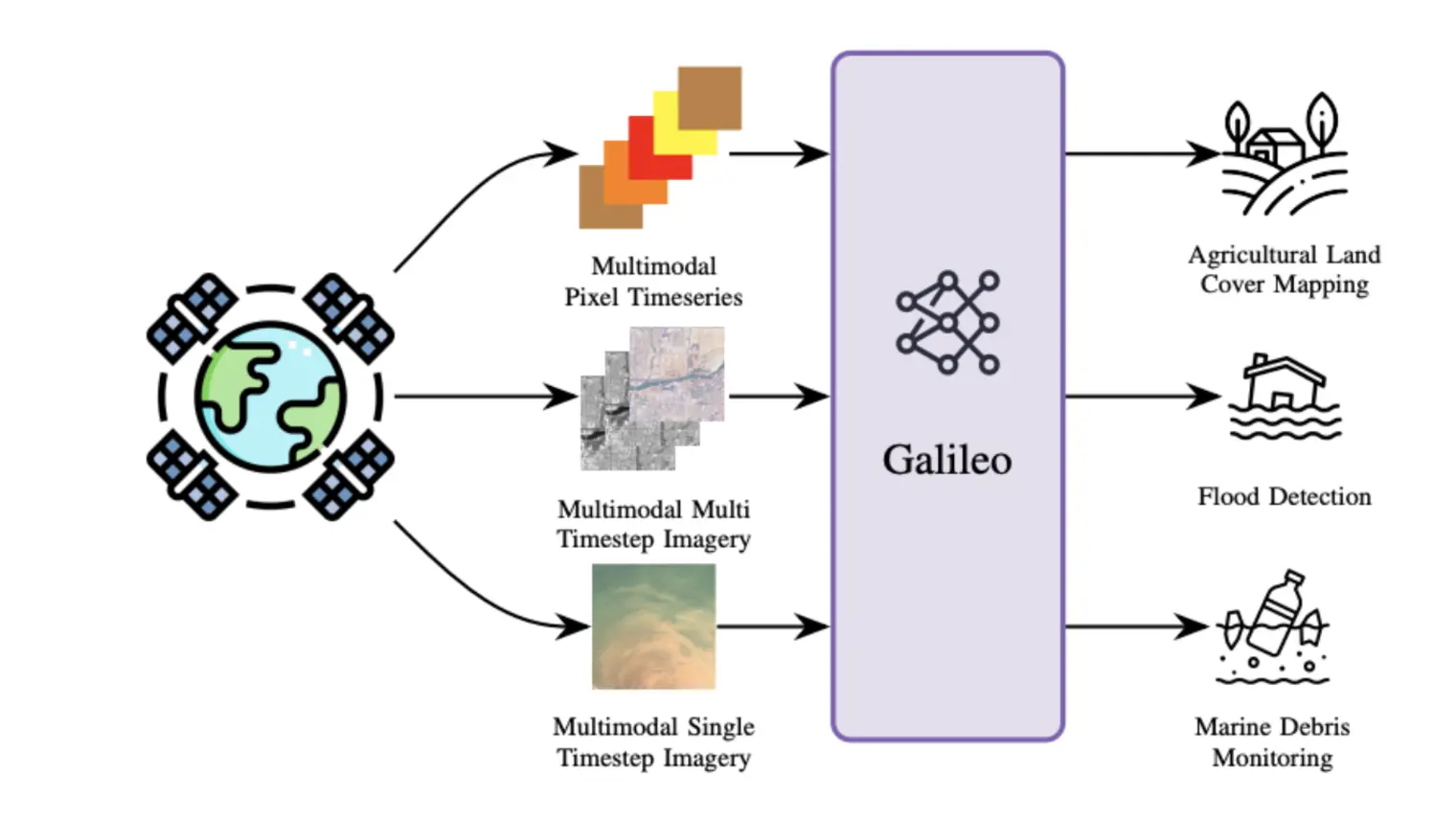
We introduce a highly multimodal transformer to represent many remote sensing modalities - multispectral optical, synthetic aperture radar, … (voir plus)elevation, weather, pseudo-labels, and more - across space and time. These inputs are useful for diverse remote sensing tasks, such as crop mapping and flood detection. However, learning shared representations of remote sensing data is challenging, given the diversity of relevant data modalities, and because objects of interest vary massively in scale, from small boats (1-2 pixels and fast) to glaciers (thousands of pixels and slow). We present a novel self-supervised learning algorithm that extracts multi-scale features across a flexible set of input modalities through masked modeling. Our dual global and local contrastive losses differ in their targets (deep representations vs. shallow input projections) and masking strategies (structured vs. not). Our Galileo is a single generalist model that outperforms SoTA specialist models for satellite images and pixel time series across eleven benchmarks and multiple tasks.
The Butterfly Effect: Neural Network Training Trajectories Are Highly Sensitive to Initial Conditions
Neural network training is inherently sensitive to initialization and the randomness induced by stochastic gradient descent. However, it is … (voir plus)unclear to what extent such effects lead to meaningfully different networks, either in terms of the models’ weights or the underlying functions that were learned. In this work, we show that during the initial "chaotic" phase of training, even extremely small perturbations reliably causes otherwise identical training trajectories to diverge-an effect that diminishes rapidly over training time. We quantify this divergence through (i)
The Butterfly Effect: Neural Network Training Trajectories Are Highly Sensitive to Initial Conditions
Neural network training is inherently sensitive to initialization and the randomness induced by stochastic gradient descent. However, it is … (voir plus)unclear to what extent such effects lead to meaningfully different networks, either in terms of the models' weights or the underlying functions that were learned. In this work, we show that during the initial "chaotic" phase of training, even extremely small perturbations reliably causes otherwise identical training trajectories to diverge-an effect that diminishes rapidly over training time. We quantify this divergence through (i)
Catalyst GFlowNet for electrocatalyst design: A hydrogen evolution reaction case study
Efficient and inexpensive energy storage is essential for accelerating the adoption of renewable energy and ensuring a stable supply, despit… (voir plus)e fluctuations in sources such as wind and solar. Electrocatalysts play a key role in hydrogen energy storage (HES), allowing the energy to be stored as hydrogen. However, the development of affordable and high-performance catalysts for this process remains a significant challenge. We introduce Catalyst GFlowNet, a generative model that leverages machine learning-based predictors of formation and adsorption energy to design crystal surfaces that act as efficient catalysts. We demonstrate the performance of the model through a proof-of-concept application to the hydrogen evolution reaction, a key reaction in HES, for which we successfully identified platinum as the most efficient known catalyst. In future work, we aim to extend this approach to the oxygen evolution reaction, where current optimal catalysts are expensive metal oxides, and open the search space to discover new materials. This generative modeling framework offers a promising pathway for accelerating the search for novel and efficient catalysts.
Catalyst GFlowNet for electrocatalyst design: A hydrogen evolution reaction case study
Efficient and inexpensive energy storage is essential for accelerating the adoption of renewable energy and ensuring a stable supply, despit… (voir plus)e fluctuations in sources such as wind and solar. Electrocatalysts play a key role in hydrogen energy storage (HES), allowing the energy to be stored as hydrogen. However, the development of affordable and high-performance catalysts for this process remains a significant challenge. We introduce Catalyst GFlowNet, a generative model that leverages machine learning-based predictors of formation and adsorption energy to design crystal surfaces that act as efficient catalysts. We demonstrate the performance of the model through a proof-of-concept application to the hydrogen evolution reaction, a key reaction in HES, for which we successfully identified platinum as the most efficient known catalyst. In future work, we aim to extend this approach to the oxygen evolution reaction, where current optimal catalysts are expensive metal oxides, and open the search space to discover new materials. This generative modeling framework offers a promising pathway for accelerating the search for novel and efficient catalysts.
Graph Dreamer: Temporal Graph World Models for Sample-Efficient and Generalisable Reinforcement Learning
Identifying birdsong syllables without labelled data
Identifying sequences of syllables within birdsongs is key to tackling a wide array of challenges, including bird individual identification … (voir plus)and better understanding of animal communication and sensory-motor learning. Recently, machine learning approaches have demonstrated great potential to alleviate the need for experts to label long audio recordings by hand. However, they still typically rely on the availability of labelled data for model training, restricting applicability to a few species and datasets. In this work, we build the first fully unsupervised algorithm to decompose birdsong recordings into sequences of syllables. We first detect syllable events, then cluster them to extract templates -- syllable representations -- before performing matching pursuit to decompose the recording as a sequence of syllables. We evaluate our automatic annotations against human labels on a dataset of Bengalese finch songs and find that our unsupervised method achieves high performance. We also demonstrate that our approach can distinguish individual birds within a species through their unique vocal signatures, for both Bengalese finches and another species, the great tit.