


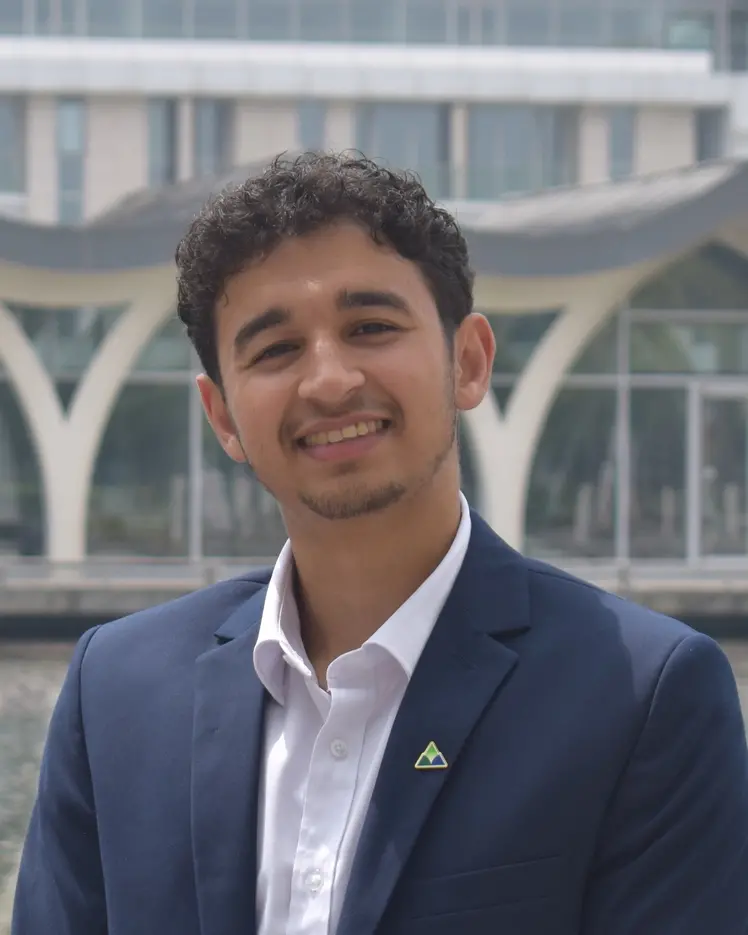
Portrait de Othmane Echchabi

Othmane Echchabi

Représentant du laboratoire
Maitrise de recherche
Superviseur⋅e principal⋅e
Sujets de recherche
IA pour le changement climatique

Biographie

Je suis étudiant en maîtrise (M.Sc.) à l’Université McGill sous la supervision du professeur Rolnick. Je travaille sur des applications de la télédétection liées au changement climatique. Ravi d’être l’un des représentants de laboratoire cette année et enthousiaste à l’idée de travailler avec l’équipe pour représenter et défendre les intérêts des étudiants à Mila.

Publications

Seeing SDG 6 from space: Local-scale monitoring of piped water and sewage systems across Africa using satellite imagery and self-supervised learning
Aya Lahlou
Nizar Talty
Josh Malcolm Manto
Tongshu Zheng
Ka Leung Lam
Access to drinking water and sanitation services is essential. Sustainable Development Goal 6 (SDG 6) aims to achieve universal access, but … (voir plus)progress monitoring remains constrained by costly, infrequent, and spatially uneven household surveys and censuses, particularly in data-scarce regions. To address this gap, this study develops a scalable remote-sensing framework for estimating area-level presence of piped water and sewage systems at 2.56 km spatial resolution across Africa. The framework integrates Sentinel-2 imagery, enumerator-observed system-presence records from Afrobarometer enumeration areas, 30 m population data, and Vision Transformer representations learned with DINO self-supervised learning. The best-performing models achieve held-out AUROC values of 91.54% for piped water and 93.24% for sewage across enumeration areas. Under leave-one-region-out cross-validation, this falls to 75.5% and 78.7% respectively, reflecting transfer difficulty to unsampled regions. Applied across 50 African countries, population-weighted piped water estimates closely track WHO/UNICEF JMP piped water access ( R 2 = 0.92 ), while sewage estimates show meaningful agreement with the broader JMP safely managed sanitation benchmark ( R 2 = 0.72 ). In countries without Afrobarometer survey coverage, the model achieves population-weighted mean absolute errors of 9.5% for piped water and 10.7% for sewage. A Nigeria application across 767 Local Government Areas shows how our framework’s fine-scale predictions reveal substantial subnational inequality, with the largest populations living where no piped water system is present reaching 1.187 million, and no sewage system 1.577 million. These findings show that DINO-based self-supervised learning using freely available satellite imagery can complement traditional household surveys, supporting SDG 6 monitoring, infrastructure planning, and environmental equity assessment.