

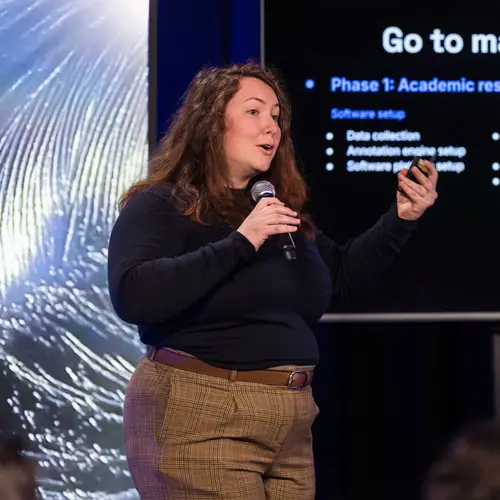

Portrait de Marco Bonizzato

Marco Bonizzato

Membre académique associé
Professeur adjoint, Polytechnique Montréal, Département de génie électrique
Professeur adjoint, Université de Montréal, Département de neurosciences
Sujets de recherche
Neurosciences computationnelles
Optimisation en boîte noire
Systèmes dynamiques

Biographie

Marco Bonizzato est ingénieur en contrôle, en électricité et en sciences de la vie, et cumule plus de 10 ans d'expérience dans le domaine des interfaces cerveau-ordinateur implantables et de la technologie de neuromodulation. Il possède une double expertise unique en prothèses neurales et en intelligence et optimisation des machines.

Il est professeur adjoint de génie électrique à Polytechnique Montréal et professeur auxiliaire de neurosciences à l'Université de Montréal.

Il dirige également le laboratoire sciNeurotech. L'objectif de la recherche qui y est menée est de développer l'arc translationnel complet de nouvelles thérapies de neurostimulation afin de restaurer la fonction sensorimotrice après un neurotraumatisme, depuis la découverte chez le rongeur jusqu'à l'application dans la technologie médicale humaine, adaptée et personnalisée à chaque utilisateur par l'intelligence artificielle.

Étudiants actuels

Doctorat - Polytechnique
Stagiaire de recherche - Polytechnique
Doctorat - Polytechnique
Postdoctorat - Polytechnique
Maîtrise recherche - Polytechnique
Co-superviseur⋅e :
Doctorat - UdeM
Maîtrise recherche - UdeM
Co-superviseur⋅e :
Postdoctorat - Polytechnique
Stagiaire de recherche - Polytechnique

Publications

Use of Invasive Brain-Computer Interfaces in Pediatric Neurosurgery: Technical and Ethical Considerations
David Bergeron
Christian Iorio-Morin
Nathalie Orr Gaucher
Éric Racine
Alexander G. Weil
Autonomous optimization of neuroprosthetic stimulation parameters that drive the motor cortex and spinal cord outputs in rats and monkeys
Sandrine L. Côté
Elena Massai
Parikshat Sirpal
Stephan Quessy
Marina Martinez
Numa Dancause
Neural stimulation can alleviate paralysis and sensory deficits. Novel high-density neural interfaces can enable refined and multipronged ne… (voir plus)urostimulation interventions. To achieve this, it is essential to develop algorithmic frameworks capable of handling optimization in large parameter spaces. Here, we leveraged an algorithmic class, Gaussian-process (GP)-based Bayesian optimization (BO), to solve this problem. We show that GP-BO efficiently explores the neurostimulation space, outperforming other search strategies after testing only a fraction of the possible combinations. Through a series of real-time multi-dimensional neurostimulation experiments, we demonstrate optimization across diverse biological targets (brain, spinal cord), animal models (rats, non-human primates), in healthy subjects, and in neuroprosthetic intervention after injury, for both immediate and continual learning over multiple sessions. GP-BO can embed and improve “prior” expert/clinical knowledge to dramatically enhance its performance. These results advocate for broader establishment of learning agents as structural elements of neuroprosthetic design, enabling personalization and maximization of therapeutic effectiveness.
Implementing automation in deep brain stimulation: has the time come?
Alfonso Fasano