

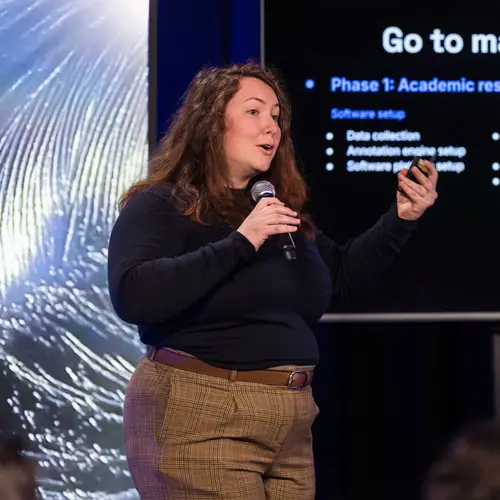

Portrait of Marco Bonizzato

Marco Bonizzato

Associate Academic Member
Assistant Professor, Polytechnique Montréal, Department of Electrical Engineering
Adjunct Professor, Université de Montréal, Department of Neurosciences
Research Topics
Blackbox Optimization
Computational Neuroscience
Dynamical Systems

Biography

Marco Bonizzato is a control, electrical and life sciences engineer with over ten years’ experience in implantable brain-computer interfaces and neuromodulation technology. He has unique double expertise in (a) neural prostheses, and (b) machine intelligence and optimization.

Bonizzato is an assistant professor of electrical engineering at Polytechnique Montréal and an adjunct professor of neuroscience at Université de Montréal.

He also directs the Polytechnique’s sciNeurotech Lab, whose research goal is to develop the entire translational arc of new neurostimulation therapies aimed at restoring sensorimotor function after neurotrauma—from discovery in rodents to application in human medical technologies tailored and personalized to the user using AI.

Current Students

PhD - Polytechnique Montréal
Research Intern - Polytechnique Montréal
PhD - Polytechnique Montréal
Postdoctorate - Polytechnique Montréal
Master's Research - Polytechnique Montréal
PhD - Université de Montréal
Master's Research - Université de Montréal
Postdoctorate - Polytechnique Montréal
Research Intern - Polytechnique Montréal

Publications

Use of Invasive Brain-Computer Interfaces in Pediatric Neurosurgery: Technical and Ethical Considerations
David Bergeron
Christian Iorio-Morin
Nathalie Orr Gaucher
Éric Racine
Alexander G. Weil
Autonomous optimization of neuroprosthetic stimulation parameters that drive the motor cortex and spinal cord outputs in rats and monkeys
Sandrine L. Côté
Elena Massai
Parikshat Sirpal
Stephan Quessy
Marina Martinez
Numa Dancause
Neural stimulation can alleviate paralysis and sensory deficits. Novel high-density neural interfaces can enable refined and multipronged ne… (see more)urostimulation interventions. To achieve this, it is essential to develop algorithmic frameworks capable of handling optimization in large parameter spaces. Here, we leveraged an algorithmic class, Gaussian-process (GP)-based Bayesian optimization (BO), to solve this problem. We show that GP-BO efficiently explores the neurostimulation space, outperforming other search strategies after testing only a fraction of the possible combinations. Through a series of real-time multi-dimensional neurostimulation experiments, we demonstrate optimization across diverse biological targets (brain, spinal cord), animal models (rats, non-human primates), in healthy subjects, and in neuroprosthetic intervention after injury, for both immediate and continual learning over multiple sessions. GP-BO can embed and improve “prior” expert/clinical knowledge to dramatically enhance its performance. These results advocate for broader establishment of learning agents as structural elements of neuroprosthetic design, enabling personalization and maximization of therapeutic effectiveness.
Implementing automation in deep brain stimulation: has the time come?
Alfonso Fasano