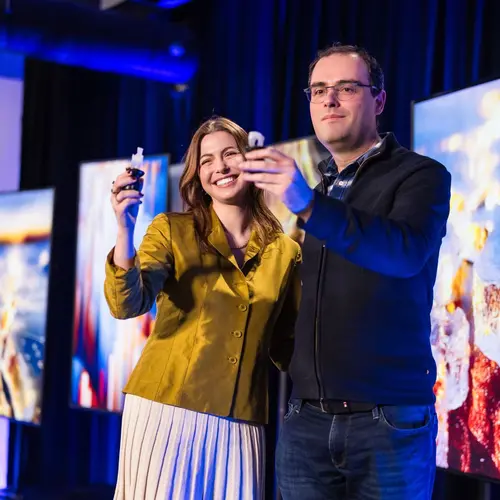
Rejoignez-nous le 19 novembre pour la troisième édition du concours de vulgarisation scientifique de Mila, où les étudiant·e·s présenteront leurs recherches complexes en trois minutes devant un jury.
Nous utilisons des témoins pour analyser le trafic et l’utilisation de notre site web, afin de personnaliser votre expérience. Vous pouvez désactiver ces technologies à tout moment, mais cela peut restreindre certaines fonctionnalités du site. Consultez notre Politique de protection de la vie privée pour en savoir plus.
Paramètre des cookies
Vous pouvez activer et désactiver les types de cookies que vous souhaitez accepter. Cependant certains choix que vous ferez pourraient affecter les services proposés sur nos sites (ex : suggestions, annonces personnalisées, etc.).
Cookies essentiels
Ces cookies sont nécessaires au fonctionnement du site et ne peuvent être désactivés. (Toujours actif)
Cookies analyse
Acceptez-vous l'utilisation de cookies pour mesurer l'audience de nos sites ?
Lecteur Multimédia
Acceptez-vous l'utilisation de cookies pour afficher et vous permettre de regarder les contenus vidéo hébergés par nos partenaires (YouTube, etc.) ?
Most spinal cord injuries (SCI) spare descending motor pathways and sublesional networks, which can be activated through motor cortex and sp… (voir plus)inal cord stimulation to mitigate locomotor deficits. However, the potential synergy between cortical and spinal stimulation as a neuroprosthetic intervention remains unknown. Here, we first investigated phase-locked electrical stimulation of the motor cortex and lumbar spinal cord at 40 Hz in a rat model of unilateral SCI. Combining cortical and lumbar stimulation around the anticipated lift synergistically enhanced leg movements. When integrated into rehabilitation training, cortical stimulation proved essential for recovery of skilled locomotion. As a further refinement, we next investigated the effects of high-frequency (330 Hz) lumbar and sacral stimulation combined with cortical stimulation. Timely integration during the swing phase showed that cortical and rostral lumbar stimulations enhance the initial and mid-swing phases, while sacral stimulation improves extension velocity in the late swing. These findings indicate that supraspinal and sublesional neuromodulation offer complementary neuroprosthetic effects in targeted SCI gait rehabilitation. Highlights Cortical and spinal stimulations summate motor outputs via distinct pathways. Each improves gait post-SCI, but combined stimulation maximizes gait improvement. Integrating cortico-spinal stimulation into rehabilitation promotes lasting recovery. EES capabilities extended using high-frequency lumbosacral protocols.