



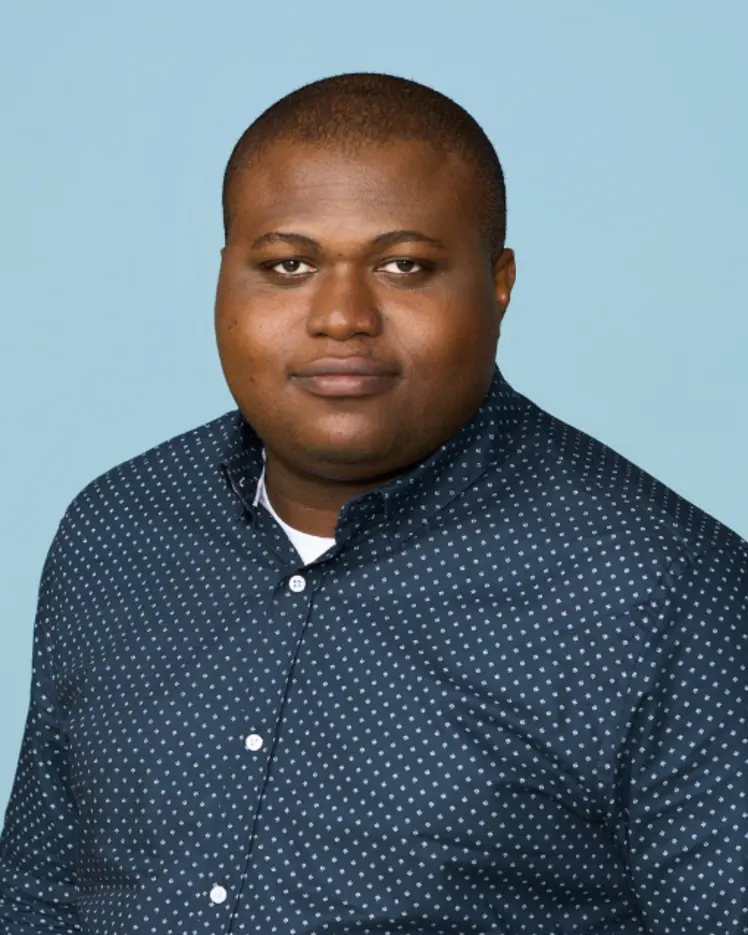
Portrait de David Ifeoluwa Adelani

David Ifeoluwa Adelani

Membre académique principal
Chaire en IA Canada-CIFAR
McGill University
Sujets de recherche
Apprentissage de représentations
Apprentissage profond
Traitement de la parole
Traitement du langage naturel

Biographie

David Adelani est professeur adjoint en science informatique et lutte contre les inégalités à l’Université McGill, et membre académique principal à Mila – Institut québécois d'intelligence artificielle. Ses recherches se concentrent sur le traitement multilingue du langage naturel, avec un accent particulier sur les langues sous-dotées en ressources.

Étudiants actuels

Maîtrise recherche - McGill
Stagiaire de recherche - McGill
Collaborateur·rice de recherche - McGill
Postdoctorat - McGill
Stagiaire de recherche - McGill
Doctorat - McGill
Stagiaire de recherche - McGill
Doctorat - McGill
Doctorat - McGill
Stagiaire de recherche - McGill
Maîtrise recherche - McGill
Stagiaire de recherche - McGill
Maîtrise professionnelle - UdeM
Stagiaire de recherche - McGill
Maîtrise recherche - McGill

Publications

mSTEB: Massively Multilingual Evaluation of LLMs on Speech and Text Tasks
Luel Hagos Beyene
Min Ma
Jesujoba Oluwadara Alabi
Fabian David Schmidt
Joyce Nakatumba-Nabende
Large Language models (LLMs) have demonstrated impressive performance on a wide range of tasks, including in multimodal settings such as spe… (voir plus)ech. However, their evaluation is often limited to English and a few high-resource languages. For low-resource languages, there is no standardized evaluation benchmark. In this paper, we address this gap by introducing mSTEB, a new benchmark to evaluate the performance of LLMs on a wide range of tasks covering language identification, text classification, question answering, and translation tasks on both speech and text modalities. We evaluated the performance of leading LLMs such as Gemini 2.0 Flash and GPT-4o (Audio) and state-of-the-art open models such as Qwen 2 Audio and Gemma 3 27B. Our evaluation shows a wide gap in performance between high-resource and low-resource languages, especially for languages spoken in Africa and Americas/Oceania. Our findings show that more investment is needed to address their under-representation in LLMs coverage.
SSA-COMET: Do LLMs Outperform Learned Metrics in Evaluating MT for Under-Resourced African Languages?
Senyu Li
Jiayi Wang
Felermino Dario Mario Ali
Colin Cherry
Daniel Deutsch
Eleftheria Briakou
Rui Sousa-Silva
Henrique Lopes Cardoso
Pontus Stenetorp
Evaluating machine translation (MT) quality for under-resourced African languages remains a significant challenge, as existing metrics often… (voir plus) suffer from limited language coverage and poor performance in low-resource settings. While recent efforts, such as AfriCOMET, have addressed some of the issues, they are still constrained by small evaluation sets, a lack of publicly available training data tailored to African languages, and inconsistent performance in extremely low-resource scenarios. In this work, we introduce SSA-MTE, a large-scale human-annotated MT evaluation (MTE) dataset covering 13 African language pairs from the News domain, with over 63,000 sentence-level annotations from a diverse set of MT systems. Based on this data, we develop SSA-COMET and SSA-COMET-QE, improved reference-based and reference-free evaluation metrics. We also benchmark prompting-based approaches using state-of-the-art LLMs like GPT-4o and Claude. Our experimental results show that SSA-COMET models significantly outperform AfriCOMET and are competitive with the strongest LLM (Gemini 2.5 Pro) evaluated in our study, particularly on low-resource languages such as Twi, Luo, and Yoruba. All resources are released under open licenses to support future research.
Improving Multilingual Math Reasoning for African Languages
Odunayo Ogundepo
Akintunde Oladipo
Kelechi Ogueji
Esther Adenuga
Jimmy Lin
Researchers working on low-resource languages face persistent challenges due to limited data availability and restricted access to computati… (voir plus)onal resources. Although most large language models (LLMs) are predominantly trained in high-resource languages, adapting them to low-resource contexts, particularly African languages, requires specialized techniques. Several strategies have emerged for adapting models to low-resource languages in todays LLM landscape, defined by multi-stage pre-training and post-training paradigms. However, the most effective approaches remain uncertain. This work systematically investigates which adaptation strategies yield the best performance when extending existing LLMs to African languages. We conduct extensive experiments and ablation studies to evaluate different combinations of data types (translated versus synthetically generated), training stages (pre-training versus post-training), and other model adaptation configurations. Our experiments focuses on mathematical reasoning tasks, using the Llama 3.1 model family as our base model.
The NaijaVoices Dataset: Cultivating Large-Scale, High-Quality, Culturally-Rich Speech Data for African Languages
The NaijaVoices Community
Busayo Awobade
Abraham Owodunni
Handel Emezue
Gloria Monica Tobechukwu Emezue
N. N. Emezue
Sewade Ogun
Bunmi Akinremi
Christopher Pal
Does Generative AI speak Nigerian-Pidgin?: Issues about Representativeness and Bias for Multilingualism in LLMs
A. Seza Doğruöz
Iyanuoluwa Shode
Aremu Anuoluwapo
Lugha-Llama: Adapting Large Language Models for African Languages
Happy Buzaaba
Alexander Wettig
Christiane Fellbaum
SemEval-2025 Task 11: Bridging the Gap in Text-Based Emotion Detection
Shamsuddeen Hassan Muhammad
Nedjma OUSIDHOUM
Idris Abdulmumin
Seid Muhie Yimam
Jan Philip Wahle
Terry Lima Ruas
Meriem Beloucif
Christine de Kock
Tadesse Belay
Ibrahim Ahmad
Nirmal Surange
Daniela Teodorescu
Alham Fikri Aji
Felermino Ali
Vladimir Araujo
Abinew Ayele
Oana Ignat
Alexander Panchenko
Yi Zhou … (voir 1 de plus)
Saif M. Mohammad
BRIGHTER: BRIdging the Gap in Human-Annotated Textual Emotion Recognition Datasets for 28 Languages
Shamsuddeen Hassan Muhammad
Nedjma OUSIDHOUM
Idris Abdulmumin
Jan Philip Wahle
Terry Lima Ruas
Meriem Beloucif
Christine de Kock
Nirmal Surange
Daniela Teodorescu
Ibrahim Ahmad
Alham Fikri Aji
Felermino Ali
Ilseyar Alimova
Vladimir Araujo
Nikolay Babakov
Naomi Baes
Ana-Maria Bucur
Andiswa Bukula
Guanqun Cao … (voir 28 de plus)
Rodrigo Tufino Cardenas
Rendi Chevi
Chiamaka Ijeoma Chukwuneke
Alexandra Ciobotaru
Daryna Dementieva
Murja Sani Gadanya
Robert Geislinger
Bela Gipp
Oumaima Hourrane
Oana Ignat
Falalu Lawan
Rooweither Mabuya
Rahmad Mahendra
Vukosi Marivate
Andrew Piper
Alexander Panchenko
Charles Henrique Porto Ferreira
Vitaly Protasov
Samuel Rutunda
Manish Shrivastava
Aura Cristina Udrea
Lilian D. A. Wanzare
Sophie Wu
Florian Valentin Wunderlich
Hanif Muhammad Zhafran
Tianhui Zhang
Yi Zhou
Saif M. Mohammad
INJONGO: A Multicultural Intent Detection and Slot-filling Dataset for 16 African Languages
Hao Yu
Jesujoba Oluwadara Alabi
Andiswa Bukula
Zhuang Yun Jian
En-Shiun Annie Lee
Tadesse Kebede Guge
Israel Abebe Azime
Happy Buzaaba
Blessing Kudzaishe Sibanda
Godson Kalipe
Jonathan Mukiibi
S. Kabenamualu
M. Setaka
Lolwethu Ndolela
Nkiruka Bridget Odu
Rooweither Mabuya
Shamsuddeen Hassan Muhammad
Salomey Osei
Sokhar Samb
Juliet W. Murage … (voir 2 de plus)
Dietrich Klakow
AfriHate: A Multilingual Collection of Hate Speech and Abusive Language Datasets for African Languages
Shamsuddeen Hassan Muhammad
Idris Abdulmumin
Abinew Ayele
Ibrahim Ahmad
Saminu Mohammad Aliyu
Nelson Odhiambo Onyango
Lilian D. A. Wanzare
Samuel Rutunda
Lukman Jibril Aliyu
Esubalew Alemneh
Oumaima Hourrane
Hagos Gebremichael
Elyas Abdi Ismail
Meriem Beloucif
Ebrahim Chekol Jibril
Andiswa Bukula
Rooweither Mabuya
Salomey Osei
Abigail Oppong … (voir 7 de plus)
Tadesse Belay
Tadesse Kebede Guge
Tesfa Tegegne Asfaw
Chiamaka Ijeoma Chukwuneke
Paul Rottger
Seid Muhie Yimam
Nedjma OUSIDHOUM
Hate speech and abusive language are global phenomena that need socio-cultural background knowledge to be understood, identified, and modera… (voir plus)ted. However, in many regions of the Global South, there have been several documented occurrences of (1) absence of moderation and (2) censorship due to the reliance on keyword spotting out of context. Further, high-profile individuals have frequently been at the center of the moderation process, while large and targeted hate speech campaigns against minorities have been overlooked. These limitations are mainly due to the lack of high-quality data in the local languages and the failure to include local communities in the collection, annotation, and moderation processes. To address this issue, we present AfriHate: a multilingual collection of hate speech and abusive language datasets in 15 African languages. Each instance in AfriHate is annotated by native speakers familiar with the local culture. We report the challenges related to the construction of the datasets and present various classification baseline results with and without using LLMs. The datasets, individual annotations, and hate speech and offensive language lexicons are available on https://github.com/AfriHate/AfriHate
AFRIDOC-MT: Document-level MT Corpus for African Languages
Jesujoba Oluwadara Alabi
Israel Abebe Azime
Miaoran Zhang
Cristina España-Bonet
Rachel Bawden
Dawei Zhu
Clement Odoje
Idris Akinade
Iffat Maab
Davis David
Shamsuddeen Hassan Muhammad
Neo Putini
David O. Ademuyiwa
Andrew Caines
Dietrich Klakow
This paper introduces AFRIDOC-MT, a document-level multi-parallel translation dataset covering English and five African languages: Amharic, … (voir plus)Hausa, Swahili, Yor\`ub\'a, and Zulu. The dataset comprises 334 health and 271 information technology news documents, all human-translated from English to these languages. We conduct document-level translation benchmark experiments by evaluating neural machine translation (NMT) models and large language models (LLMs) for translations between English and these languages, at both the sentence and pseudo-document levels. These outputs are realigned to form complete documents for evaluation. Our results indicate that NLLB-200 achieved the best average performance among the standard NMT models, while GPT-4o outperformed general-purpose LLMs. Fine-tuning selected models led to substantial performance gains, but models trained on sentences struggled to generalize effectively to longer documents. Furthermore, our analysis reveals that some LLMs exhibit issues such as under-generation, repetition of words or phrases, and off-target translations, especially for African languages.
Charting the Landscape of African NLP: Mapping Progress and Shaping the Road Ahead
Jesujoba Oluwadara Alabi
Michael A. Hedderich
Dietrich Klakow