
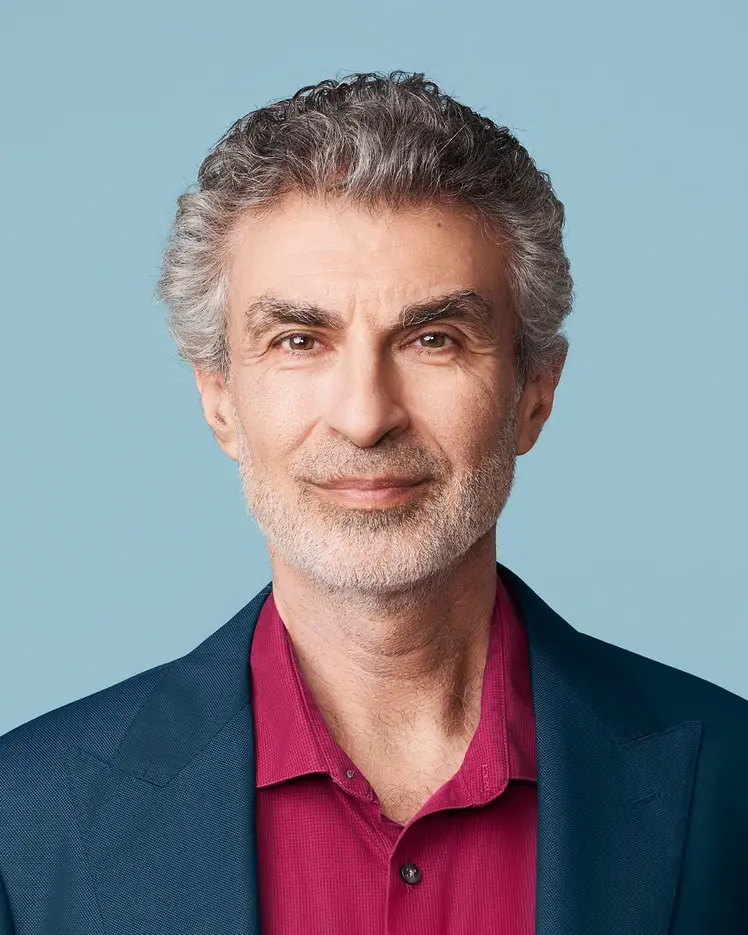
Portrait of Yoshua Bengio

Yoshua Bengio

Core Academic Member
Canada CIFAR AI Chair
Full Professor, Université de Montréal, Department of Computer Science and Operations Research Department
Founder and Scientific Advisor, Leadership Team
Research Topics
Causality
Computational Neuroscience
Deep Learning
Generative Models
Graph Neural Networks
Machine Learning Theory
Medical Machine Learning
Molecular Modeling
Natural Language Processing
Probabilistic Models
Reasoning
Recurrent Neural Networks
Reinforcement Learning
Representation Learning

Biography

*For media requests, please write to medias@mila.quebec.

For more information please contact Cassidy MacNeil, Senior Assistant and Operation Lead at cassidy.macneil@mila.quebec.

Yoshua Bengio is recognized worldwide as a leading expert in AI. He is most known for his pioneering work in deep learning, which earned him the 2018 A.M. Turing Award, “the Nobel Prize of computing,” with Geoffrey Hinton and Yann LeCun.

Bengio is a full professor at Université de Montréal, and the founder and scientific advisor of Mila – Quebec Artificial Intelligence Institute. He is also a senior fellow at CIFAR and co-directs its Learning in Machines & Brains program, serves as special advisor and founding scientific director of IVADO, and holds a Canada CIFAR AI Chair.

In 2019, Bengio was awarded the prestigious Killam Prize and in 2022, he was the most cited computer scientist in the world by h-index. He is a Fellow of the Royal Society of London, Fellow of the Royal Society of Canada, Knight of the Legion of Honor of France and Officer of the Order of Canada. In 2023, he was appointed to the UN’s Scientific Advisory Board for Independent Advice on Breakthroughs in Science and Technology.

Concerned about the social impact of AI, Bengio helped draft the Montréal Declaration for the Responsible Development of Artificial Intelligence and continues to raise awareness about the importance of mitigating the potentially catastrophic risks associated with future AI systems.

Current Students

Collaborating Alumni - McGill University
Collaborating Alumni - Université de Montréal
Collaborating researcher - Cambridge University
Principal supervisor :
PhD - Université de Montréal
Independent visiting researcher
Co-supervisor :
PhD - Université de Montréal
Independent visiting researcher
Principal supervisor :
Collaborating researcher - N/A
Principal supervisor :
PhD - Université de Montréal
Collaborating researcher - KAIST
Collaborating Alumni - Université de Montréal
PhD - Université de Montréal
Collaborating Alumni - Université de Montréal
Co-supervisor :
Independent visiting researcher
Principal supervisor :
PhD - Université de Montréal
Co-supervisor :
PhD - Université de Montréal
Principal supervisor :
Collaborating Alumni - Université de Montréal
Postdoctorate - Université de Montréal
Principal supervisor :
Collaborating Alumni - Université de Montréal
Postdoctorate - Université de Montréal
Principal supervisor :
Collaborating Alumni - Université de Montréal
Principal supervisor :
Collaborating Alumni
PhD - Université de Montréal
Collaborating Alumni - Université de Montréal
PhD - Université de Montréal
Co-supervisor :
PhD - Université de Montréal
Principal supervisor :
PhD - Université de Montréal
Principal supervisor :
Postdoctorate - Université de Montréal
Principal supervisor :
Independent visiting researcher - Université de Montréal
PhD - Université de Montréal
Principal supervisor :
Collaborating researcher - Ying Wu Coll of Computing
Collaborating researcher - University of Waterloo
Principal supervisor :
Collaborating Alumni - Max-Planck-Institute for Intelligent Systems
Collaborating researcher - Université de Montréal
Co-supervisor :
PhD - Université de Montréal
Postdoctorate - Université de Montréal
Independent visiting researcher - Université de Montréal
Postdoctorate - Université de Montréal
PhD - Université de Montréal
Principal supervisor :
Independent visiting researcher
Principal supervisor :
Postdoctorate - Université de Montréal
Collaborating Alumni - Université de Montréal
Postdoctorate
Co-supervisor :
PhD - Université de Montréal
Co-supervisor :
Independent visiting researcher
Principal supervisor :
Collaborating Alumni - Université de Montréal
Postdoctorate - Université de Montréal
Co-supervisor :
PhD - Université de Montréal
Principal supervisor :
Collaborating researcher
Collaborating researcher - Université de Montréal
PhD - Université de Montréal
PhD - McGill University
Principal supervisor :
PhD - Université de Montréal
Principal supervisor :
Collaborating Alumni - McGill University
Principal supervisor :

Publications

HotpotQA: A Dataset for Diverse, Explainable Multi-hop Question Answering
Zhilin Yang
Peng Qi
William W. Cohen
Russ Salakhutdinov
Christopher D Manning
Existing question answering (QA) datasets fail to train QA systems to perform complex reasoning and provide explanations for answers. We int… (see more)roduce HotpotQA, a new dataset with 113k Wikipedia-based question-answer pairs with four key features: (1) the questions require finding and reasoning over multiple supporting documents to answer; (2) the questions are diverse and not constrained to any pre-existing knowledge bases or knowledge schemas; (3) we provide sentence-level supporting facts required for reasoning, allowing QA systems to reason with strong supervision and explain the predictions; (4) we offer a new type of factoid comparison questions to test QA systems’ ability to extract relevant facts and perform necessary comparison. We show that HotpotQA is challenging for the latest QA systems, and the supporting facts enable models to improve performance and make explainable predictions.
Introduction to NIPS 2017 Competition Track
Sergio Escalera
Markus Weimer
Mikhail Burtsev
Valentin Malykh
Varvara Logacheva
Iulian V. Serban
Alexander Rudnicky
Alan W. Black
Shrimai Prabhumoye
Łukasz Kidziński
Sharada Prasanna Mohanty
Carmichael F. Ong
Jennifer L. Hicks
Sergey Levine
Marcel Salathé
Scott Delp
Iker Huerga
Alexander Grigorenko … (see 19 more)
Leifur Thorbergsson
Anasuya Das
Kyla Nemitz
Jenna Sandker
Stephen King
Alexander S. Ecker
Leon A. Gatys
Matthias Bethge
Jordan Boyd-Graber
Shi Feng
Pedro Rodriguez
Mohit Iyyer
He He
Hal Daumé III
Sean McGregor
Amir Banifatemi
Alexey Kurakin
Ian G Goodfellow
The First Conversational Intelligence Challenge
Mikhail Burtsev
Varvara Logacheva
Valentin Malykh
Iulian V. Serban
Shrimai Prabhumoye
Alan W. Black
Alexander Rudnicky
Deep Graph Infomax
William Fedus
William L. Hamilton
Pietro Lio
Deep Graph Infomax
William Fedus
William L. Hamilton
Pietro Lio
We present Deep Graph Infomax (DGI), a general approach for learning node representations within graph-structured data in an unsupervised ma… (see more)nner. DGI relies on maximizing mutual information between patch representations and corresponding high-level summaries of graphs---both derived using established graph convolutional network architectures. The learnt patch representations summarize subgraphs centered around nodes of interest, and can thus be reused for downstream node-wise learning tasks. In contrast to most prior approaches to unsupervised learning with GCNs, DGI does not rely on random walk objectives, and is readily applicable to both transductive and inductive learning setups. We demonstrate competitive performance on a variety of node classification benchmarks, which at times even exceeds the performance of supervised learning.
Deep Graph Infomax
William Fedus
William L. Hamilton
Pietro Lio
Deep Graph Infomax
William Fedus
William L. Hamilton
Pietro Lio
We present Deep Graph Infomax (DGI), a general approach for learning node representations within graph-structured data in an unsupervised ma… (see more)nner. DGI relies on maximizing mutual information between patch representations and corresponding high-level summaries of graphs---both derived using established graph convolutional network architectures. The learnt patch representations summarize subgraphs centered around nodes of interest, and can thus be reused for downstream node-wise learning tasks. In contrast to most prior approaches to unsupervised learning with GCNs, DGI does not rely on random walk objectives, and is readily applicable to both transductive and inductive learning setups. We demonstrate competitive performance on a variety of node classification benchmarks, which at times even exceeds the performance of supervised learning.
Deep Graph Infomax
William Fedus
William L. Hamilton
Pietro Lio
Deep Graph Infomax
William Fedus
William L. Hamilton
Pietro Lio
We present Deep Graph Infomax (DGI), a general approach for learning node representations within graph-structured data in an unsupervised ma… (see more)nner. DGI relies on maximizing mutual information between patch representations and corresponding high-level summaries of graphs---both derived using established graph convolutional network architectures. The learnt patch representations summarize subgraphs centered around nodes of interest, and can thus be reused for downstream node-wise learning tasks. In contrast to most prior approaches to unsupervised learning with GCNs, DGI does not rely on random walk objectives, and is readily applicable to both transductive and inductive learning setups. We demonstrate competitive performance on a variety of node classification benchmarks, which at times even exceeds the performance of supervised learning.
Deep Graph Infomax
William Fedus
William L. Hamilton
Pietro Lio
We present Deep Graph Infomax (DGI), a general approach for learning node representations within graph-structured data in an unsupervised ma… (see more)nner. DGI relies on maximizing mutual information between patch representations and corresponding high-level summaries of graphs---both derived using established graph convolutional network architectures. The learnt patch representations summarize subgraphs centered around nodes of interest, and can thus be reused for downstream node-wise learning tasks. In contrast to most prior approaches to unsupervised learning with GCNs, DGI does not rely on random walk objectives, and is readily applicable to both transductive and inductive learning setups. We demonstrate competitive performance on a variety of node classification benchmarks, which at times even exceeds the performance of supervised learning.
Deep Graph Infomax
William Fedus
William L. Hamilton
Pietro Lio
Deep Graph Infomax
William Fedus
William L. Hamilton
Pietro Lio