
Portrait of Yoshua Bengio

Yoshua Bengio

Core Academic Member
Canada CIFAR AI Chair
Full Professor, Université de Montréal, Department of Computer Science and Operations Research Department
Founder and Scientific Advisor, Leadership Team
Research Topics
Causality
Computational Neuroscience
Deep Learning
Generative Models
Graph Neural Networks
Machine Learning Theory
Medical Machine Learning
Molecular Modeling
Natural Language Processing
Probabilistic Models
Reasoning
Recurrent Neural Networks
Reinforcement Learning
Representation Learning

Biography

*For media requests, please write to medias@mila.quebec.

For more information please contact Cassidy MacNeil, Senior Assistant and Operation Lead at cassidy.macneil@mila.quebec.

Yoshua Bengio is recognized worldwide as a leading expert in AI. He is most known for his pioneering work in deep learning, which earned him the 2018 A.M. Turing Award, “the Nobel Prize of computing,” with Geoffrey Hinton and Yann LeCun.

Bengio is a full professor at Université de Montréal, and the founder and scientific advisor of Mila – Quebec Artificial Intelligence Institute. He is also a senior fellow at CIFAR and co-directs its Learning in Machines & Brains program, serves as special advisor and founding scientific director of IVADO, and holds a Canada CIFAR AI Chair.

In 2019, Bengio was awarded the prestigious Killam Prize and in 2022, he was the most cited computer scientist in the world by h-index. He is a Fellow of the Royal Society of London, Fellow of the Royal Society of Canada, Knight of the Legion of Honor of France and Officer of the Order of Canada. In 2023, he was appointed to the UN’s Scientific Advisory Board for Independent Advice on Breakthroughs in Science and Technology.

Concerned about the social impact of AI, Bengio helped draft the Montréal Declaration for the Responsible Development of Artificial Intelligence and continues to raise awareness about the importance of mitigating the potentially catastrophic risks associated with future AI systems.

Current Students

Collaborating Alumni - McGill University
Collaborating Alumni - Université de Montréal
Collaborating researcher - Cambridge University
Principal supervisor :
PhD - Université de Montréal
Independent visiting researcher
Co-supervisor :
PhD - Université de Montréal
Independent visiting researcher
Principal supervisor :
Collaborating researcher - N/A
Principal supervisor :
PhD - Université de Montréal
Collaborating researcher - KAIST
Collaborating Alumni - Université de Montréal
PhD - Université de Montréal
Collaborating Alumni - Université de Montréal
Co-supervisor :
Independent visiting researcher
Principal supervisor :
PhD - Université de Montréal
Co-supervisor :
PhD - Université de Montréal
Principal supervisor :
Collaborating Alumni - Université de Montréal
Postdoctorate - Université de Montréal
Principal supervisor :
Collaborating Alumni - Université de Montréal
Postdoctorate - Université de Montréal
Principal supervisor :
Collaborating Alumni
Collaborating Alumni - Université de Montréal
Principal supervisor :
PhD - Université de Montréal
Collaborating Alumni - Université de Montréal
PhD - Université de Montréal
Co-supervisor :
PhD - Université de Montréal
Principal supervisor :
PhD - Université de Montréal
Principal supervisor :
Postdoctorate - Université de Montréal
Principal supervisor :
Independent visiting researcher - Université de Montréal
PhD - Université de Montréal
Principal supervisor :
Collaborating researcher - Ying Wu Coll of Computing
Collaborating researcher - University of Waterloo
Principal supervisor :
Collaborating Alumni - Max-Planck-Institute for Intelligent Systems
Collaborating researcher - Université de Montréal
Co-supervisor :
PhD - Université de Montréal
Postdoctorate - Université de Montréal
Independent visiting researcher - Université de Montréal
Postdoctorate - Université de Montréal
PhD - Université de Montréal
Principal supervisor :
Independent visiting researcher
Principal supervisor :
Postdoctorate - Université de Montréal
Collaborating Alumni - Université de Montréal
Postdoctorate
Co-supervisor :
PhD - Université de Montréal
Co-supervisor :
Independent visiting researcher
Principal supervisor :
Collaborating Alumni - Université de Montréal
Postdoctorate - Université de Montréal
Co-supervisor :
PhD - Université de Montréal
Principal supervisor :
Collaborating researcher
Collaborating researcher - Université de Montréal
PhD - Université de Montréal
PhD - McGill University
Principal supervisor :
PhD - Université de Montréal
Principal supervisor :
Collaborating Alumni - McGill University
Principal supervisor :

Publications

Ant Colony Sampling with GFlowNets for Combinatorial Optimization
We present the Generative Flow Ant Colony Sampler (GFACS), a novel meta-heuristic method that hierarchically combines amortized inference an… (see more)d parallel stochastic search. Our method first leverages Generative Flow Networks (GFlowNets) to amortize a \emph{multi-modal} prior distribution over combinatorial solution space that encompasses both high-reward and diversified solutions. This prior is iteratively updated via parallel stochastic search in the spirit of Ant Colony Optimization (ACO), leading to the posterior distribution that generates near-optimal solutions. Extensive experiments across seven combinatorial optimization problems demonstrate GFACS's promising performances.
Ant Colony Sampling with GFlowNets for Combinatorial Optimization
We present the Generative Flow Ant Colony Sampler (GFACS), a novel meta-heuristic method that hierarchically combines amortized inference an… (see more)d parallel stochastic search. Our method first leverages Generative Flow Networks (GFlowNets) to amortize a \emph{multi-modal} prior distribution over combinatorial solution space that encompasses both high-reward and diversified solutions. This prior is iteratively updated via parallel stochastic search in the spirit of Ant Colony Optimization (ACO), leading to the posterior distribution that generates near-optimal solutions. Extensive experiments across seven combinatorial optimization problems demonstrate GFACS's promising performances.
Improving and Generalizing Flow-Based Generative Models with Minibatch Optimal Transport
Continuous normalizing flows (CNFs) are an attractive generative modeling technique, but they have been held back by limitations in their si… (see more)mulation-based maximum likelihood training. We introduce the generalized \textit{conditional flow matching} (CFM) technique, a family of simulation-free training objectives for CNFs. CFM features a stable regression objective like that used to train the stochastic flow in diffusion models but enjoys the efficient inference of deterministic flow models. In contrast to both diffusion models and prior CNF training algorithms, CFM does not require the source distribution to be Gaussian or require evaluation of its density. A variant of our objective is optimal transport CFM (OT-CFM), which creates simpler flows that are more stable to train and lead to faster inference, as evaluated in our experiments. Furthermore, OT-CFM is the first method to compute dynamic OT in a simulation-free way. Training CNFs with CFM improves results on a variety of conditional and unconditional generation tasks, such as inferring single cell dynamics, unsupervised image translation, and Schrödinger bridge inference.
Integrating Generative and Experimental Platforms or Biomolecular Design
Cheng-Hao Liu
Jason Yim
Soojung Yang
Sidney Lisanza
Francesca-Zhoufan Li
Pranam Chatterjee
Tommi Jaakkola
Regina Barzilay
David Baker
Frances H. Arnold
Tackling Climate Change with Machine Learning: Fostering the Maturity of ML Applications for Climate Change
Shiva Madadkhani
Olivia Mendivil Ramos
Millie Chapman
Jesse Dunietz
Machine learning and information theory concepts towards an AI Mathematician
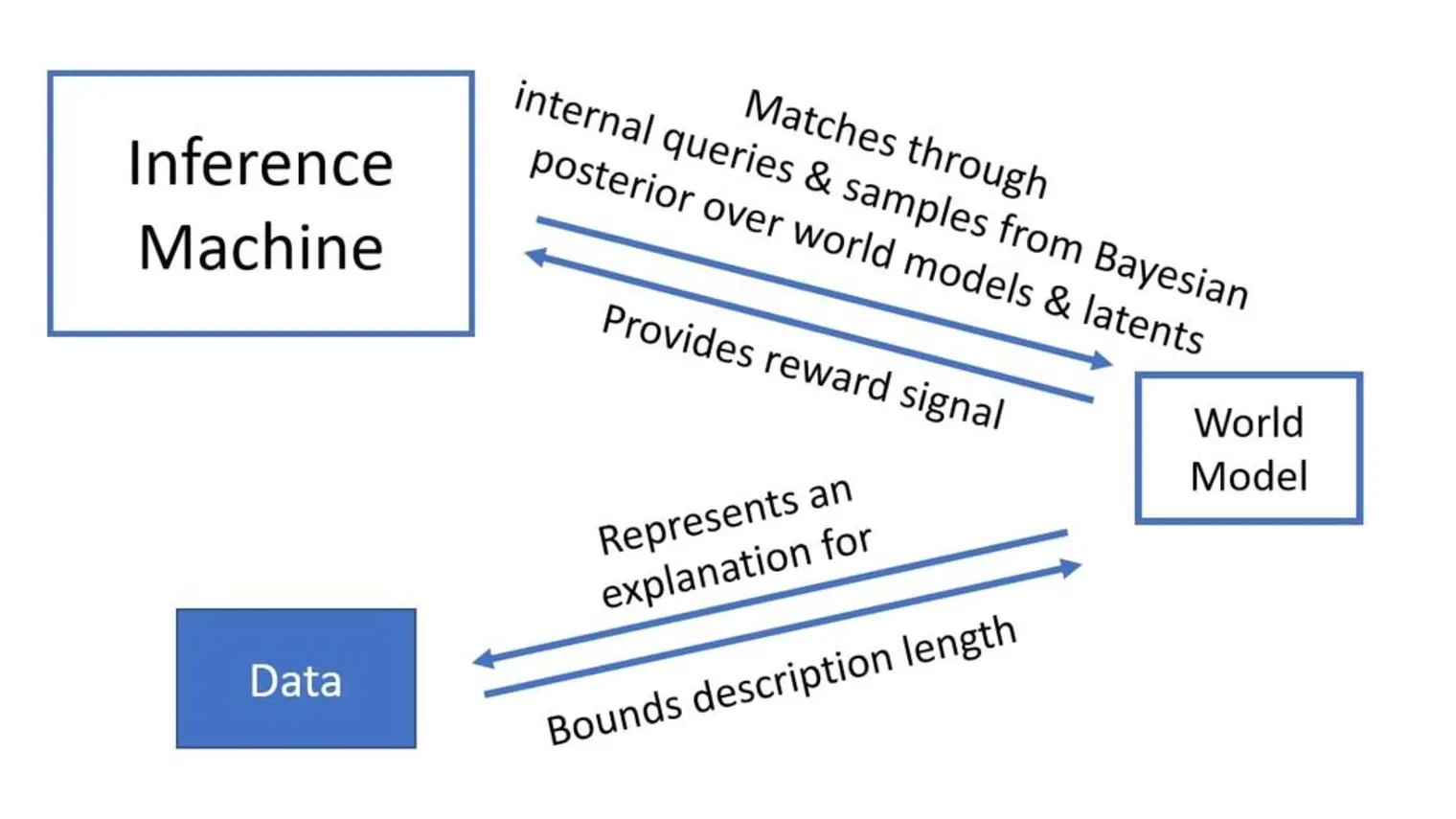
The current state of the art in artificial intelligence is impressive, especially in terms of mastery of language, but not so much in terms … (see more)of mathematical reasoning. What could be missing? Can we learn something useful about that gap from how the brains of mathematicians go about their craft? This essay builds on the idea that current deep learning mostly succeeds at system 1 abilities—which correspond to our intuition and habitual behaviors—but still lacks something important regarding system 2 abilities—which include reasoning and robust uncertainty estimation. It takes an information-theoretical posture to ask questions about what constitutes an interesting mathematical statement, which could guide future work in crafting an AI mathematician. The focus is not on proving a given theorem but on discovering new and interesting conjectures. The central hypothesis is that a desirable body of theorems better summarizes the set of all provable statements, for example, by having a small description length while at the same time being close (in terms of number of derivation steps) to many provable statements.
Machine learning and information theory concepts towards an AI Mathematician
The current state-of-the-art in artificial intelligence is impressive, especially in terms of mastery of language, but not so much in terms … (see more)of mathematical reasoning. What could be missing? Can we learn something useful about that gap from how the brains of mathematicians go about their craft? This essay builds on the idea that current deep learning mostly succeeds at system 1 abilities -- which correspond to our intuition and habitual behaviors -- but still lacks something important regarding system 2 abilities -- which include reasoning and robust uncertainty estimation. It takes an information-theoretical posture to ask questions about what constitutes an interesting mathematical statement, which could guide future work in crafting an AI mathematician. The focus is not on proving a given theorem but on discovering new and interesting conjectures. The central hypothesis is that a desirable body of theorems better summarizes the set of all provable statements, for example by having a small description length while at the same time being close (in terms of number of derivation steps) to many provable statements.
Machine learning and information theory concepts towards an AI Mathematician
The current state of the art in artificial intelligence is impressive, especially in terms of mastery of language, but not so much in terms … (see more)of mathematical reasoning. What could be missing? Can we learn something useful about that gap from how the brains of mathematicians go about their craft? This essay builds on the idea that current deep learning mostly succeeds at system 1 abilities—which correspond to our intuition and habitual behaviors—but still lacks something important regarding system 2 abilities—which include reasoning and robust uncertainty estimation. It takes an information-theoretical posture to ask questions about what constitutes an interesting mathematical statement, which could guide future work in crafting an AI mathematician. The focus is not on proving a given theorem but on discovering new and interesting conjectures. The central hypothesis is that a desirable body of theorems better summarizes the set of all provable statements, for example, by having a small description length while at the same time being close (in terms of number of derivation steps) to many provable statements.
Efficient Causal Graph Discovery Using Large Language Models
Towards DNA-Encoded Library Generation with GFlowNets
Louis Vaillancourt
Doris Alexandra Schuetz
Moksh J. Jain
Almer M. van der Sloot
Mathieu Bourgey
Anne Marinier
Sources of richness and ineffability for phenomenally conscious states
George Deane
Axel Constant
Jonathan Simon
Distributional GFlowNets with Quantile Flows
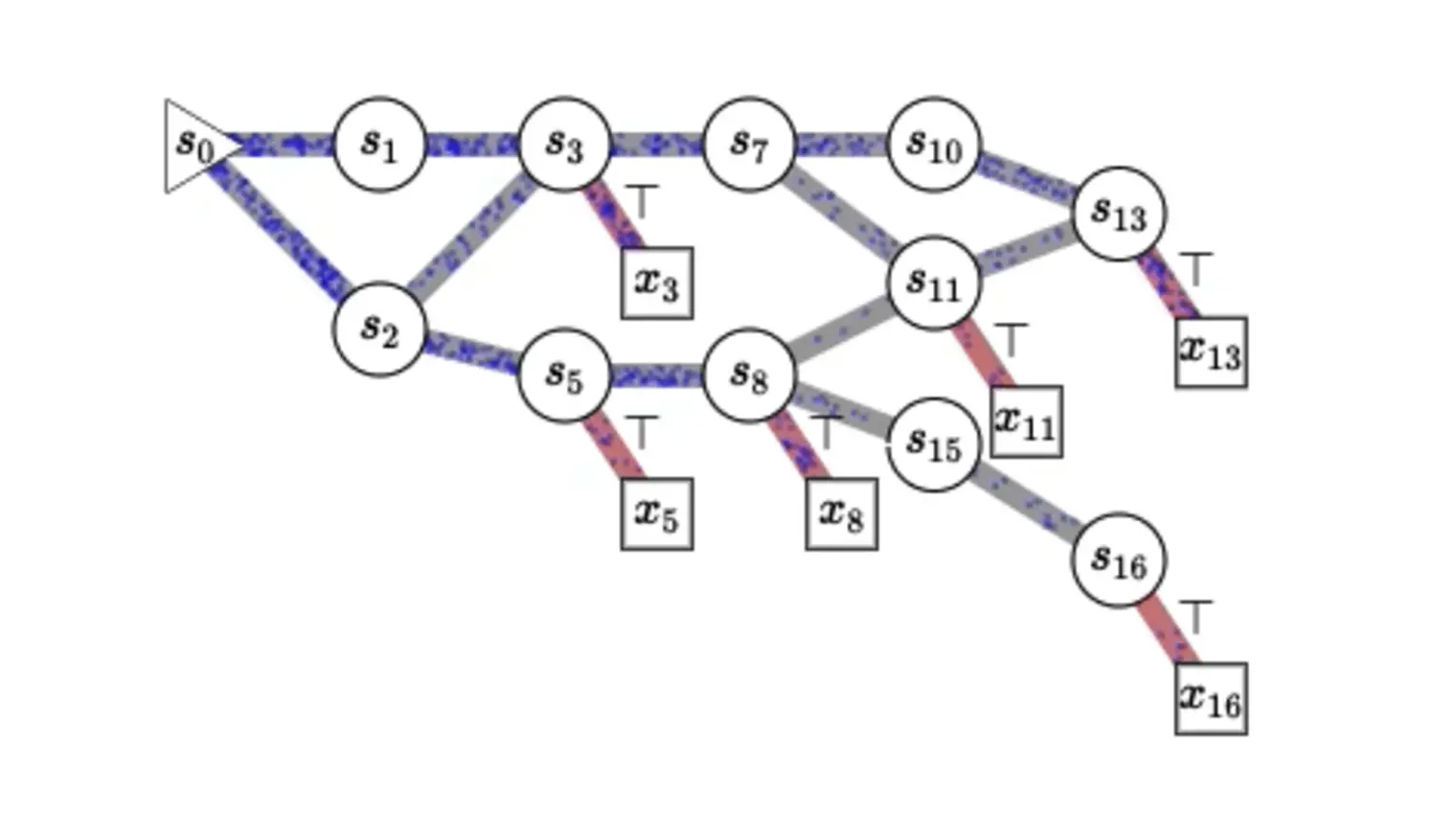
Generative Flow Networks (GFlowNets) are a new family of probabilistic samplers where an agent learns a stochastic policy for generating com… (see more)plex combinatorial structure through a series of decision-making steps. Despite being inspired from reinforcement learning, the current GFlowNet framework is relatively limited in its applicability and cannot handle stochasticity in the reward function. In this work, we adopt a distributional paradigm for GFlowNets, turning each flow function into a distribution, thus providing more informative learning signals during training. By parameterizing each edge flow through their quantile functions, our proposed \textit{quantile matching} GFlowNet learning algorithm is able to learn a risk-sensitive policy, an essential component for handling scenarios with risk uncertainty. Moreover, we find that the distributional approach can achieve substantial improvement on existing benchmarks compared to prior methods due to our enhanced training algorithm, even in settings with deterministic rewards.