Portrait of Yoshua Bengio

Yoshua Bengio

Core Academic Member
Canada CIFAR AI Chair
Full Professor, Université de Montréal, Department of Computer Science and Operations Research Department
Research Topics
Causality
Computational Neuroscience
Deep Learning
Generative Models
Graph Neural Networks
Machine Learning Theory
Medical Machine Learning
Molecular Modeling
Natural Language Processing
Probabilistic Models
Reasoning
Recurrent Neural Networks
Reinforcement Learning
Representation Learning

Biography

*For media requests, please write to medias@mila.quebec.

For more information please contact Cassidy MacNeil, Senior Assistant and Operation Lead at cassidy.macneil@mila.quebec.

Yoshua Bengio is recognized worldwide as a leading expert in AI. He is most known for his pioneering work in deep learning, which earned him the 2018 A.M. Turing Award, “the Nobel Prize of computing,” with Geoffrey Hinton and Yann LeCun.

Bengio is a full professor at Université de Montréal, and the founder and scientific advisor of Mila – Quebec Artificial Intelligence Institute. He is also a senior fellow at CIFAR and co-directs its Learning in Machines & Brains program, serves as special advisor and founding scientific director of IVADO, and holds a Canada CIFAR AI Chair.

In 2019, Bengio was awarded the prestigious Killam Prize and in 2022, he was the most cited computer scientist in the world by h-index. He is a Fellow of the Royal Society of London, Fellow of the Royal Society of Canada, Knight of the Legion of Honor of France and Officer of the Order of Canada. In 2023, he was appointed to the UN’s Scientific Advisory Board for Independent Advice on Breakthroughs in Science and Technology.

Concerned about the social impact of AI, Bengio helped draft the Montréal Declaration for the Responsible Development of Artificial Intelligence and continues to raise awareness about the importance of mitigating the potentially catastrophic risks associated with future AI systems.

Current Students

Collaborating Alumni - McGill University
Collaborating researcher - Cambridge University
Principal supervisor :
PhD - Université de Montréal
Collaborating researcher - N/A
Principal supervisor :
PhD - Université de Montréal
Collaborating Alumni - Université de Montréal
Postdoctorate - Université de Montréal
Principal supervisor :
Collaborating researcher - Université de Montréal
Research Intern - KOREA ADVANCED INSTITUTE OF SCIENCE AND TECHNOLOGY
Collaborating researcher - s.o.
PhD - Université de Montréal
Co-supervisor :
PhD - Université de Montréal
Principal supervisor :
Independent visiting researcher - Université de Montréal
Collaborating researcher - Ying Wu Coll of Computing
Collaborating researcher - University of Waterloo
Principal supervisor :
Postdoctorate - Université de Montréal
PhD - Université de Montréal
Principal supervisor :
Postdoctorate - Université de Montréal
Co-supervisor :
Collaborating Alumni - Université de Montréal
Co-supervisor :
Collaborating Alumni - Université de Montréal
Collaborating researcher - University of Cambridge
Collaborating Alumni - Université de Montréal
Co-supervisor :
PhD - Université de Montréal
Principal supervisor :
Collaborating researcher - Université de Montréal
PhD - McGill University
Principal supervisor :

Publications

Inductive Biases for Relational Tasks
Current deep learning approaches have shown good in-distribution performance but struggle in out-of-distribution settings. This is especiall… (see more)y true in the case of tasks involving abstract relations like recognizing rules in sequences, as required in many intelligence tests. In contrast, our brains are remarkably flexible at such tasks, an attribute that is likely linked to anatomical constraints on computations. Inspired by this, recent work has explored how enforcing that relational representations remain distinct from sensory representations can help artificial systems. Building on this work, we further explore and formalize the advantages afforded by ``partitioned'' representations of relations and sensory details. We investigate inductive biases that ensure abstract relations are learned and represented distinctly from sensory data across several neural network architectures and show that they outperform existing architectures on out-of-distribution generalization for various relational tasks. These results show that partitioning relational representations from other information streams may be a simple way to augment existing network architectures' robustness when performing relational computations.
Object-centric Compositional Imagination for Visual Abstract Reasoning
Like humans devoid of imagination, current machine learning systems lack the ability to adapt to new, unexpected situations by foreseeing th… (see more)em, which makes them unable to solve new tasks by analogical reasoning. In this work, we introduce a new compositional imagination framework that improves a model's ability to generalize. One of the key components of our framework is object-centric inductive biases that enables models to perceive the environment as a series of objects, properties, and transformations. By composing these key ingredients, it is possible to generate new unseen tasks that, when used to train the model, improve generalization. Experiments on a simplified version of the Abstraction and Reasoning Corpus (ARC) demonstrate the effectiveness of our framework.
A New Era: Intelligent Tutoring Systems Will Transform Online Learning for Millions
Francois St-Hilaire
Dung D. Vu
Antoine Frau
Nathan J. Burns
Farid Faraji
Joseph Potochny
Stephane Robert
Arnaud Roussel
Selene Zheng
Taylor Glazier
Junfel Vincent Romano
Robert Belfer
Muhammad Shayan
Ariella Smofsky
Tommy Delarosbil
Seulmin Ahn
Simon Eden-Walker
Kritika Sony
Ansona Onyi Ching
Sabina Elkins … (see 11 more)
A. Stepanyan
Adela Matajova
Victor Chen
Hossein Sahraei
Robert Larson
N. Markova
Andrew Barkett
Iulian V. Serban
Ekaterina Kochmar
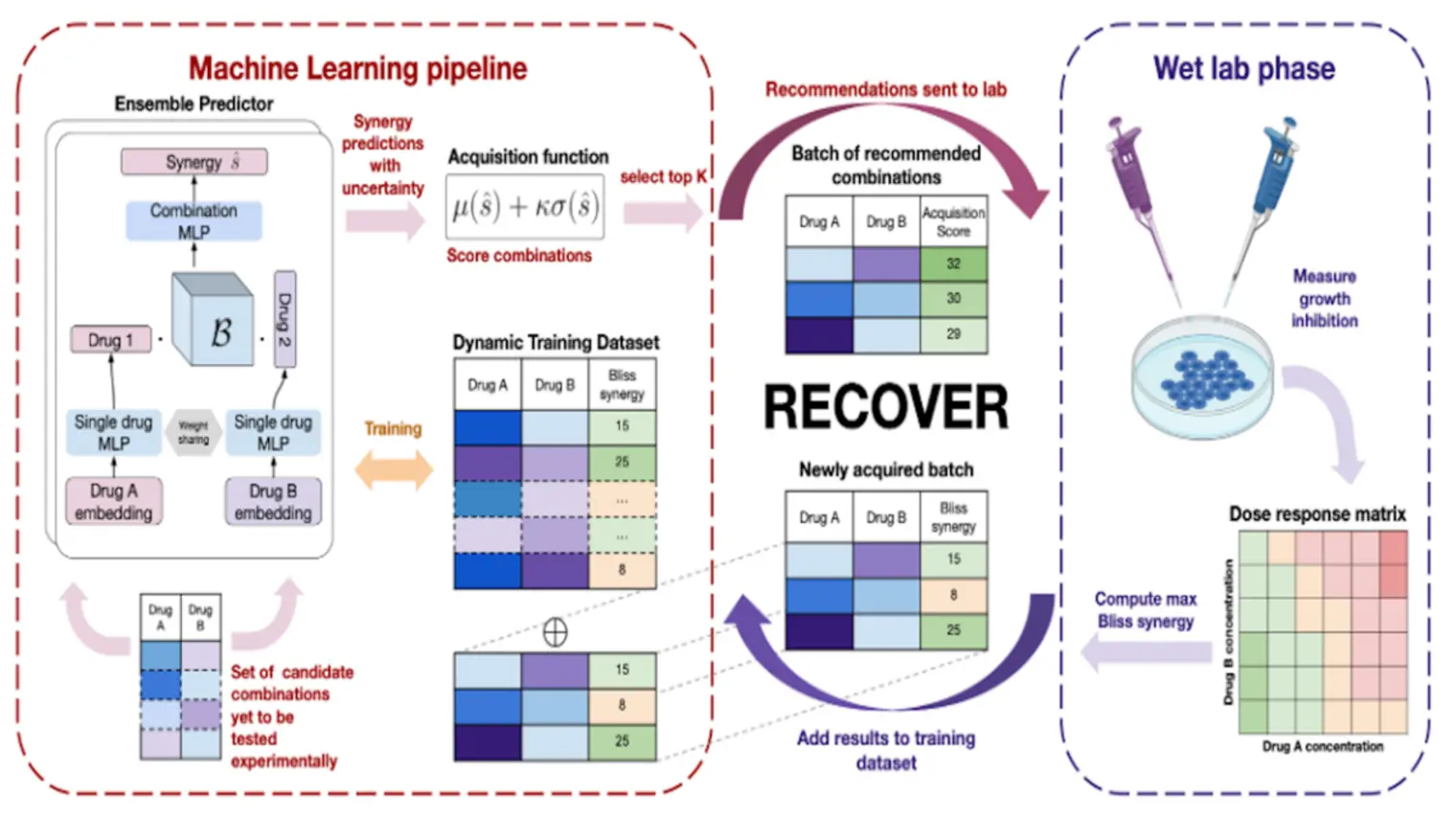
RECOVER: sequential model optimization platform for combination drug repurposing identifies novel synergistic compounds in vitro
Thomas Gaudelet
Andrew Anighoro
Torsten Gross
Francisco Martínez-Peña
Eileen L. Tang
Suraj M S
Cristian Regep
Jeremy B. R. Hayter
Nicholas Valiante
Mike Tyers
Charles Roberts
Michael M. Bronstein
Luke L. Lairson
Jake P. Taylor-King
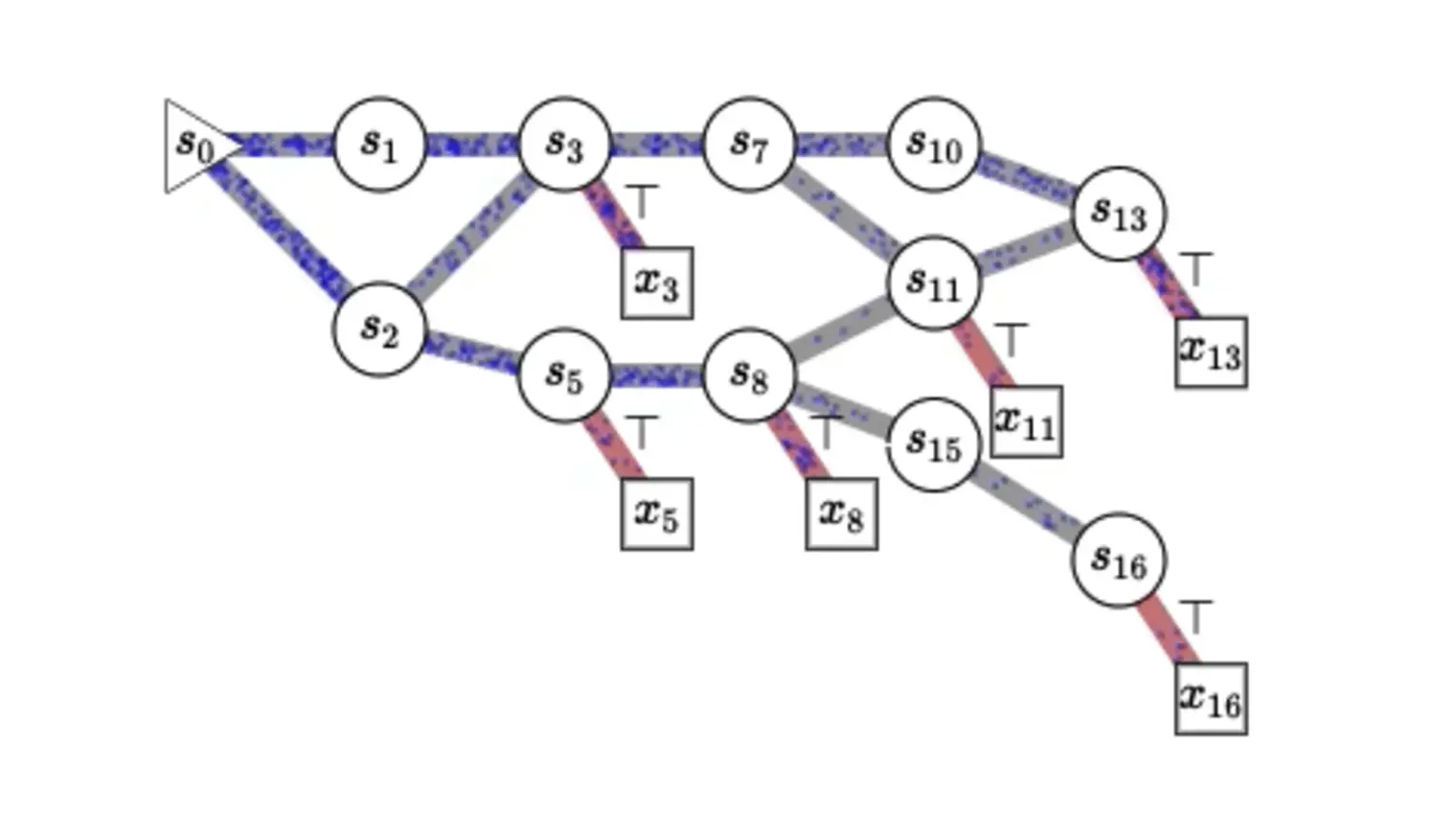
Unifying Likelihood-Free Inference with Black-Box Optimization and Beyond
Black-box optimization formulations for biological sequence design have drawn recent attention due to their promising potential impact on th… (see more)e pharmaceutical industry. In this work, we propose to unify two seemingly distinct worlds: likelihood-free inference and black-box optimization, under one probabilistic framework. In tandem, we provide a recipe for constructing various sequence design methods based on this framework. We show how previous optimization approaches can be "reinvented" in our framework, and further propose new probabilistic black-box optimization algorithms. Extensive experiments on sequence design application illustrate the benefits of the proposed methodology.
Boosting Exploration in Multi-Task Reinforcement Learning using Adversarial Networks
Biasly: a machine learning based platform for automatic racial discrimination detection in online texts
David Bamman
Chris Dyer
Noah A. Smith. 2014
Steven Bird
Ewan Klein
Edward Loper
Nat-527
Jacob Devlin
Ming-Wei Chang
Kenton Lee
Kristina Toutanova. 2019
Bert
Samuel Gehman
Suchin Gururangan
Maarten Sap
Dan Hendrycks
Kevin Gimpel. 2020
Gaussian
Di He … (see 22 more)
Guolin Ke
Feng-Ju Liao
Mirco Ravanaelli
Zhenzhong Lan
Mingda Chen
Sebastian Goodman
Bernhard E. Boser
J. Denker
Don-608 nie Henderson
Robin Howard
Wayne Hubbard
Yinhan Liu
Myle Ott
Naman Goyal
Jingfei Du
Mandar Joshi
Danqi Chen
Omer Levy
Mike Lewis
Warning : this paper contains content that may 001 be offensive or upsetting. 002 Detecting hateful, toxic, and otherwise racist 003 or sexi… (see more)st language in user-generated online con-004 tents has become an increasingly important task 005 in recent years. Indeed, the anonymity, the 006 transience, the size of messages, and the dif-007 ficulty of management, facilitate the diffusion 008 of racist or hateful messages across the Inter-009 net. The critical influence of this cyber-racism 010 is no longer limited to social media, but also 011 has a significant effect on our society : corpo-012 rate business operation, users’ health, crimes, 013 etc. Traditional racist speech reporting chan-014 nels have proven inadequate due to the enor-015 mous explosion of information, so there is an 016 urgent need for a method to automatically and 017 promptly detect texts with racial discrimination. 018 We propose in this work, a machine learning-019 based approach to enable automatic detection 020 of racist text content over the internet. State-of-021 the-art machine learning models that are able 022 to grasp language structures are adapted in this 023 study. Our main contribution include 1) a large 024 scale racial discrimination data set collected 025 from three distinct sources and annotated ac-026 cording to a guideline developed by specialists, 027 2) a set of machine learning models with vari-028 ous architectures for racial discrimination de-029 tection, and 3) a web-browser-based software 030 that assist users to debias their texts when us-031 ing the internet. All these resources are made 032 publicly available.
Contrastive introspection (ConSpec) to rapidly identify invariant prototypes for success in RL
Chen Sun
Mila
Wannan Yang
†. BlakeRichards
Reinforcement learning (RL) algorithms have achieved notable success in recent years, but still struggle with fundamental issues in long-ter… (see more)m credit assignment. It remains difficult to learn in situations where success is contingent upon multiple critical steps that are distant in time from each other and from a sparse reward; as is often the case in real life. Moreover, how RL algorithms assign credit in these difficult situations is typically not coded in a way that can rapidly generalize to new situations. Here, we present an approach using offline contrastive learning, which we call contrastive introspection (ConSpec), that can be added to any existing RL algorithm and addresses both issues. In ConSpec, a contrastive loss is used during offline replay to identify invariances among successful episodes. This takes advantage of the fact that it is easier to retrospectively identify the small set of steps that success is contingent upon than it is to prospectively predict reward at every step taken in the environment. ConSpec stores this knowledge in a collection of prototypes summarizing the intermediate states required for success. During training, arrival at any state that matches these prototypes generates an intrinsic reward that is added to any external rewards. As well, the reward shaping provided by ConSpec can be made to preserve the optimal policy of the underlying RL agent. The prototypes in ConSpec provide two key benefits for credit assignment: (1) They enable rapid identification of all the critical states. (2) They do so in a readily interpretable manner, enabling out of distribution generalization when sensory features are altered. In summary, ConSpec is a modular system that can be added to any existing RL algorithm to improve its long-term credit assignment.
Enhanced Biomedical Knowledge Discovery From Unstructured Text Using Contextual Embeddings
Iz Beltagy
Kyle Lo
Arman Cohan. 2019
Scib-500
R´ejean Ducharme
P Vincent
Rishi Bommasani
Kelly Davis
Claire Cardie
Billy Chiu
Sampo Pyysalo
Ivan Vuli´c
Extracting knowledge from large, unstruc-001 tured text corpora presents a challenge. Re-002 cently, authors have utilized unsupervised, 003… (see more) static word embeddings to uncover "latent 004 knowledge" contained within domain-specific 005 scientific corpora. Here semantic-similarity 006 measures between representations of concepts, 007 objects or entities were used to predict re-008 lationships, which were later verified using 009 physical methods. Static language models 010 have recently been surpassed at most down-011 stream tasks by massively pre-trained, contex-012 tual language models like BERT. Some have 013 postulated that contextualized embeddings po-014 tentially yield word representations superior 015 to static ones for knowledge-discovery pur-016 poses. In an effort to address this ques-017 tion, two biomedically-trained BERT models 018 (BioBERT, SciBERT) were used to encode 019 n = 500, 1000 or 5000 sentences containing 020 words of interest extracted from a biomedical 021 corpus (Coronavirus Open Research Dataset). 022 The n representations for the words of inter-023 est were subsequently extracted and then ag-024 gregated to yield static-equivalent word rep-025 resentations. These words belonged to the 026 vocabularies of intrinsic benchmarking tools 027 for the biomedical domain (Bio-SimVerb and 028 Bio-SimLex), which assess quality of word 029 representations using semantic-similarity and 030 relatedness measures. Using intrinsic bench-031 marking tasks, feasibility of using contextual-032 ized word representations for knowledge dis-033 covery tasks can be assessed: Word represen-034 tations that better encode described reality are 035 expected to perform better (i.e. closer to do-036 main experts). As postulated, BERT embed-037 dings outperform static counterparts
Extended Abstract Track
Jason Hartford
Christian Shewmake
Simone Azeglio
Arianna Di Bernardo
Nina Miolane
S5 Framework: A Review of Self-Supervised Shared Semantic Space Optimization for Multimodal Zero-Shot Learning
Clst
Yonatan Bisk
Ari Holtzman
Jesse Thomason
Ja-740 cob
Angeliki Lapata
Jonathan Lazaridou
Alek-742 May
Nicolas sandr Nisnevich
P. PintoJoseph
Turian
Ting Chen
Simon Kornblith
Mohammad Norouzi
Yen-Chun Chen
Linjie Li
Licheng Yu
Ahmed El … (see 89 more)
Faisal Kholy
Zhe Ahmed
Yu Gan
Cheng
Zihan Dai
Hanxiao Liu
Quoc V. Le
Jia Deng
Wei Dong
Richard Socher
Li-Jia Li
K. Liu
Jacob Devlin
Ming-Wei Chang
Kenton Lee
Jesse Dodge
Maarten Sap
Ana Marasovic
Gabriel Agnew
Dirk Ilharco
Groeneveld Matt
Li Dong
Nan Yang
Wenhui Wang
Furu Wei
Yang Liu
Jianfeng Wang
Ming Gao
Zhou
Xiaoyi Dong
Jia Bao
Ting Zhang
Dongdong
Weiming Chen
Lu Zhang
Dong Yuan
Fang Chen
Da-cheng Juan
Chuntian Lu
Zhen Li
Futang Peng
Aleksei Timofeev
Yi-Ting Chen
Yaxi Gao
Tom
Andrew Duerig
Tomkins Sujith
Ravi
Lukasz Kaiser
Aidan N. Gomez
Noam M. Shazeer
Niki Vaswani
Llion Parmar
Jones Jakob
Uszko-850
Alex G. Kendall
Yarin Gal
Roberto Cipolla
Salman H. Khan
Muzammal Naseer
Munawar Hayat
Waqas Zamir
Fahad Shahbaz
Khan
Ranjay Krishna
Yuke Zhu
Oliver Groth
Justin John-867
Kenji Hata
Joshua Kravitz
Stephanie Chen
Mike Lewis
Yinhan Liu
Marjan Naman Goyal
Abdelrahman Ghazvininejad
Omer Mohamed
Levy
Luke Zettlemoyer
Bohan Li
Hao Zhou
Jun-Tao He
Mingxuan Wang
Liunian Harold
Mark Li
Da Yatskar
Yin
Cho-Jui
Kai-Wei Chang
Visualbert
In this review, we aim to inspire research into 001 S elf-S upervised S hared S emantic S pace ( S5 ) 002 multimodal learning problems. We e… (see more)quip non-003 expert researchers with a framework of in-004 formed modeling decisions via an extensive 005 literature review, an actionable modeling check-006 list, as well as a series of novel zero-shot eval-007 uation tasks. The core idea for our S5 check-008 list lies in learning contextual multimodal in-009 teractions at various granularity levels via a 010 shared Transformer encoder with a denoising 011 loss term, which is also regularized by a con-012 trastive loss term to induce a semantic align-013 ment prior on the contextual embedding space. 014 Essentially, we aim to model human concept 015 understanding and thus learn to “put a name to 016 a face”. This ultimately enables interpretable 017 zero-shot S5 generalization on a variety of 018 novel downstream tasks. In summary, this re-019 view provides sufficient background and ac-020 tionable strategies for training cutting-edge S5 021 multimodal networks. 022
Harvesting Mature Relation Extraction Models from Limited Seed Knowledge: A Self-Development Framework for DS Rule Expansion
Raphael Hoffmann
Congle Zhang
Xiao Ling
Yankai Lin
Shiqi Shen
Zhiyuan Liu
Huanbo Luan
Christopher D Manning
M. Surdeanu
John Bauer
Adriana Romero
Pietro Lio’
Xuanhui Wang
Cheng Li
Nadav Golbandi
Bendersky Marc
Najork. 2018
The
Wentao Wu … (see 2 more)
Hongsong Li
Haixun Wang
Distantly-supervised relation extraction 001 (DSRE) is an effective method to scale relation 002 extraction (RE) to large unlabeled corpora … (see more)003 with the utilization of knowledge bases (KBs), 004 but suffers from the scale of KBs and the 005 introduced noise. 006 To alleviate the above two problems, we 007 propose a novel framework called S elf-008 devel O pment r U le ex P ansion ( SOUP ), which 009 starts from limited amount of labeled data 010 and continuously produces low-noise labels on 011 large-scaled unlabeled data by a growing learn-012 able logical rules set. 013 Specifically, SOUP achieves a mutual enhance-014 ment of RE model and logical rules set, first 015 a RE model is trained on the labeled data to 016 summarize the knowledge, then the knowledge 017 is utilized to explore candidate rules from unla-018 beled data, finally high-quality candidates are 019 selected in a graph-based ranking manner to ex-020 tend the logical rules set and new rule-labeled 021 data are provided for better RE model training. 022 Experiments on wiki20 dataset demonstrate 023 that, with limited seed knowledge from small-024 scaled manually labeled data, SOUP achieves 025 significant improvement compared to baselines 026 by producing continuous growth of both logical 027 rules and the RE model, and that labeling noise 028 of SOUP is much less than DS. Furthermore, 029 RE model enhanced by SOUP with 1.6k logical 030 rules learned from prior knowledge could pro-031 duce an equivalent performance to the model 032 trained on data labeled in DS manner by 72k 033 relational facts of KBs. 034