


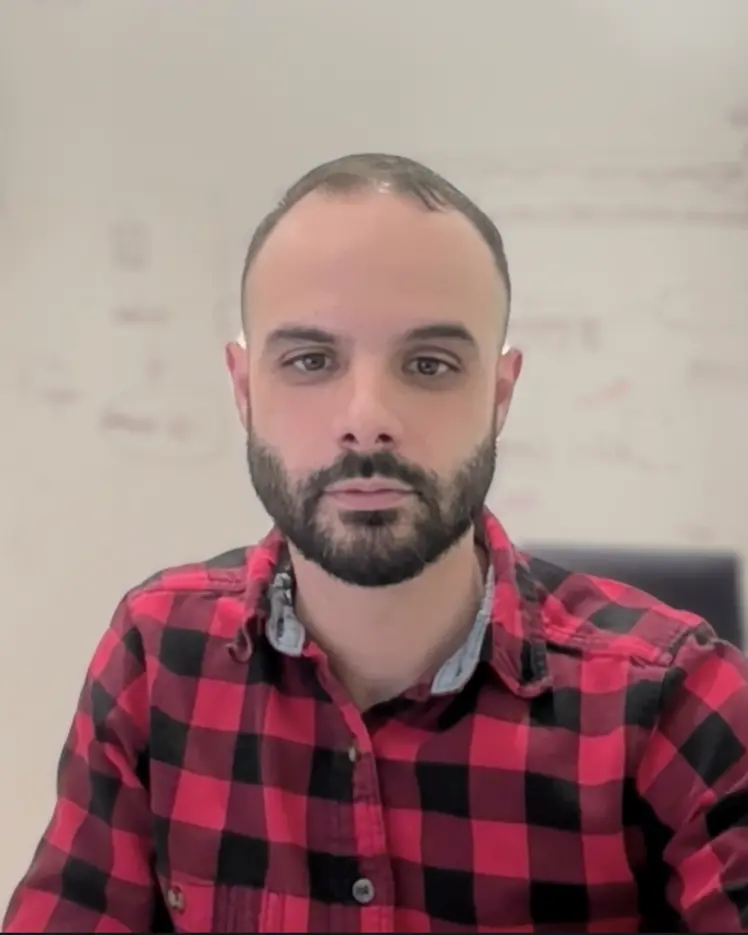
Portrait de David Vázquez

David Vázquez

Membre industriel associé
Professeur associé, Polytechnique Montréal, Département d'informatique et de génie logiciel
ServiceNow
Sujets de recherche
Apprentissage de représentations
Apprentissage multimodal
Apprentissage profond
Grands modèles de langage (LLM)
IA conversationnelle
Modèles génératifs
Vision par ordinateur

Publications

Multi-label Iterated Learning for Image Classification with Label Ambiguity
Sai Rajeswar
Pau Rodríguez
Transfer learning from large-scale pre-trained models has become essential for many computer vision tasks. Recent studies have shown that da… (voir plus)tasets like ImageNet are weakly labeled since images with multiple object classes present are assigned a single label. This ambiguity biases models towards a single prediction, which could result in the suppression of classes that tend to co-occur in the data. Inspired by language emergence literature, we propose multi-label iterated learning (MILe) to incorporate the inductive biases of multi-label learning from single labels using the framework of iterated learning. MILe is a simple yet effective procedure that builds a multi-label description of the image by propagating binary predictions through successive generations of teacher and student networks with a learning bottleneck. Experiments show that our approach exhibits systematic benefits on ImageNet accuracy as well as ReaL F1 score, which indicates that MILe deals better with label ambiguity than the standard training procedure, even when fine-tuning from self-supervised weights. We also show that MILe is effective reducing label noise, achieving state-of-the-art performance on real-world large-scale noisy data such as WebVision. Furthermore, MILe improves performance in class incremental settings such as IIRC and it is robust to distribution shifts. Code: https://github.com/rajeswar18/MILe
A Probabilistic Perspective on Reinforcement Learning via Supervised Learning
Rafael Pardinas
Christopher Pal
Object-centric Compositional Imagination for Visual Abstract Reasoning
Like humans devoid of imagination, current machine learning systems lack the ability to adapt to new, unexpected situations by foreseeing th… (voir plus)em, which makes them unable to solve new tasks by analogical reasoning. In this work, we introduce a new compositional imagination framework that improves a model's ability to generalize. One of the key components of our framework is object-centric inductive biases that enables models to perceive the environment as a series of objects, properties, and transformations. By composing these key ingredients, it is possible to generate new unseen tasks that, when used to train the model, improve generalization. Experiments on a simplified version of the Abstraction and Reasoning Corpus (ARC) demonstrate the effectiveness of our framework.
Consistency-CAM: Towards Improved Weakly Supervised Semantic Segmentation.
Sai Rajeswar
Issam Hadj Laradji
Pau Rodríguez
Overcoming Challenges in Leveraging GANs for Few-Shot Data Augmentation
In this paper, we explore the use of GAN-based few-shot data augmentation as a method to improve few-shot classification performance. We per… (voir plus)form an exploration into how a GAN can be fine-tuned for such a task (one of which is in a class-incremental manner), as well as a rigorous empirical investigation into how well these models can perform to improve few-shot classification. We identify issues related to the difficulty of training such generative models under a purely supervised regime with very few examples, as well as issues regarding the evaluation protocols of existing works. We also find that in this regime, classification accuracy is highly sensitive to how the classes of the dataset are randomly split. Therefore, we propose a semi-supervised fine-tuning approach as a more pragmatic way forward to address these problems.
Towards good validation metrics for generative models in offline model-based optimisation
In this work we propose a principled evaluation framework for model-based optimisation to measure how well a generative model can extrapolat… (voir plus)e. We achieve this by interpreting the training and validation splits as draws from their respective ‘truncated’ ground truth distributions, where examples in the validation set contain scores much larger than those in the training set. Model selection is performed on the validation set for some prescribed validation metric. A major research question however is in determining what validation metric correlates best with the expected value of generated candidates with respect to the ground truth oracle; work towards answering this question can translate to large economic gains since it is expensive to evaluate the ground truth oracle in the real world. We compare various validation metrics for generative adversarial networks using our framework. We also discuss limitations with our framework with respect to existing datasets and how progress can be made to mitigate them. 1
Beyond Trivial Counterfactual Explanations with Diverse Valuable Explanations
Pau Rodríguez
Massimo Caccia
Alexandre Lacoste
Lee Zamparo
Explainability for machine learning models has gained considerable attention within the research community given the importance of deploying… (voir plus) more reliable machine-learning systems. In computer vision applications, generative counterfactual methods indicate how to perturb a model's input to change its prediction, providing details about the model's decision-making. Current methods tend to generate trivial counterfactuals about a model's decisions, as they often suggest to exaggerate or remove the presence of the attribute being classified. For the machine learning practitioner, these types of counterfactuals offer little value, since they provide no new information about undesired model or data biases. In this work, we identify the problem of trivial counterfactual generation and we propose DiVE to alleviate it. DiVE learns a perturbation in a disentangled latent space that is constrained using a diversity-enforcing loss to uncover multiple valuable explanations about the model's prediction. Further, we introduce a mechanism to prevent the model from producing trivial explanations. Experiments on CelebA and Synbols demonstrate that our model improves the success rate of producing high-quality valuable explanations when compared to previous state-of-the-art methods. Code is available at https://github.com/ElementAI/beyond-trivial-explanations.
Haptics-based Curiosity for Sparse-Reward Tasks
Sai Rajeswar
Cyril Ibrahim
Nitin Surya
Pedro O. Pinheiro
Sequoia: A Software Framework to Unify Continual Learning Research
Pau Rodríguez
J. Hurtado
Dominic Zhao
Ryan Lindeborg
Timothee LESORT
Massimo Caccia
The field of Continual Learning (CL) seeks to develop algorithms that accumulate knowledge and skills over time through interaction with non… (voir plus)-stationary environments. In practice, a plethora of evaluation procedures (settings) and algorithmic solutions (methods) exist, each with their own potentially disjoint set of assumptions. This variety makes measuring progress in CL difficult. We propose a taxonomy of settings, where each setting is described as a set of assumptions. A tree-shaped hierarchy emerges from this view, where more general settings become the parents of those with more restrictive assumptions. This makes it possible to use inheritance to share and reuse research, as developing a method for a given setting also makes it directly applicable onto any of its children. We instantiate this idea as a publicly available software framework called Sequoia, which features a wide variety of settings from both the Continual Supervised Learning (CSL) and Continual Reinforcement Learning (CRL) domains. Sequoia also includes a growing suite of methods which are easy to extend and customize, in addition to more specialized methods from external libraries. We hope that this new paradigm and its first implementation can help unify and accelerate research in CL. You can help us grow the tree by visiting www.github.com/lebrice/Sequoia.
Touch-based Curiosity for Sparse-Reward Tasks
Sai Rajeswar
Cyril Ibrahim
Nitin Surya
Pedro O. Pinheiro
Pix2Shape – Towards Unsupervised Learning of 3D Scenes from Images using a View-based Representation
We infer and generate three-dimensional (3D) scene information from a single input image and without supervision. This problem is under-expl… (voir plus)ored, with most prior work relying on supervision from, e.g., 3D ground-truth, multiple images of a scene, image silhouettes or key-points. We propose Pix2Shape, an approach to solve this problem with four components: (i) an encoder that infers the latent 3D representation from an image, (ii) a decoder that generates an explicit 2.5D surfel-based reconstruction of a scene from the latent code (iii) a differentiable renderer that synthesizes a 2D image from the surfel representation, and (iv) a critic network trained to discriminate between images generated by the decoder-renderer and those from a training distribution. Pix2Shape can generate complex 3D scenes that scale with the view-dependent on-screen resolution, unlike representations that capture world-space resolution, i.e., voxels or meshes. We show that Pix2Shape learns a consistent scene representation in its encoded latent space and that the decoder can then be applied to this latent representation in order to synthesize the scene from a novel viewpoint. We evaluate Pix2Shape with experiments on the ShapeNet dataset as well as on a novel benchmark we developed, called 3D-IQTT, to evaluate models based on their ability to enable 3d spatial reasoning. Qualitative and quantitative evaluation demonstrate Pix2Shape's ability to solve scene reconstruction, generation, and understanding tasks.
Online Fast Adaptation and Knowledge Accumulation (OSAKA): a New Approach to Continual Learning
Massimo Caccia
Pau Rodríguez
Lucas Caccia
Alexandre Lacoste
Continual learning studies agents that learn from streams of tasks without forgetting previous ones while adapting to new ones. Two recent c… (voir plus)ontinual-learning scenarios have opened new avenues of research. In meta-continual learning, the model is pre-trained to minimize catastrophic forgetting of previous tasks. In continual-meta learning, the aim is to train agents for faster remembering of previous tasks through adaptation. In their original formulations, both methods have limitations. We stand on their shoulders to propose a more general scenario, OSAKA, where an agent must quickly solve new (out-of-distribution) tasks, while also requiring fast remembering. We show that current continual learning, meta-learning, meta-continual learning, and continual-meta learning techniques fail in this new scenario. We propose Continual-MAML, an online extension of the popular MAML algorithm as a strong baseline for this scenario. We empirically show that Continual-MAML is better suited to the new scenario than the aforementioned methodologies, as well as standard continual learning and meta-learning approaches.