Conférence d'ouverture | Créer une IA plus sécuritaire pour la santé mentale des jeunes
Le 16 mars prochain à 9h, prenez part à cet événement qui réunira des chercheur·euse·s de premier plan en IA, des expert·e·s cliniques, et des voix du terrain pour discuter des cadres nécessaires à la conception d’une IA qui soit performante et sécuritaire en santé mentale.
TRAIL : IA responsable pour les professionnels et les leaders
Apprenez à intégrer des pratique d'IA responsable dans votre organisation avec le programme TRAIL. Inscrivez-vous à la séance d'information le 12 mars prochain pour en apprendre plus sur le programme.
Nous utilisons des témoins pour analyser le trafic et l’utilisation de notre site web, afin de personnaliser votre expérience. Vous pouvez désactiver ces technologies à tout moment, mais cela peut restreindre certaines fonctionnalités du site. Consultez notre Politique de protection de la vie privée pour en savoir plus.
Paramètre des cookies
Vous pouvez activer et désactiver les types de cookies que vous souhaitez accepter. Cependant certains choix que vous ferez pourraient affecter les services proposés sur nos sites (ex : suggestions, annonces personnalisées, etc.).
Cookies essentiels
Ces cookies sont nécessaires au fonctionnement du site et ne peuvent être désactivés. (Toujours actif)
Cookies analyse
Acceptez-vous l'utilisation de cookies pour mesurer l'audience de nos sites ?
Lecteur Multimédia
Acceptez-vous l'utilisation de cookies pour afficher et vous permettre de regarder les contenus vidéo hébergés par nos partenaires (YouTube, etc.) ?
Alexander Tong
Alumni

Publications
Steering Masked Discrete Diffusion Models via Discrete Denoising Posterior Prediction
The Cambrian explosion of easily accessible pre-trained diffusion models suggests a demand for methods that combine multiple different pre-t… (voir plus)rained diffusion models without incurring the significant computational burden of re-training a larger combined model. In this paper, we cast the problem of combining multiple pre-trained diffusion models at the generation stage under a novel proposed framework termed superposition. Theoretically, we derive superposition from rigorous first principles stemming from the celebrated continuity equation and design two novel algorithms tailor-made for combining diffusion models in SuperDiff. SuperDiff leverages a new scalable It\^o density estimator for the log likelihood of the diffusion SDE which incurs no additional overhead compared to the well-known Hutchinson's estimator needed for divergence calculations. We demonstrate that SuperDiff is scalable to large pre-trained diffusion models as superposition is performed solely through composition during inference, and also enjoys painless implementation as it combines different pre-trained vector fields through an automated re-weighting scheme. Notably, we show that SuperDiff is efficient during inference time, and mimics traditional composition operators such as the logical OR and the logical AND. We empirically demonstrate the utility of using SuperDiff for generating more diverse images on CIFAR-10, more faithful prompt conditioned image editing using Stable Diffusion, as well as improved conditional molecule generation and unconditional de novo structure design of proteins. https://github.com/necludov/super-diffusion
Modeling stochastic and irregularly sampled time series is a challenging problem found in a wide range of applications, especially in medici… (voir plus)ne. Neural stochastic differential equations (Neural SDEs) are an attractive modeling technique for this problem, which parameterize the drift and diffusion terms of an SDE with neural networks. However, current algorithms for training Neural SDEs require backpropagation through the SDE dynamics, greatly limiting their scalability and stability. To address this, we propose Trajectory Flow Matching (TFM), which trains a Neural SDE in a simulation-free manner, bypassing backpropagation through the dynamics. TFM leverages the flow matching technique from generative modeling to model time series. In this work we first establish necessary conditions for TFM to learn time series data. Next, we present a reparameterization trick which improves training stability. Finally, we adapt TFM to the clinical time series setting, demonstrating improved performance on three clinical time series datasets both in terms of absolute performance and uncertainty prediction.
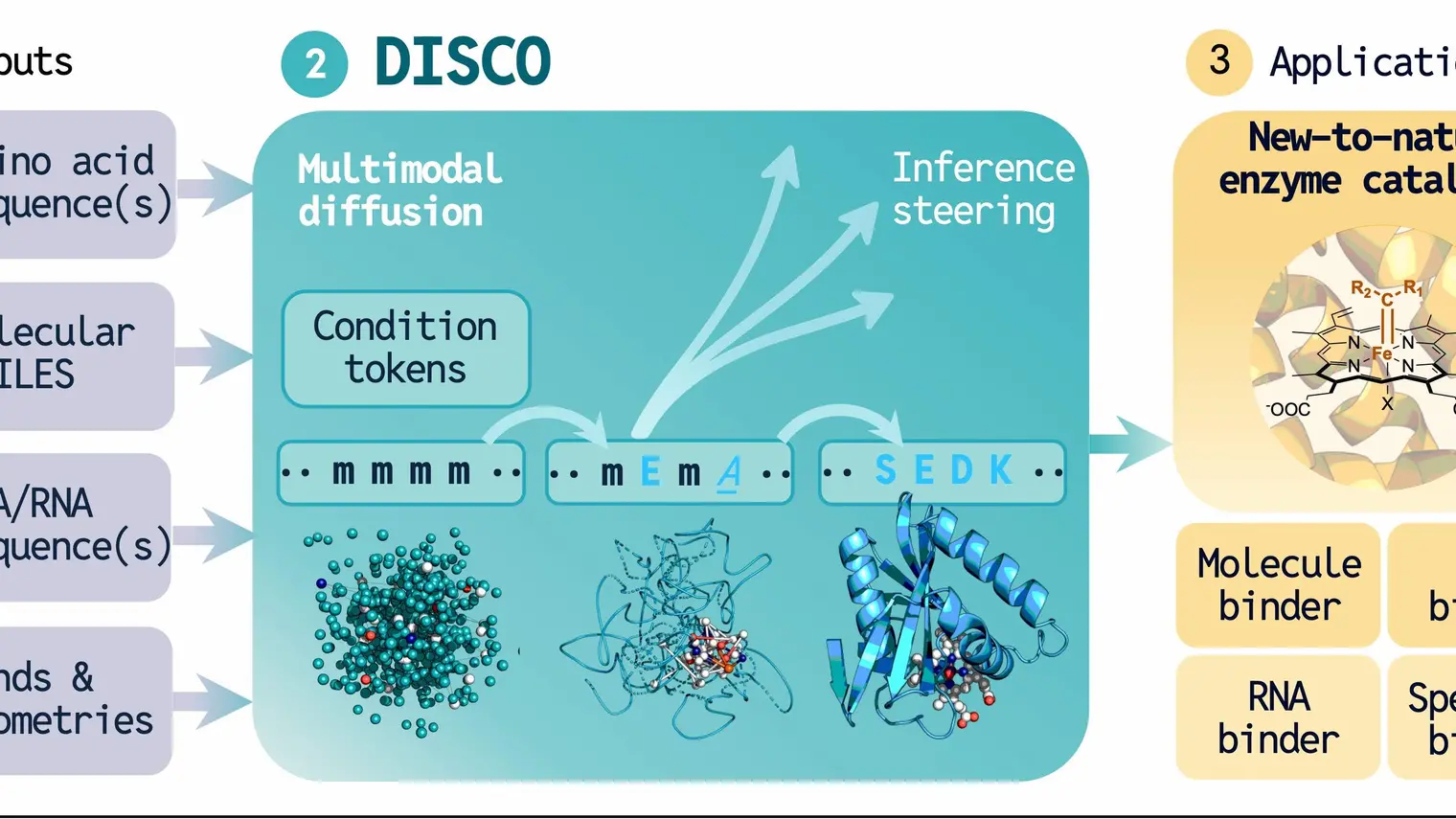
Generative modeling of discrete data underlies important applications spanning text-based agents like ChatGPT to the design of the very buil… (voir plus)ding blocks of life in protein sequences. However, application domains need to exert control over the generated data by steering the generative process - typically via RLHF - to satisfy a specified property, reward, or affinity metric. In this paper, we study the problem of steering Masked Diffusion Models (MDMs), a recent class of discrete diffusion models that offer a compelling alternative to traditional autoregressive models. We introduce Discrete Denoising Posterior Prediction (DDPP), a novel framework that casts the task of steering pre-trained MDMs as a problem of probabilistic inference by learning to sample from a target Bayesian posterior. Our DDPP framework leads to a family of three novel objectives that are all simulation-free, and thus scalable while applying to general non-differentiable reward functions. Empirically, we instantiate DDPP by steering MDMs to perform class-conditional pixel-level image modeling, RLHF-based alignment of MDMs using text-based rewards, and finetuning protein language models to generate more diverse secondary structures and shorter proteins. We substantiate our designs via wet-lab validation, where we observe transient expression of reward-optimized protein sequences.
Modeling stochastic and irregularly sampled time series is a challenging problem found in a wide range of applications, especially in medici… (voir plus)ne. Neural stochastic differential equations (Neural SDEs) are an attractive modeling technique for this problem, which parameterize the drift and diffusion terms of an SDE with neural networks. However, current algorithms for training Neural SDEs require backpropagation through the SDE dynamics, greatly limiting their scalability and stability.
To address this, we propose **Trajectory Flow Matching** (TFM), which trains a Neural SDE in a *simulation-free* manner, bypassing backpropagation through the dynamics. TFM leverages the flow matching technique from generative modeling to model time series. In this work we first establish necessary conditions for TFM to learn time series data. Next, we present a reparameterization trick which improves training stability. Finally, we adapt TFM to the clinical time series setting, demonstrating improved performance on three clinical time series datasets both in terms of absolute performance and uncertainty prediction.
Numerous biological and physical processes can be modeled as systems of interacting entities evolving continuously over time, e.g. the dynam… (voir plus)ics of communicating cells or physical particles. Learning the dynamics of such systems is essential for predicting the temporal evolution of populations across novel samples and unseen environments. Flow-based models allow for learning these dynamics at the population level - they model the evolution of the entire distribution of samples. However, current flow-based models are limited to a single initial population and a set of predefined conditions which describe different dynamics. We argue that multiple processes in natural sciences have to be represented as vector fields on the Wasserstein manifold of probability densities. That is, the change of the population at any moment in time depends on the population itself due to the interactions between samples. In particular, this is crucial for personalized medicine where the development of diseases and their respective treatment response depend on the microenvironment of cells specific to each patient. We propose Meta Flow Matching (MFM), a practical approach to integrate along these vector fields on the Wasserstein manifold by amortizing the flow model over the initial populations. Namely, we embed the population of samples using a Graph Neural Network (GNN) and use these embeddings to train a Flow Matching model. This gives MFM the ability to generalize over the initial distributions, unlike previously proposed methods. We demonstrate the ability of MFM to improve the prediction of individual treatment responses on a large-scale multi-patient single-cell drug screen dataset.