Portrait of Yoshua Bengio

Yoshua Bengio

Core Academic Member
Canada CIFAR AI Chair
Full Professor, Université de Montréal, Department of Computer Science and Operations Research Department
Research Topics
Causality
Computational Neuroscience
Deep Learning
Generative Models
Graph Neural Networks
Machine Learning Theory
Medical Machine Learning
Molecular Modeling
Natural Language Processing
Probabilistic Models
Reasoning
Recurrent Neural Networks
Reinforcement Learning
Representation Learning

Biography

*For media requests, please write to medias@mila.quebec.

For more information please contact Cassidy MacNeil, Senior Assistant and Operation Lead at cassidy.macneil@mila.quebec.

Yoshua Bengio is recognized worldwide as a leading expert in AI. He is most known for his pioneering work in deep learning, which earned him the 2018 A.M. Turing Award, “the Nobel Prize of computing,” with Geoffrey Hinton and Yann LeCun.

Bengio is a full professor at Université de Montréal, and the founder and scientific advisor of Mila – Quebec Artificial Intelligence Institute. He is also a senior fellow at CIFAR and co-directs its Learning in Machines & Brains program, serves as special advisor and founding scientific director of IVADO, and holds a Canada CIFAR AI Chair.

In 2019, Bengio was awarded the prestigious Killam Prize and in 2022, he was the most cited computer scientist in the world by h-index. He is a Fellow of the Royal Society of London, Fellow of the Royal Society of Canada, Knight of the Legion of Honor of France and Officer of the Order of Canada. In 2023, he was appointed to the UN’s Scientific Advisory Board for Independent Advice on Breakthroughs in Science and Technology.

Concerned about the social impact of AI, Bengio helped draft the Montréal Declaration for the Responsible Development of Artificial Intelligence and continues to raise awareness about the importance of mitigating the potentially catastrophic risks associated with future AI systems.

Current Students

Collaborating Alumni - McGill University
Collaborating researcher - Cambridge University
Principal supervisor :
PhD - Université de Montréal
Collaborating researcher - N/A
Principal supervisor :
PhD - Université de Montréal
Collaborating Alumni - Université de Montréal
Collaborating researcher - Université de Montréal
Postdoctorate - Université de Montréal
Principal supervisor :
Research Intern - KOREA ADVANCED INSTITUTE OF SCIENCE AND TECHNOLOGY
Collaborating researcher - s.o.
PhD - Université de Montréal
Co-supervisor :
PhD - Université de Montréal
Principal supervisor :
Independent visiting researcher - Université de Montréal
Collaborating researcher - Ying Wu Coll of Computing
Collaborating researcher - University of Waterloo
Principal supervisor :
Postdoctorate - Université de Montréal
PhD - Université de Montréal
Principal supervisor :
Postdoctorate - Université de Montréal
Co-supervisor :
Collaborating Alumni - Université de Montréal
Co-supervisor :
Collaborating Alumni - Université de Montréal
Collaborating researcher - University of Cambridge
Collaborating Alumni - Université de Montréal
Co-supervisor :
PhD - Université de Montréal
Principal supervisor :
Collaborating researcher - Université de Montréal
PhD - McGill University
Principal supervisor :

Publications

Adsorption energies are necessary but not sufficient to identify good catalysts
Alexander Davis
Alexandre AGM Duval
Oleksandr Voznyy
Alex Hern'andez-Garcia
Adaptive Inference-Time Scaling via Cyclic Diffusion Search
Gyubin Lee
Truong Nhat Nguyen Bao
Jaesik Yoon
Dongwoo Lee
Diffusion models have demonstrated strong generative capabilities across domains ranging from image synthesis to complex reasoning tasks. Ho… (see more)wever, most inference-time scaling methods rely on fixed denoising schedules, limiting their ability to allocate computation based on instance difficulty or task-specific demands adaptively. We introduce the challenge of adaptive inference-time scaling-dynamically adjusting computational effort during inference-and propose Adaptive Bi-directional Cyclic Diffusion (ABCD), a flexible, search-based inference framework. ABCD refines outputs through bi-directional diffusion cycles while adaptively controlling exploration depth and termination. It comprises three components: Cyclic Diffusion Search, Automatic Exploration-Exploitation Balancing, and Adaptive Thinking Time. Experiments show that ABCD improves performance across diverse tasks while maintaining computational efficiency.
AlignVLM: Bridging Vision and Language Latent Spaces for Multimodal Document Understanding
Juan A. Rodriguez
Chao Wang
Akshay Kalkunte Suresh
Xiangru Jian
Pierre-Andre Noel
Sathwik Tejaswi Madhusudhan
Enamul Hoque
Christopher Pal
Issam H. Laradji
Sai Rajeswar
Aligning visual features with language embeddings is a key challenge in vision-language models (VLMs). The performance of such models hinges… (see more) on having a good connector that maps visual features generated by a vision encoder to a shared embedding space with the LLM while preserving semantic similarity. Existing connectors, such as multilayer perceptrons (MLPs), lack inductive bias to constrain visual features within the linguistic structure of the LLM's embedding space, making them data-hungry and prone to cross-modal misalignment. In this work, we propose a novel vision-text alignment method, AlignVLM, that maps visual features to a weighted average of LLM text embeddings. Our approach leverages the linguistic priors encoded by the LLM to ensure that visual features are mapped to regions of the space that the LLM can effectively interpret. AlignVLM is particularly effective for document understanding tasks, where visual and textual modalities are highly correlated. Our extensive experiments show that AlignVLM achieves state-of-the-art performance compared to prior alignment methods, with larger gains on document understanding tasks and under low-resource setups. We provide further analysis demonstrating its efficiency and robustness to noise.
Bringing SAM to new heights: Leveraging elevation data for tree crown segmentation from drone imagery
Information on trees at the individual level is crucial for monitoring forest ecosystems and planning forest management. Current monitoring … (see more)methods involve ground measurements, requiring extensive cost, time and labor. Advances in drone remote sensing and computer vision offer great potential for mapping individual trees from aerial imagery at broad-scale. Large pre-trained vision models, such as the Segment Anything Model (SAM), represent a particularly compelling choice given limited labeled data. In this work, we compare methods leveraging SAM for the task of automatic tree crown instance segmentation in high resolution drone imagery in three use cases: 1) boreal plantations, 2) temperate forests and 3) tropical forests. We also study the integration of elevation data into models, in the form of Digital Surface Model (DSM) information, which can readily be obtained at no additional cost from RGB drone imagery. We present BalSAM, a model leveraging SAM and DSM information, which shows potential over other methods, particularly in the context of plantations. We find that methods using SAM out-of-the-box do not outperform a custom Mask R-CNN, even with well-designed prompts. However, efficiently tuning SAM end-to-end and integrating DSM information are both promising avenues for tree crown instance segmentation models.
Fast Monte Carlo Tree Diffusion: 100× Speedup via Parallel and Sparse Planning
Jaesik Yoon
Hyeonseo Cho
Diffusion models have recently emerged as a powerful approach for trajectory planning. However, their inherently non-sequential nature limit… (see more)s their effectiveness in long-horizon reasoning tasks at test time. The recently proposed Monte Carlo Tree Diffusion (MCTD) offers a promising solution by combining diffusion with tree-based search, achieving state-of-the-art performance on complex planning problems. Despite its strengths, our analysis shows that MCTD incurs substantial computational overhead due to the sequential nature of tree search and the cost of iterative denoising. To address this, we propose Fast-MCTD, a more efficient variant that preserves the strengths of MCTD while significantly improving its speed and scalability. Fast-MCTD integrates two techniques: Parallel MCTD, which enables parallel rollouts via delayed tree updates and redundancy-aware selection; and Sparse MCTD, which reduces rollout length through trajectory coarsening. Experiments show that Fast-MCTD achieves up to 100× speedup over standard MCTD while maintaining or improving planning performance. Remarkably, it even outperforms Diffuser in inference speed on some tasks, despite Diffuser requiring no search and yielding weaker solutions. These results position Fast-MCTD as a practical and scalable solution for diffusion-based inference-time reasoning.
Trajectory Balance with Asynchrony: Decoupling Exploration and Learning for Fast, Scalable LLM Post-Training
Brian Bartoldson
James Diffenderfer
Tal Ben-Nun
Johan Obando-Ceron
Bhavya Kailkhura
Reinforcement learning (RL) is a critical component of large language model (LLM) post-training. However, on-policy algorithms used for post… (see more)-training are not naturally robust to a diversified content of experience replay buffers, which asynchronous off-policy actors can efficiently populate in parallel to training. We propose efficiently learning on such off-policy data via Trajectory Balance with Asynchrony (TBA), an approach to asynchronous RL for LLMs that leverages the principled off-policy TB objective. On math, preference-tuning, and automated red-teaming tasks, we post-train models ranging from Pythia 410M to Qwen 2.5 7B, finding TBA offers speed and performance boosts over strong baselines like Online DPO and Dr. GRPO. Beyond TBA's performance benefits (high accuracy even as asynchrony grows) and speedups (
A HOT Dataset: 150,000 Buildings for HVAC Operations Transfer Research
About 12% of global energy consumption is attributable to heating, ventilation, and air conditioning (HVAC) systems in buildings [11]. Machi… (see more)ne learning-based intelligent HVAC control offers significant energy efficiency potential, but progress is constrained by limited data for training and evaluating performance across different kinds of buildings. Existing datasets primarily target energy prediction rather than control applications, forcing studies to rely on limited building sets or single-variable perturbations that fail to capture real-world complexity. We present HOT (HVAC Operations Transfer), the first large-scale open-source dataset purpose-built for research into transfer learning in building control. HOT contains 159,744 unique building-weather combinations with systematic variations across envelope properties, occupancy patterns, and climate conditions spanning all 19 ASHRAE climate zones across 76 global locations. We formalise a comprehensive similarity-based framework with quantitative metrics for assessing transfer feasibility between source and target buildings across multiple context dimensions. Our key contributions: (1) a large-scale, open dataset and tooling enabling systematic, multi-variable transfer studies across 19 climate zones; (2) a quantitative similarity framework spanning geometry, thermal, climate, and function; and (3) zero-shot climate transfer experiments showing why realistic context variation matters for HVAC control.
A HOT Dataset: 150,000 Buildings for HVAC Operations Transfer Research
Identifying indicators of consciousness in AI systems
Patrick Butlin
Robert Long
Tim Bayne
Jonathan Birch
David Chalmers
Axel Constant
George Deane
Stephen M. Fleming
Ryota Kanai
Colin Klein
Grace Lindsay
Matthias Michel
Liad Mudrik
Megan A.K. Peters
Eric Schwitzgebel
Jonathan Simon
Rufin Vanrullen
Scaling Latent Reasoning via Looped Language Models
Ruiming Zhu
Zixuan Wang
Kai Hua
Ziniu Li
Haoran Que
Boyi Wei
Zixin Wen
Fan Yin
He Xing
Li Li
Jiajun Shi
Kaijing Ma
Shanda Li
Taylor Kergan
Andrew C. Smith
Xin Qu
Mude Hui
Bohong Wu
Qiyang Min … (see 13 more)
Hongzhi Huang
Xun Zhou
Wei Ye
Jiaheng Liu
Jian Yang 0030
Yunfeng Shi
Chenghua Lin
Enduo Zhao
Tianle Cai
Ge Zhang
Jason K. Eshraghian
Modern LLMs are trained to"think"primarily via explicit text generation, such as chain-of-thought (CoT), which defers reasoning to post-trai… (see more)ning and under-leverages pre-training data. We present and open-source Ouro, named after the recursive Ouroboros, a family of pre-trained Looped Language Models (LoopLM) that instead build reasoning into the pre-training phase through (i) iterative computation in latent space, (ii) an entropy-regularized objective for learned depth allocation, and (iii) scaling to 7.7T tokens. Ouro 1.4B and 2.6B models enjoy superior performance that match the results of up to 12B SOTA LLMs across a wide range of benchmarks. Through controlled experiments, we show this advantage stems not from increased knowledge capacity, but from superior knowledge manipulation capabilities. We also show that LoopLM yields reasoning traces more aligned with final outputs than explicit CoT. We hope our results show the potential of LoopLM as a novel scaling direction in the reasoning era. Our model is available here: http://ouro-llm.github.io.
Deep-learning-based virtual screening of antibacterial compounds
Gabriele Scalia
Steven T. Rutherford
Ziqing Lu
Kerry R. Buchholz
Nicholas Skelton
Kangway Chuang
Nathaniel Diamant
Jan-Christian Hütter
Jerome-Maxim Luescher
Anh Miu
Jeff Blaney
Leo Gendelev
Elizabeth Skippington
Greg Zynda
Nia Dickson
Aviv Regev
Man-Wah Tan
Tommaso Biancalani
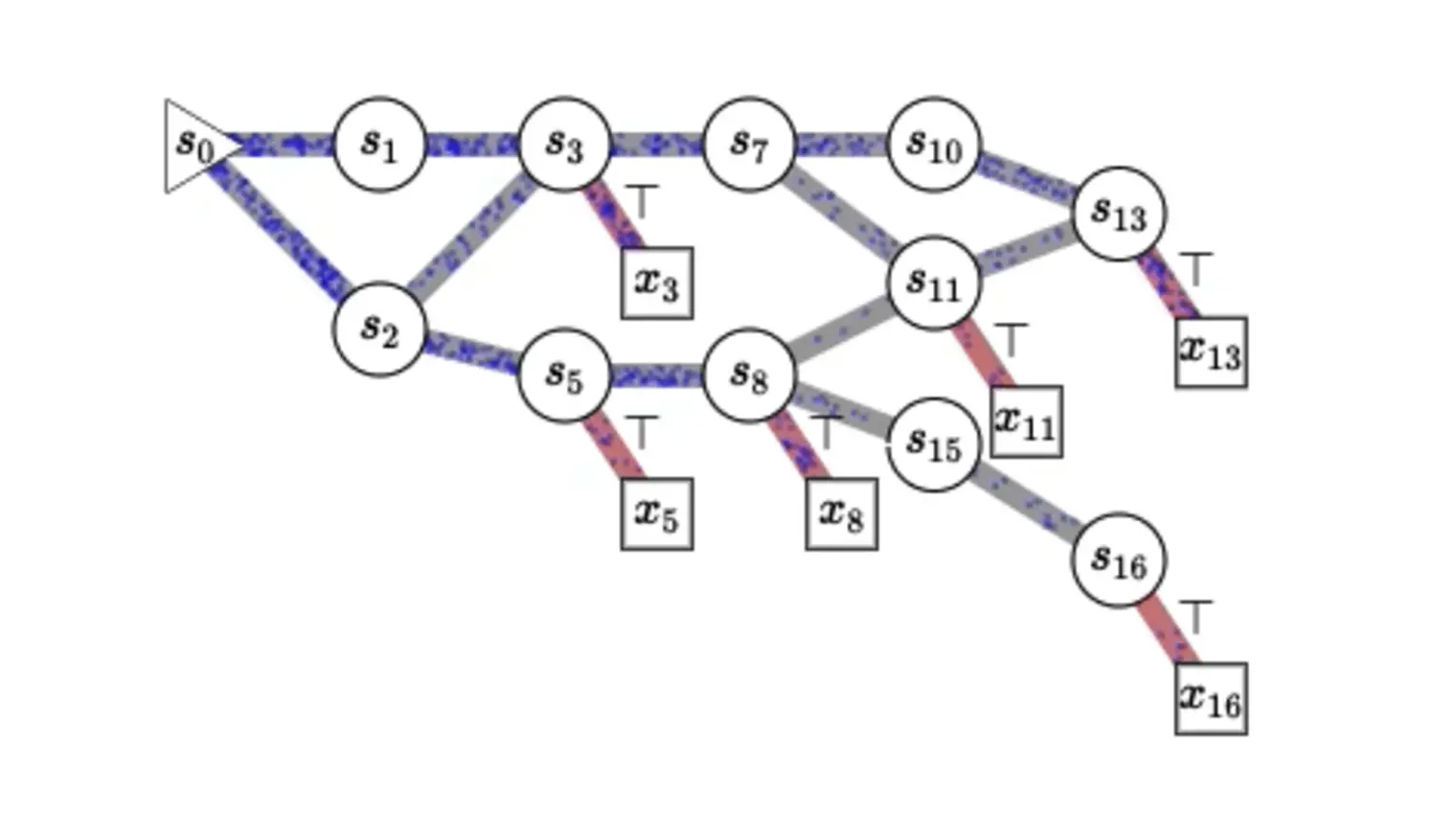
Surrogate-based quantification of policy uncertainty in generative flow networks
Ram'on Nartallo-Kaluarachchi
Robert Manson-Sawko
Shashanka Ubaru
Dongsung Huh
Malgorzata J. Zimo'n
Lior Horesh