TRAIL : IA responsable pour les professionnels et les leaders
Apprenez à intégrer des pratique d'IA responsable dans votre organisation avec le programme TRAIL. Inscrivez-vous à la prochaine cohorte qui débutera le 15 avril.
Avantage IA : productivité dans la fonction publique
Apprenez à tirer parti de l’IA générative pour soutenir et améliorer votre productivité au travail. La prochaine cohorte se déroulera en ligne les 28 et 30 avril 2026.
Nous utilisons des témoins pour analyser le trafic et l’utilisation de notre site web, afin de personnaliser votre expérience. Vous pouvez désactiver ces technologies à tout moment, mais cela peut restreindre certaines fonctionnalités du site. Consultez notre Politique de protection de la vie privée pour en savoir plus.
Paramètre des cookies
Vous pouvez activer et désactiver les types de cookies que vous souhaitez accepter. Cependant certains choix que vous ferez pourraient affecter les services proposés sur nos sites (ex : suggestions, annonces personnalisées, etc.).
Cookies essentiels
Ces cookies sont nécessaires au fonctionnement du site et ne peuvent être désactivés. (Toujours actif)
Cookies analyse
Acceptez-vous l'utilisation de cookies pour mesurer l'audience de nos sites ?
Lecteur Multimédia
Acceptez-vous l'utilisation de cookies pour afficher et vous permettre de regarder les contenus vidéo hébergés par nos partenaires (YouTube, etc.) ?
We investigate scaling laws for stochastic momentum algorithms with small batch on the power law random features model, parameterized by dat… (voir plus)a complexity, target complexity, and model size. When trained with a stochastic momentum algorithm, our analysis reveals four distinct loss curve shapes determined by varying data-target complexities. While traditional stochastic gradient descent with momentum (SGD-M) yields identical scaling law exponents to SGD, dimension-adapted Nesterov acceleration (DANA) improves these exponents by scaling momentum hyperparameters based on model size and data complexity. This outscaling phenomenon, which also improves compute-optimal scaling behavior, is achieved by DANA across a broad range of data and target complexities, while traditional methods fall short. Extensive experiments on high-dimensional synthetic quadratics validate our theoretical predictions and large-scale text experiments with LSTMs show DANA's improved loss exponents over SGD hold in a practical setting.
Latent variable models (LVMs) with discrete compositional latents are an important but challenging setting due to a combinatorially large nu… (voir plus)mber of possible configurations of the latents. A key tradeoff in modeling the posteriors over latents is between expressivity and tractable optimization. For algorithms based on expectation-maximization (EM), the E-step is often intractable without restrictive approximations to the posterior. We propose the use of GFlowNets, algorithms for sampling from an unnormalized density by learning a stochastic policy for sequential construction of samples, for this intractable E-step. By training GFlowNets to sample from the posterior over latents, we take advantage of their strengths as amortized variational inference algorithms for complex distributions over discrete structures. Our approach, GFlowNet-EM, enables the training of expressive LVMs with discrete compositional latents, as shown by experiments on non-context-free grammar induction and on images using discrete variational autoencoders (VAEs) without conditional independence enforced in the encoder.
2023-07-02
Proceedings of the 40th International Conference on Machine Learning (publié)
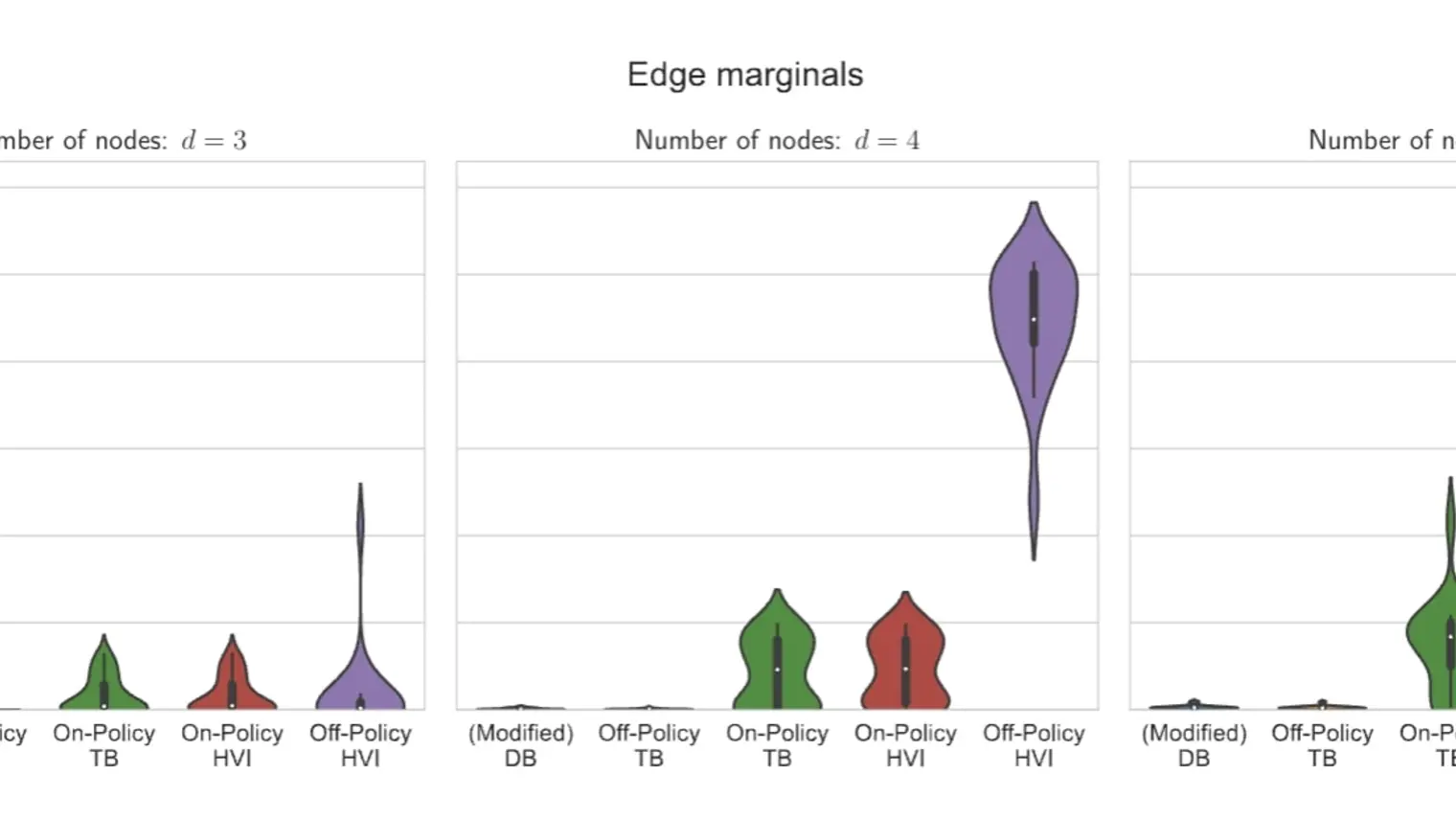
This paper builds bridges between two families of probabilistic algorithms: (hierarchical) variational inference (VI), which is typically us… (voir plus)ed to model distributions over continuous spaces, and generative flow networks (GFlowNets), which have been used for distributions over discrete structures such as graphs. We demonstrate that, in certain cases, VI algorithms are equivalent to special cases of GFlowNets in the sense of equality of expected gradients of their learning objectives. We then point out the differences between the two families and show how these differences emerge experimentally. Notably, GFlowNets, which borrow ideas from reinforcement learning, are more amenable than VI to off-policy training without the cost of high gradient variance induced by importance sampling. We argue that this property of GFlowNets can provide advantages for capturing diversity in multimodal target distributions.