Ce programme soutient les startups spécialisées en IA à tout moment de l'année. Bénéficiez de ressources de pointe et d'un accompagnement sur mesure pour accélérer le développement de votre technologie.
Développez des compétences fondamentales en intelligence artificielle (IA) responsable grâce à des cours autodirigés, animés par des expert·e·s de Mila reconnu·e·s à l’échelle internationale.
Le Fellowship Mila en politiques de l'IA transforme l'expertise approfondie en IA en politiques rigoureuses d'intérêt public. Découvrez la dernière publication Combler la disparité en matière d’expertise : mécanismes de transfert des connaissances pour la réglementation de l’IA par Moritz von Knebel.
Nous utilisons des témoins pour analyser le trafic et l’utilisation de notre site web, afin de personnaliser votre expérience. Vous pouvez désactiver ces technologies à tout moment, mais cela peut restreindre certaines fonctionnalités du site. Consultez notre Politique de protection de la vie privée pour en savoir plus.
Paramètre des cookies
Vous pouvez activer et désactiver les types de cookies que vous souhaitez accepter. Cependant certains choix que vous ferez pourraient affecter les services proposés sur nos sites (ex : suggestions, annonces personnalisées, etc.).
Cookies essentiels
Ces cookies sont nécessaires au fonctionnement du site et ne peuvent être désactivés. (Toujours actif)
Cookies analyse
Acceptez-vous l'utilisation de cookies pour mesurer l'audience de nos sites ?
Lecteur Multimédia
Acceptez-vous l'utilisation de cookies pour afficher et vous permettre de regarder les contenus vidéo hébergés par nos partenaires (YouTube, etc.) ?
Language models are increasingly used in settings where outputs must satisfy user-specified randomness constraints, yet their generation pro… (voir plus)babilities are often poorly calibrated to those targets. We study whether this capability can be improved directly through fine-tuning. Concretely, we fine-tune language models on synthetic prompts that require sampling from mathematical distributions, and compare two Calibration Fine-Tuning variants: a soft-target method that converts the desired output distribution into trie-derived next-token targets, and a hard-target method that trains on sampled completions from the same target distribution. Across 12 models spanning four families, both methods substantially improve structured-sampling fidelity on held-out distribution families and unseen parameter settings, showing that probabilistic calibration is a trainable capability. Under our selected training configurations, the two methods exhibit different empirical profiles: hard-target fine-tuning is often strongest on structured numeric sampling, while soft-target fine-tuning performs better on broader stochastic generation benchmarks, including open-ended random generation, multiple-choice answer-position balancing, and NoveltyBench. The gains sometimes reduce downstream capability, especially arithmetic reasoning, with costs varying by model. Overall, our results show that probabilistic calibration can be improved through fine-tuning, with our hard-target configuration favoring exact numeric fidelity and our soft-target configuration favoring broader stochastic transfer. Code is available at https://github.com/chandar-lab/calibration-finetuning.
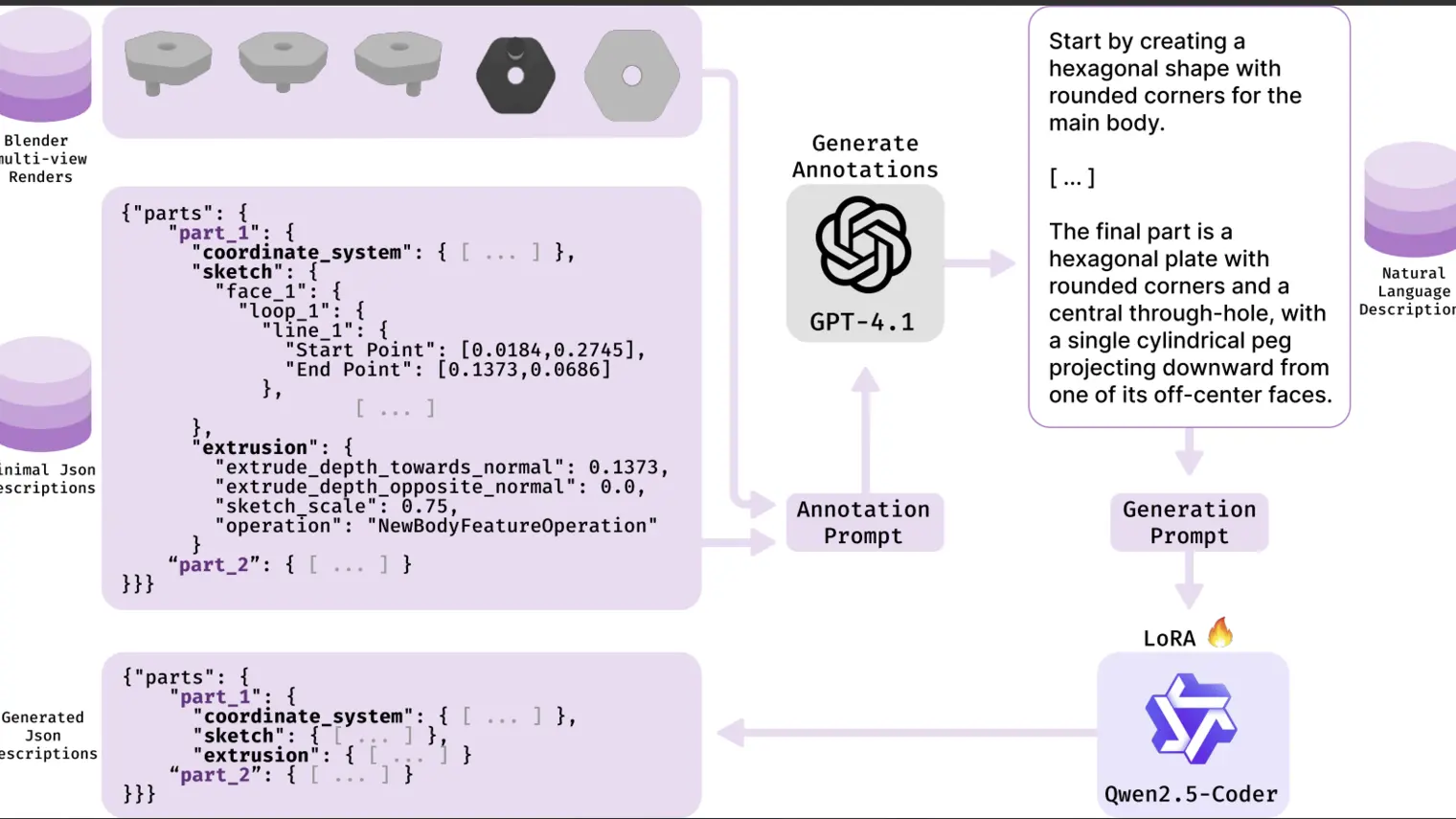
Computer-aided design (CAD) is the digital construction of 2D and 3D objects, and is central to a wide range of engineering and manufacturin… (voir plus)g applications like automobile and aviation. Despite its importance, CAD modeling remains largely a time-intensive, manual task. Recent works have attempted to automate this process with small transformer-based models and handcrafted CAD sequence representations. However, there has been little effort to leverage the potential of large language models (LLMs) for sequential CAD design. In this work, we introduce a new large-scale dataset of more than 170k CAD models annotated with high-quality, human-like descriptions generated with our pipeline based on GPT-4.1. Using this dataset, we fine-tune powerful code-LLMs to generate CAD sequences represented in a JSON-based format from natural language descriptions, demonstrating the viability and effectiveness of this approach for text-conditioned CAD generation. Because simple metrics often fail to reflect the quality of generated objects, we introduce geometric and topological metrics based on sphericity, mean curvature, and Euler characteristic to provide richer structural insights. Our experiments and ablation studies on both synthetic and human-annotated data demonstrate that CADmium is able to automate CAD design, drastically speeding up the design of new objects. The dataset, code, and fine-tuned models are available online.